|
|||
The Dollar and the Current AccountSteve Saville
The US runs a large and expanding current account deficit and the consensus view seems to be that a lowering of the dollar's exchange value will be needed to bring the deficit down to a more reasonable level. For the reasons discussed below this consensus view is, however, highly questionable. Actually, we think it's totally wrong. For one thing, the main driver of the large and expanding current account deficit is the fact that it costs a lot less to make things outside the US -- in countries such as China where labour costs are very low -- than it does to make them in the US. And with the all-in cost of employing a factory worker in the US being at least 400% more than the cost of employing a factory worker in China, a 20% (for example) reduction in the dollar's exchange value is not going to materially alter the situation. A probable effect of such a reduction in the dollar's exchange value would, however, be higher prices within the US. For another thing, the historical record does not provide any support whatsoever to the notion that a weaker dollar helps to reduce the US current account deficit. The below chart comparison of the quarterly current account balance (the bottom part of the chart) and the dollar's value relative to a trade-weighted basket of major currencies (the top part of the chart), for example, shows that there has been no consistent relationship between the performances of the US$ and the US current account balance over the past 25 years. Furthermore, focusing on the periods labeled "A" and "B" on the chart we see that: - The quarterly current account moved from a sizeable deficit to a small surplus during 1988-1991, but during this period the Dollar Index was essentially flat. - The quarterly current account balance plunged from an already-high $100B per quarter to $200B per quarter between the first quarter of 2002 and the first quarter of 2005, but during this period the Dollar Index fell by 20%. Based on this historical evidence, why on earth would anyone consider a lower US$ to be a solution to the perceived current account problem? 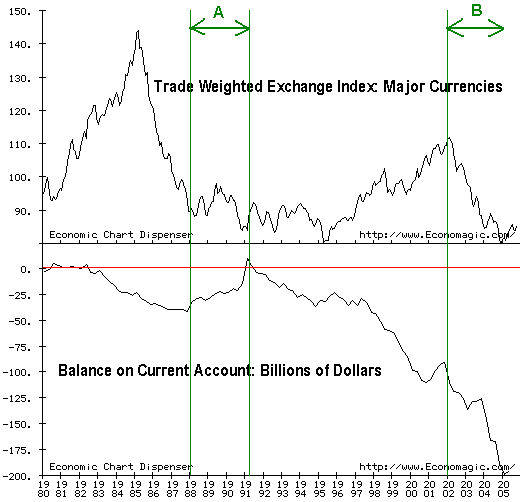 A large current account deficit will put downward pressure on the US$ over the long-term because dollar-denominated investments are generally not priced to yield superior returns (meaning there's no good reason to expect the investment-related demand for dollars to counteract the trade-related supply of dollars over the long-term). However, it's very unlikely that the imbalance will be corrected via a weaker dollar. If the imbalance is going to be corrected it will be via a marked reduction in US consumer spending, something that is unlikely to occur in the absence of a severe US recession. It's not a coincidence, for example, that the last time the quarterly current account moved into surplus was during the severe 1990-1991 recession; or that the only significant improvement in the current account deficit over the past 10 years occurred during the mild 2001 recession. However, no US politician or Fed representative is going to come out and say something like: "The current account deficit is a problem and what we need in order to address this problem is a severe recession". Therefore, talk of the need for a lower dollar will almost certainly persist. Steve Saville Regular financial market forecasts and analyses are provided at our web site: We aren't offering a free trial subscription at this time, but free samples of our work (excerpts from our regular commentaries) can be viewed at: http://tsi-blog.com Saville Archives 321gold Inc |