Ron Paul's Great Question
Jude Wanniski
Posted Aug 5, 2005
Memo To: Rep. Ron Paul [R
TX]
From: Jude Wanniski
Re: Greenspan and Gold
Dear Ron... I didn't watch
all of Greenspan's testimony before the House Financial Affairs
Committee last Wednesday, but I was lucky enough to catch the
one question they gave you time to ask. Indeed, you were the
only member of either your committee or Senate Banking the following
day to ask him about gold and its place in the monetary realm.
But first, by way of background, you reminded him that with this
floating dollar, tied to nothing real, we have a system that
is "a convenient way to default on our debt -- to liquidate
our debt after the inflationary scheme."
Even you, in the 1960s, described
the paper system as a scheme for the confiscation of wealth....
Is it not true that the paper system that we work with today
is actually a scheme to default on our debt? And is it not true
that, for this reason, that's a good argument for people not
-- eventually, at some day -- wanting to buy Treasury bills because
they will be paid back with cheaper dollars?....
And aligned with this question,
I would like to ask something to dealing exactly with gold, is
that: If paper money -- today it seems to be working rather well
-- but if the paper system doesn't work, when will the time come?
What will the signs be that we should reconsider gold? Even in
1981, when you came before the Gold Commission, people were frightened
about what was happening -- and that's not too many years ago.
And you testified that it might not be a bad idea to back our
government bonds with gold in order to bring down interest rates.
So what are the conditions that might exist for the central bankers
of the world to reconsider gold? We do know that they haven't
given up on gold. They haven't gotten rid of their gold. They're
holding it there for some reason. So what's the purpose of the
gold if it isn't with the idea that some day they might need
it? They don't hold lead or pork bellies. They hold gold. So
what are the conditions that you might anticipate when the world
may reconsider gold?
Given the fact that this was
probably the last shot you'd have to put a question to Alan,
the Fed Chairman these past 18 years, Ron, this was a great question.
And to tell you the truth, I was shocked by Greenspan's answer:
GREENSPAN: Well, you say central
banks own gold -- or monetary authorities own gold. The United
States is a large gold holder. And you have to ask yourself:
Why do we hold gold? And the answer is essentially, implicitly,
the one that you've raised -- namely that, over the generations,
when fiat monies arose and, indeed, created the type of problems
-- which I think you correctly identify -- of the 1970s, although
the implication that it was some scheme or conspiracy gives it
a much more conscious focus than actually, as I recall, it was
occurring. It was more inadvertence that created the basic problems.
But as I've testified here
before to a similar question, central bankers began to realize
in the late 1970s how deleterious a factor the inflation was.
And, indeed, since the late '70s, central bankers generally have
behaved as though we were on the gold standard. And, indeed,
the extent of liquidity contraction that has occurred as a consequence
of the various different efforts on the part of monetary authorities
is a clear indication that we recognize that excessive creation
of liquidity creates inflation which, in turn, undermines economic
growth.
So that the question is: Would
there be any advantage, at this particular stage, in going back
to the gold standard? And the answer is: I don't think so,
because we're acting as though we were there. Would it have
been a question at least open in 1981, as you put it? And the
answer is yes. Remember, the gold price was $800 an ounce. We
were dealing with extraordinary imbalances, interest rates were
up sharply, the system looked to be highly unstable -- and we
needed to do something.
Now, we did something. The
United States -- Paul Volcker, as you may recall, in 1979 came
into office and put a very severe clamp on the expansion of credit,
and that led to a long sequence of events here, which we are
benefiting from up to this date. So I think central banking,
I believe, has learned the dangers of fiat money, and I think,
as a consequence of that, we've behaved as though there are,
indeed, real reserves underneath the system.
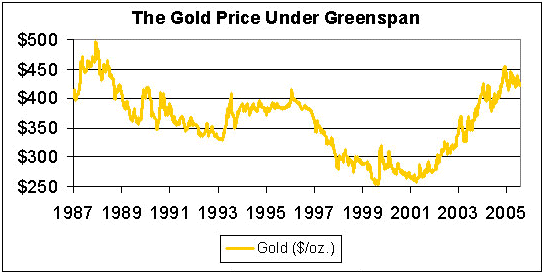
Too bad you had no time for
a follow-up question, or you might have asked him about the wide
swings in the dollar gold price during his tenure, and how they
seem to have gotten worse with time, not better. Look at the
chart of the dollar/gold price and you'll see after an initial
spurt to $500 from $400, gold dipped to $350 oz in 1985 and hovered
there for several years, to 1997. Greenspan could then have said
he was producing a de facto gold standard. But look at the path
gold followed thereafter, bringing in its wake a great deflation
and now a new, incipient inflation, with consequences Greenspan
now admits he still does not understand. He calls the movement
of interest rates just this past year as a "conundrum."
Yes, at first I was shocked
to hear Greenspan say he did not see any circumstances that would
require the dollar to be fixed to gold again, as it had been
for most of our history until President Nixon floated the dollar
in 1971. But then, Greenspan would have had to acknowledge the
gold signal would have done a vastly superior job in managing
the value of the dollar these past 18 years than he has done,
and that is not the legacy he wishes to leave.
Notice he credits his predecessor,
Paul Volcker, for having "put a very severe clamp on the
expansion of credit, and that led to a long sequence of events
here, which we are benefiting from up to this date." That's
part of the conspiracy among central bankers who essentially
don't know what they are doing from day to day, as Greenspan
should know Volcker never put a "severe clamp on credit."
It was Volcker, the new Fed chairman in 1979, who presided over
the stunning rise in the price of gold, from the $240 oz level
to as high as $850 oz on February 1, 1980. The price of gold
only came down because the Reagan tax cuts of 1981 sharply increased
the demand for dollars, and Volcker simply watched as the markets
ended the inflation.
One member of your committee
after another heaped praise on Greenspan, knowing he will not
be back next year to appear before the committee. The same was
true in Senate Banking. My gosh, the Maestro!! What would we
have done without him? Well, I think you know the answer, that
we would have done a lot better if we had been on the gold standard
Nixon left instead of the paper standard that Greenspan should
have ended which is what so many of us expected him to do.
Jude Wanniski
 Legendary supply-sider
Jude Wanniski, founder and chairman of Polyconomics, Inc., is
a world-renowned political economist whose 1978 book The
Way the World Works was named one of the 100 most influential books
of the 20th Century by the editors of the National Review. Legendary supply-sider
Jude Wanniski, founder and chairman of Polyconomics, Inc., is
a world-renowned political economist whose 1978 book The
Way the World Works was named one of the 100 most influential books
of the 20th Century by the editors of the National Review.
He was an economic
advisor to Ronald Reagan from 1978 to 1981.
Wanniski runs
Wanniski.com a macroeconomic investment
newsletter.
321gold Inc

|