|
|||
One of the Most Undervalued Juniors Ready to Leap to the Next LevelBoris Sobolev  There are three ways to profit based on the above cycles. First - find a lucky junior exploration company that will make a discovery. Second - buy undervalued shares of stock with established resources for cheap and ride it to production. Third - pinpoint a troubled junior producer at the moment of an operational turnaround. The second approach is certainly safer than the first and has more upside than the third approach given the project is economically viable and the management has what it takes to capitalize on that. Sounds easy? Not really, because after months of little news or visible progress by the company, it is difficult to get into a stock that is falling for no comprehensible reason. One can't help but start hesitating. Let's first examine why it is typical to see a stock give up most of its post-discovery gains. When the speculative new discovery-related hype is over, a waiting period begins. Speculators take profits anticipating that the company will use the high stock price to issue new shares and raise cash. The stock starts falling and even the loyal shareholders lose patience: why is the stock price falling when the company is making good progress? More and more doubts surface and many shareholders get out. New investors are scared to buy, seeing a falling price. The main reason stocks often lose most or even all of their discovery gains is their high demand for cash required for preliminary economic programs at the time of zero cash flow and little or no substantive news. But the company is making progress behind the scenes. They are issuing technical reports, upgrading resources and piecing together various project development studies. The time approaches for a patient and shrewd investor to find exceptional value. Now, let's take a look at the chart below. Looks familiar? The story of Terrane Metals Corp. (TRX.V, TRXOF) began when Barrick Gold bought Placer Dome and Goldcorp bought some of Placer Dome's assets. At that time, a highly experienced management team from Placer Dome came on board of a shell company (former Atlas Cromwell, Ltd.) and acquired four valuable ex-Placer Dome Canadian assets from Goldcorp - Mt. Milligan, Berg, Howard Pass and Maze Lake. The company was renamed to Terrane Metals Corp. The stock price jump in April 2006 was akin to a discovery stage in Figure 1. 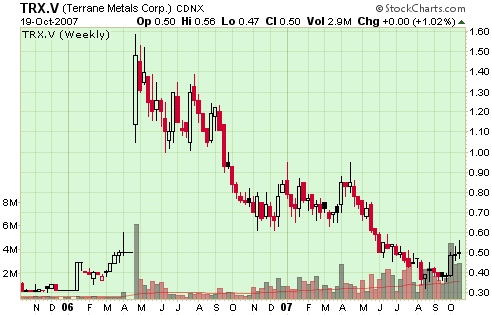 Using higher stock prices, the company issued shares, raising money necessary to show economic viability of its two main projects. A correction in gold and base metals followed and Terrane's stock price fell to its pre-takeover levels. While investors lost patience, the company did not lose time. Capitalizing on work done by Placer Dome, Terrane moved fast to complete an economic evaluation of its flagship project, Mt. Milligan, located in the mining friendly British Columbia, Canada (11th best place for mining in the world based on the Fraser Institute Survey). The company also started intensive drilling at the Berg property to convert its massive historical resource into a NI 43-101 compliant estimate. With a seasoned management team headed by President and CEO Rob Pease, who used to be responsible for managing all aspects of Placer Dome's Canadian exploration, Terrane may well turn out a great success. If everything goes as planned, Terrane will put its Mt. Milligan project into production in 2011. Mt. Milligan Project Before the Mt. Milligan project was acquired by Terrane, the previous owners had completed extensive drilling programs totaling in excess of 200,000 metres. After Placer Dome purchased the project in 1990 for US$230 million (today Terrane's market cap is just over $150M), copper prices fell to $0.60/lb and gold to $270/oz. At these depressed metal prices the project was determined to be uneconomic. In 2005 Placer Dome began reassessing the project but was soon acquired by Barrick Gold. Since then, the new owner Terrane, completed an extensive drill program and outlined an NI 43-101 resource of 5.5 million ounces of gold and 1.93 billion pounds of copper in the measured and indicated category (at conservative US$1.50/lb copper, US$550/oz gold). At a more realistic but still conservative price of $2.00/lb copper and $600/oz gold, the measured and indicated resource totals 2.7 billion lbs copper and 7.1 million oz gold. This yields a total in-ground (in situ) deposit value of $15B, $5.4B of which is in gold. In other words, by buying $1000 worth of Terrane shares an investor is purchasing 45 ounces of gold and about 17,000 pounds of copper located at Mt. Milligan. A feasibility study costing $20 million is nearing completion. This economic assessment of a large scale open pit mine is expected to be finalized in Q1 2008. First signs are very promising. Last week, the Company announced the results of a Preliminary Economic Assessment on Mt. Milligan. Given a planned 60,000 tonne per day milling capacity, annual production is expected to exceed 220 thousand ounces of gold and 90 million pounds of copper. Thanks to a friendly terrain, close proximity to roads and rail, cheap electricity from the British Columbia power grid, easy access to professional workforce and a low strip ratio at the mine, cost efficiency for the project is very high. In a base case scenario with gold at US$550/oz and copper at US$2.5lb, the cash costs are expected to be negative $190/oz gold net of copper credit. Revenue from gold would make up 36 percent of the total revenue, with the rest coming from copper. In this scenario, the project would pay for itself in 3.9 years (before taxes). At more recent prices of US$740/oz and US$3.65/lb, the payback period decreases to 2.6 years and the Net Present Value (NPV) of the project discounted at 8 percent is nearly $1.3 billion (More details). Construction capital expenditures are anticipated to be CA$827 million. But since the US dollar has fallen significantly against the Canadian dollar during the past couple of months, the initial capital cost is lower by CA$35 million. The mine life is projected to be 14.5 years with higher grade ore near the surface, allowing for high profit margins to come sooner rather than later. The project lies in the "McKenzie land use plan" which is mining friendly even for British Columbia. As far as overcoming the usual environmental hurdles, Terrane will be able to make good use of Placer Dome's work in compiling the Environmental Impact Assessment, which is going to be filed by the end of 2007. The company expects to have all the permits and certificates to be in place by Q2 2009. Nevertheless, there are two risk factors for Terrane Metals we need to take into account: permitting/environmental issues and high upfront capital expenditure requirements. On the permitting front, even though Terrane is capitalizing on the environmental work done by Placer Dome, the risks in dealing with local level authorities are always there until the last permit is received. A recent story with Northgate Minerals Corp. (NXG) is a good example of such risk. Rob Pease, however, during a recent conference call, brought up convincing arguments as to why the Company is optimistic about the permitting process going forward. High capital requirement is a difficulty because it narrows down a list of possible partners/buyers. Only large mining companies can find $800 million in their coffers. The Company owns two other projects adjacent to Mt. Milligan. If Terrane shows additional mineralization at one of the nearby properties, this would improve Mt. Milligan's position. Mt. Milligan's size of gold and copper resources, its mining friendly location and strong economics make it an attractive target for many mid-size and large gold and base metal producers. Berg Project Terrane's second most important asset, the Berg project, is located 585 km north of Vancouver, British Columbia and is in close proximity to the operating Huckleberry copper-molybdenum mine. Berg has a defined historical resource, at a 0.25% Cu cut-off, of 238 million tonnes grading 0.40% Cu, 0.052% MoS2 (0.031% Mo) and 2.84 g/t Ag. In other words the deposit contains 2.1 billion pounds of copper, 270 million pounds of molybdenum disulfide, and 22 million ounces of silver. Since the resource estimates were calculated in the 1980s, they are not NI 43-101 compliant. Being a copper-molybdenum porphyry deposit, it is easy to compare Berg to other similar deposits in British Columbia such as Imperial Metals' (III.TO) Huckleberry Mine and Copper Fox's (CUU.V) Shaft Creek Project. Huckleberry produced 71 million pounds of copper and 300 thousand pounds of molybdenum in 2006. Despite decreasing production, Huckleberry continues to generate around $60 million in net income annually. The development of Imperial Metals Huckleberry Mine, which is located just 22 kilometers southeast of Berg, has brought new infrastructure to the region. An access road, a gas pipeline and other improvements nearby strengthen the appeal of the project. Huckleberry is scheduled to close in 2010, while Berg could go into production in 2012. It is clear that once the economic viability is demonstrated, Berg will attract a great deal of interest. Terrane is conducting a 12,000 metre drilling program. In Q4 2007, it plans to confirm and upgrade the historical resource defined by Placer Dome to NI 43-101 and possibly expand the resource estimate further. The deposit remains open at depth. Since Berg is about two years behind Mt. Milligan and resources are still historic, the market is largely discounting the value of this monster. Berg's ore is much richer in molybdenum than Huckleberry's ore. Moly is still trading at its high of $35 per pound and is one of the few metals that did not experience a correction over the summer months. Goldcorp's Role There is an interesting twist to Terrane's story. Goldcorp (GG) owns 240 million preferred shares at a deemed price of $0.50 a share. This is approximately 58% of the company on a fully diluted basis. Goldcorp has the right to convert its preferred shares into common shares and effectively take control of Terrane. In November 2006 Terrane announced a lockup agreement with Goldcorp, whereby Goldcorp is able to convert the shares to common but cannot sell shares in the open market until January 15, 2008. Even at that time, Goldcorp can only sell 250,000 shares per month. Given Terrane's current 30 day average of 265,000 shares per day, this unlikely selling should not significantly affect Terrane's share price. At this time it is not clear how Goldcorp will proceed: keep its Terrane interest or sell to a third party that is interested in bringing Mt. Milligan to production. Upcoming feasibility results should help answer this question. Comparative Valuation It is very difficult to value early stage exploration and development companies. Typical valuation models are based on the future cash flows. But when first revenues are years away, coming up with reliable projections is not easy. There are just too many uncertainties - labor and equipment costs, metal prices, terms of financing - the list goes on. Even when companies issue feasibility studies, the numbers are not written in stone as there are just way too many moving pieces. Even though the preliminary economic estimates for Mt. Milligan's profitability are looking robust, it is still important to look Terrane's comparative valuation. Looking back at Figure 1, which shows typical stages of a mining company's development, Terrane's approximate position on the chart is marked as "TRX". Its valuation is among the lowest levels in the mining company life cycle. We made this conclusion by analyzing around 60 companies broken into groups: Exploration I, Exploration II, Junior and Mid-Tier Producers. These groups carry different risks and rewards for investors. By understanding such factors and by comparing group valuation levels, investors can make decisions as to how to reallocate their funds from one stock to another. The difference between stocks included in the Exploration I group and the Exploration II group is simple. While both groups of stocks have established resources, companies included in the second group have demonstrated economic viability of at least one of their projects. That is why Exploration II companies are generally more richly valued than their Exploration I counterparts. The reason is that they are closer to production and certain risks associated with issuing a positive feasibility study have been eliminated. 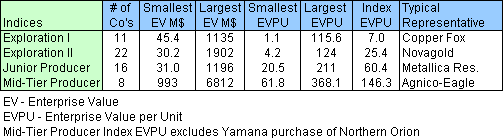 From each group, we calculate a stock index price and value. Details are shown in the table above. The indices make it possible to track different group performance and understand valuation levels. "Index EVPU column" shows that valuation levels rise as a company progresses from one stage to another. At this moment, Terrane is the fourth most undervalued company out of 57 gold and base metal stocks based on the EVPU measure. In addition to this, Terrane is in an interesting position where it is moving from an Exploration I to an Exploration II group. And with the recent release of the preliminary economic assessment and the upcoming results from a feasibility study, the stock should experience a sizable revaluation. To better understand the size of a potential re-rating of Terrane by the market, let's look at Enterprise Value per Unit (EVPU). EVPU simply shows how much an investor is paying for each ounce of gold in the ground by buying Terrane's shares. By converting copper, moly and silver into a gold equivalent, and including Berg's historic resources (which will almost certainly be upgraded to 43-101 in the near future), we get an EVPU for Terrane of $3.6/oz. This means that an investor is paying a few bucks for every gold ounce equivalent on Terrane's properties. Even after taking out Berg's historic resources, the EVPU for the company is still at a tiny $10.3/oz which shows that the market is not factoring in Berg's potential. 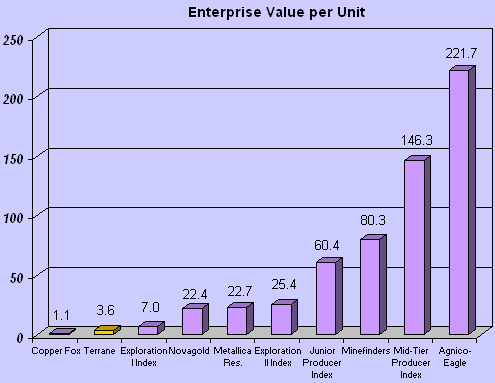 An index EVPU for the Exploration I group is 7.0 and for the Exploration II group it is 25.4. It is clear that most stocks experience a sizable revaluation (3.5X on average) as they graduate to a higher group by showing economic viability of their projects. Terrane, with its large exposure to copper, gold and molybdenum in a mining friendly region, a very strong management team and fast progress to date is likely to bridge the valuation gap in next 18 months and exceed its all time high of $1.59. Our opinion is that Terrane has a compelling story to tell to investors. Visit Terrane's full profile for more in-depth information. Boris Sobolev The author
is not registered as a broker dealer or investment advisor in
any jurisdiction. The information presented should not be construed
as consisting of investment advice. The information is general
in nature and may not be suitable for all investors. Neither
the author nor Terrane assumes any responsibility or liability
resulting from the use of the information or opinions contained
herein. You should not act or rely on the information presented
herein without first obtaining specific legal, tax, accounting
or investment advice. |