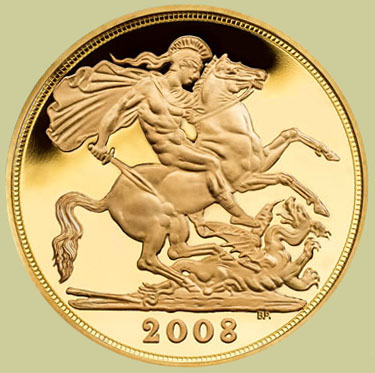
British Gold Sovereigns
The Preserve of Collectors, Savers
and Smart Investors
Mark O'Byrne
Aug 15,
2008
Gold as Essential Diversification
and Financial Insurance
Gold bullion remains an essential
diversification and essential financial insurance to have in
all properly diversified portfolios. Besides the ever more important
factors of inflation hedging and financial insurance, gold is
likely to continue to outperform other asset classes and to provide
significant returns to gold buyers.
Many of the world's major investment
banks are in agreement that gold is again in a long term multiyear
bull market. Many believe gold will surpass its inflation adjusted
1980 high of $2,400/oz in the coming years.
Citigroup's former head of
technical research and managing director of Yamada Technical
Research Advisors LLC., Louise Yamada sees gold on its way to
$3,000 within a decade. "Gold is the purest play against
the dollar," said Louise Yamada, Yamada is highly respected
and was voted Wall Street's best technical analyst from 2001
to 2004.
Credit Agricole's (France's
largest bank and the fourth largest bank in the world) brokerage,
Cheuvreux see the possibility of a rise to $2,000/oz or higher.
How to Invest in Gold in Preparation
for $2,000/oz Gold
Gold and Silver Investments
Limited agree and believe gold will surpass its inflation adjusted
high of $2,400 per ounce in the next 5 years.
This is why we continue to
advocate investors continue to diversify and increase their gold
holdings. So, how should one invest in gold?
There are many different ways
to invest in gold and one's motivation for buying gold should
dictate how one buys gold. Are you a speculator, investor or
saver? Are you buying to make a capital gain or as a hedge against
systemic risk and using your gold as financial insurance? Is
your motivation a little of each?
ETFs, mining funds, digital
gold, Perth Mint certificates, gold bullion coins and bars in
one's possession and or semi numismatic gold coins are good ways
to buy gold.
Given the extent of current
macroeconomic and systemic risk a diversified precious metals
holding makes sense and it should not be a question of "either
or" rather a combination of these various ways.
Having eggs in various gold
baskets, so to speak, is the most sensible and
prudent strategy.
As part of this mix, older
gold coins should be looked at. Classic European and world gold
coinage is an often overlooked but extremely important sector
in today's gold market. Pre 1933 and 19th Century European and
world gold coins are an intelligent alternative to modern gold
bullion coins or bars as there is often more room for appreciation
with these beautiful old coins due to their rarity and yet they
can often be bought at bullion prices.
2008 Gold Proof Sovereign depicting
Saint George
photo
courtesy of The Royal
Mint
Importantly from an investment
point of view is the fact that gold bullion and older gold coins
are not subject to VAT due to the EU Gold Directive. Even more
important is the fact that unlike the other forms of gold investment
outlined above, British gold sovereigns are also not subject
to capital gains tax (CGT). Thus all post-1837 British gold sovereigns,
due to them being legal tender. and having a legal tender face
value, are capital gains tax free, which is obviously a massive
benefit to investors vis-à-vis other gold investments.
The prices of these beautiful
coins are only slightly more expensive than modern gold bullion
but offer many advantages. Besides not having to pay CGT, other
advantages include increasing scarcity, aesthetic value and historical
significance. European and British gold coins are recognised
as one of the most advantageous ways to invest in "bulk"
gold, by sophisticated investors.
European, American and world
gold coins are bought by both collectors and investors at a small
premium to the price of bullion coins. Perhaps the most popular
semi numismatic gold coins internationally are British sovereigns.
The British Sovereign (originally
the one pound coin) is the most widely traded semi-numismatic
gold coin in the world. There is constant and excellent liquidity
in most countries in the world. For the investor looking for
slight leverage to the gold price with the potential for the
premium (numismatic value) to rise, British sovereigns are a
good way to invest in gold.
History of the British Sovereign -
From Henry VII to James Bond
The first British sovereigns
were minted more than 500 years ago. They were minted under Tudor
King Henry VII in 1489. The coin got its name from that first
mintage which depicts the monarch seated majestically on the
throne facing outward.
Sovereigns were then struck
for Henry VIII from 1509. Henry VIII needed to raise revenue
as he was engaged in George Bush style overspending which
led to a flow of gold and silver to Europe (equivalent of dollars
to Russia, OPEC nations and China today).
The current design type with
St. George slaying a dragon on the reverse and the monarch on
the front was introduced nearly 200 years ago in 1816 under George
III. The sovereign was minted almost continuously from that date
until 1932 when Britain went off the gold standard.

Sovereign, 1558
Thus he was responsible for
debasing and devaluing English money when he reduced the precious
metal content from 23 carat to 22 carat to 20 carat (96% to 91.6%
to 83.33%). Silver coins were debased even more and by 1551 silver
coins had been reduced to 25% of their face value in what became
known as the 'Great Debasement'.
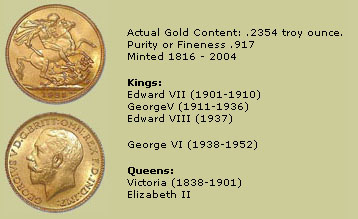
British sovereign 'kings' minted
during the reigns of Edward VII and George V are probably the
most widely owned and recognized pre-1933 gold coins.
In 1816 the British sovereign
as we know it today was first introduced, and as the British
Empire expanded under Queen Victoria during the 1800's, this
coin came to be the world's most widely distributed gold coin.
Minted originally in London, the sovereign came to be minted
all over the world as Australia and South Africa came to be large
gold producers. Mints in Pretoria, Bombay, Ottawa, Melbourne,
Sydney and Perth minted thousands of sovereigns during the late
1800's and early 1900's.
The design of Saint George,
aboard his brave steed, slaying the dragon is common to the reverse
of all variations of the coin. Saint George who is believed to
have lived from 275 to 303 AD was a soldier of the Roman Empire,
from Anatolia, now modern day Turkey. He was venerated as an
Islamic and Christian martyr.
George was immortalised in
the tale of George and the Dragon in a collection of hagiographies
and lives of the saints known as The Golden Legend or Legenda
Aurea. He is the patron saint of Canada, Catalonia, England,
Ethiopia, Georgia, Greece, Montenegro, Portugal and Serbia, as
well as a wide range of professions and organisations. This gives
sovereigns an international appeal not enjoyed by many coins.
When coins were sent to places
such as the United States for international payments between
governments, coins were frequently melted down into gold bars
because of the Federal regulations then in force. When gold coins
were finally withdrawn from circulation in 1933 in the US, many
thousands of British gold sovereigns were consigned to the melting
pot in this way.
Gold sovereigns were accepted
as money and as payment throughout the world at the height of
the British Empire and indeed this international currency may
have helped create and strengthen the Empire.
More recently, many armies
around the world (including the US Army) gave their servicemen
an emergency supply of gold sovereigns. They are still recognised
in most parts of the world and unlike paper dollars will not
be damaged by shredding, water or intense heat.
This is why Q gives James Bond
50 gold sovereigns in From Russia with Love. Near the
beginning of the movie Q gives Bond a special black briefcase.
Hidden in the case are 40 rounds of ammunition; a flat throwing
knife; an AR-7 folding sniper's rifle and imbedded in 2 straps
hidden inside the lining of the case are 50 gold sovereigns.
Conclusion
It is estimated that only 1%
of all gold sovereigns that have ever been minted are still in
collectible condition. It is this relative rarity in relation
to bullion coins and bars that leads to leverage whereby in gold
bull markets, the value of these coins increases by more that
the actual price of gold.
Unlike paper investments or
speculations, British gold sovereigns have a real and permanent
tangible value. Therefore, they offer two ways to build wealth.
They can offer the best of bullion and numismatics in one investment.
They contain the intrinsic security of bullion or precious metal
in a pure form and can also offer additional profit potential
due to their aesthetic and historical appeal.
The legal tender gold British
sovereign has always been a popular coin for collectors and is
becoming increasingly popular with risk conscious value investors
seeking to avoid having to be capital gains tax (CGT).
Today premiums remain very
low on the world's most famous gold coin and even beautiful Queen
Victoria sovereigns from the second half of the 19th century
can be bought at great value bullion prices, near spot or melt
value.
Experienced, knowledgeable
investors have long known that semi numismatic gold coins can
be solid investment choices. They retain their value in times
of global geopolitical instability and when there is economic
uncertainty, during systemic and monetary crises and in recessions
and depressions. With systemic risks increasing and more bank
runs possible in the coming months, the wisdom of holding a few
gold sovereigns in one's possession or in a depository will be
clearly seen by all.
It is important that investors
look at their portfolios holistically and have a financial insurance
component to their portfolio. Used correctly, a small allocation
to British sovereigns can be a highly effective component of
a properly diversified investment portfolio.
Mark O'Byrne
email: info@gold.ie
Mark O'Byrne
is Executive Director of Gold and Silver Investments Limited
(www.goldassets.co.uk).
321gold Ltd

|