The Thin Red White & Blue
Line

10 Metaphors for a Broken Economy
James Macfarlane
23 Jun, 2008
Bill Cosby used to tell an
anecdote about driving in San Francisco for the first time, and
how he got stuck at a red light atop a steep hill. He figured
that by the time he got his foot off the brake and onto the gas
he would have rolled backwards into the bay and drowned. On the
basis that dying in such a manner would not qualify for entrance
into Heaven, his solution to the dilemma was to not move. Instead
he hollered to the guy behind him; "Come around idiot, come
around!" This didn't work however because the guy behind
him was too busy shouting "Come around idiot, come around!"
to the guy behind him. And so on.
Bill's conundrum, that the
person downstream from you is unable to comply because they are
in the same jam as you, is a metaphor for the current state
of the US economy, which is a short step away from a recession
the likes of which we have not seen in our lifetimes. The trouble
with the economy - well, there's actually more than one - but
one of the biggies boils down to a single word; leverage.
Let me explain.
Leverage Works - Until It Doesn't
To be leveraged, in an economic
sense, means you control an asset by putting up fewer dollars
than the asset is actually worth. Leverage has existed ever since
there were systems of monetary exchange. In modern times a home
loan is an example. If you buy a house for 20% down and make
payments totaling 25% of your income, you've got leverage. Leverage
in this case is a good thing; a tool used to create a thriving
economy. However moving into a house you buy for 0% down and
make payments totaling 50% of your net income might be a bit
too much leverage. Everyone of course is aware of the sub-prime
mess. But not everyone is aware that over-leveraged investments
have permeated every facet of our economy, from personal credit
to commercial credit... in the US and across the globe. Leveraged
economies get into trouble when the assets being levered lose
value. That's happening now.
Most of us understand, either
anecdotally or through personal experience, what this means for
say, a highly leveraged home loan. The property can suddenly
be worth less than you paid for it. Ouch! Try refinancing your
way out of that Adjustable Rate Mortgage that just adjusted upward,
while the property has just appraised downward. But we have peaked
out on leverage across the board, and the process of un-leveraging,
if you will, is going to be painful. More so than the mainstream
financial press is letting on. It's something you may want to
get ready for.
It Ain't Just Housing
The issue with leveraged investments
extends well beyond bad loans from the so called sub-prime
crisis. It's now the global credit crisis. Everyone
is leveraged. Consumer debt is at an all time high... savings
an all time low. What's more, we consumers are leveraged in ways
we are not even aware of. Sub-prime loan risk long ago left the
local bank where the mortgage was born, and has leaked into investment
vehicles typically considered safe. Even if you personally do
not have a troubled sub-prime mortgage, your investments/retirement
plans may well be dependent on the returns from such loans, and
they stand to sustain a loss if the borrowers default.
How could that happen? You
have perhaps heard the terms credit derivatives and credit
swaps? These innocent sounding names refer to financial instruments
used to redistribute risk. The terms went mainstream earlier
this year as the press broke the news on the Bear Sterns debacle
and other credit nightmares. When money is as cheap and plentiful
as it has been, sub-prime loans were made with great frequency.
The banks have always known though that the loans were risky.
To deal with that risk they repackaged groups of such loans into
a financial vehicle known as a credit derivative. The
derivative is sold to a buyer who earns an income stream from
a portion of the loan payments contained in the derivative. In
return, the buyer of the derivative guarantees that if any loans
in the group are defaulted on, the buyer will make good on the
loan. It's kind of an insurance policy, wherein the price of
each policy is derived by the supposed credit worthiness of the
loans as a group. That all sounds good except...
The problem with these derivatives
over the past few years is that they have been traded around
and repackaged so often that the true risk of the underlying
loans has become obscured. Such derivatives have often ended
up with a higher credit rating than they warranted. And investment
in these questionably rated instruments is pervasive. For example
they are widely owned by so called hedge funds, which
have special dispensation allowing the funds to own highly speculative
investments. Hedge funds in turn are widely held by pension
plans due to the high return, and when the true value
of such funds are accounted for in the books, some people will
be receiving shocking balance statements in the mail. Another
example of a shocking place derivatives have popped up is discount
broker E*Trade, which is teetering on the verge of bankruptcy
from trying to increase their bottom line by investing in guess
what . . .derivatives. Who knew?
We now return to Bill Cosby's
dilemma and how it applies to the current state of affairs concerning
bad loans. Banks and other institutions are required to maintain
a certain level of equity, or margin, on their loans.
If the properties represented by the loans drop in value, the
bank must come up with enough cash to reestablish a minimum level
of equity. It's called a margin call. What happens is
that the phone rings one day and a voice on the other end of
the line says something to the effect of "Hey, you idiots
have to come up with a pile of $$ to cover these loans!".
(... pause . . .)
Shit! They weren't expecting
that. Why? Because investments like residential and commercial
real estate have been going up in value for so long, everyone
pretty much forgot that one day they might go down.
But that's just the first domino
to fall. The borrower doesn't have a pile of money lying
around. Why? They're over-leveraged. They bet the farm on the
premise the investments would continue to rise. But wait. Hold
the phone. Although a home mortgage can not generally receive
a margin call, the bank may have granted certain loans that do
require a minimum amount of equity be maintained. If such loans
are in any way tied to real estate they have likely dropped in
value as well. So the bank, needing some quick cash, picks up
the phone to issue a margin call of its own. We know what will
be said when the phone is answered. "Hey, you idiots have
to come up with a pile of $$ to cover this loan!". But alas,
the line is busy. I Wonder why?
Answer. Everyone is over leveraged.
A version of the above scenario played out recently with global
investment banking firm Bear Sterns. Bear Sterns was up to its
neck in bad derivatives. As the diminished value of the depreciated
loans were reflected on the books (a process called mark to
market), Sterns came due for the dreaded margin call. It
could not produce the required funds however, so the Federal
Reserve stepped in to provide the needed liquidity. This was
unheard of, but if the 'Fed' had not bailed them out, the dominos
would have started falling BIG TIME. Sterns was considered too
big to fail.
Although all this over-leveraging
has gone on for several years now, I believe the chickens are
now heading home to roost. Meaning, major cracks are appearing
in the economy, and its continued functioning is in question.
Bear Sterns was not the only bad boy on the block. Other banks
are in trouble and we will be hearing from them shortly. And
it won't just be investment banks, but rather banks with names
you will recognize. Want proof? Are you familiar with the term
"Fractional Reserve System" from high school economics?
It's the system that allows a bank to keep only a fraction of
its deposits in reserve. The rest of the deposits can be lent
out. Meaning, not everyone could take their money out of the
bank at once; but enough people could so as to prevent a bank
run. Kind of an important system. So how are bank reserves doing
today? Take a look at the chart below:
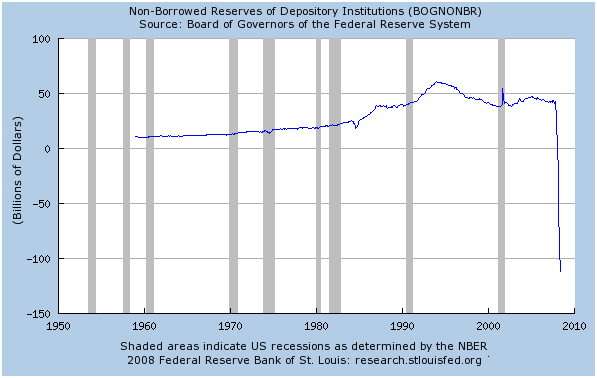 The banks have negative
reserves! This is not to be taken lightly
The banks have negative
reserves! This is not to be taken lightly
The chart is a not-so-pretty
picture showing that the amount of bank reserves is actually
in the negative. Ouch. That's more leveraging, and just
like Cosby's line of stuck cars, all the banks are in the same
jam. By the way, this chart was not made by some dufuss with
a copy of Photoshop. It's from the Federal Reserve itself. The
insurer of these banks, the Federal Deposit Insurance Corporation
(FDIC) is aware of this sad state of reserves and has beefed
up its staff, including calling employees out of retirement.
Banks of course have failed before, and we have gotten through
it. But it must be recognized that due to all the overleveraging,
the crisis upon us now could be much worse than any previous
one. Put simply, the FDIC can only cover about 1% of all insured
deposits.
Can you imagine what would
happen if a financial shock took place such that depositors rushed
to the bank to become withdrawers? The music is going to stop
and not everyone will have a chair. Would you want to be at the
end of that line? Have you ever seen the movie It's a Wonderful
Life with Jimmy Stewart? Do you now believe that I'm not
just being paranoid in sending out this warning?
What we have been living out
for the past 20 years - about since the beginning of the [Federal
Reserve Chairman] Alan Greenspan era - is a version of one of
the oldest con games in the world; the ponzi scheme. The ponzi
system works great and makes you money . . . right up until it
doesn't. It has to break down at some point. The Dot-com bubble
of 2001 gave way to the credit bubble, which gave way to the
housing bubble. It's become a bubble economy. But in the end
the bubble always pops. The party must end. There is a boom.
Then there is a bust. We should have had a more serious bust
(recession) after the Dot-com bubble. Instead, interest rates
were lowered and a credit/housing bubble was encouraged in order
to forestall an economic downturn (yes, the sub-prime mortgage
fiasco was no accident, but that's a different article). Our
economy at this point is akin to a forest that has not been allowed
to burn for many a year. We know what happens to such forests.
All it takes is one single incident, one match, and... poof.
What should have been a natural, periodic, and predictable process
gets totally and completely out of hand. The longer fire is
suppressed, the worse the damage when it comes.
Our economic system, i.e. our
way of life, is a tinderbox. This is not an exaggeration. The
Federal Reserve most certainly knows this, and it's why they
did something in March of 2008 that has never been done in their
95 year existence; they provided funds to a non-Federal Reserve
bank. The Fed bailed out Bear Sterns. Sterns owed money it
couldn't pay and had lied about that fact right up to the end.
Its debts were more than its assets to the tune of trillions
of dollars of devalued derivatives (that's trillions, with a
T). If that size a derivative pool had been defaulted
on, one of the most important elements that glue an economy together
could have burned to the ground right then; Trust.
The only reason institutions are willing to lend money to each
other is if they trust the monies will be paid back. Money is
not lent if there is no reasonable expectation of it being returned.
Without loans the economy is crippled. Capitalism runs on
capitol.
From the Federal Reserve's
point of view, Bear Sterns had to be bailed out. If it
hadn't we may well have reached a tipping point that would have
commenced the giant, painful process of un-leveraging the economy
right then and there. The Fed is pulling out all the stops to
forestall that day. So as it stands, the dominos remain upright...
for the moment. This blessing gives you and me time to take
precautions.
So Where Do We Stand?
Funny, things do seem
a bit better now, don't they? Bear Sterns was saved. Precautions
have been taken. Adjustments have been made. Measures have been
put into place. The stock market came back. We're probably out
of the woods, right? Wrong. Here is what my research has revealed:
There are a whole bunch of Bear Sterns out there. Way,
way too many to be saved by the Federal Reserve. And it's not
just investment houses. Everyone is leveraged, and asset prices
are falling. The math has turned against us. The party has gone
on for far too long. The booze (easy money) should have been
cut off years ago. But our then bartender at the Federal Reserve,
Alan Greenspan, would not hear of it. Let the good times roll,
said Greenspan. Make a toast to Uncle Al, the borrowers pal.
You need to know that right
now a lot of effort is being made to convince Americans that
the worst is over. There are newspaper articles inferring so.
There are fewer ugly stories about financial Armageddon. Most
importantly, a truly unbelievable amount of money is being spent
to convince you, the American consumer (not to mention the world),
that the worst is over. The stock market is literally being propped
up by these funds. The price of gold is being forcibly manipulated
downward by this money (Google 'plunge protection team'). It's
a dog and pony show designed to do one thing; make it appear
the worst is over. Everything is all right now. It's ok to
keep pouring the low interest loans and continue the party. But
beware the man behind the curtain. His powers are limited. And
there is a steep price to pay for what he is doing.
What we are going to see over
the next few months and years are a series of gradual revelations
regarding the truth about the economy as events force these truths
to the surface. They can be suppressed no longer. Where we stand
is that the trends we are seeing in the first half of 2008, higher
energy and food prices, shortages, rising unemployment, reductions
in our lifestyle, etc. are going to continue. Here's why:
Inflation and The Falling Dollar
The aforementioned issue of
trust when lending money now goes a step beyond the question
of "Will I get paid back"? The question has been amended
to "Will I get paid back with anything of value"?
Dollars are worth less and less these days. This is the other
shoe dropping, and it will have far reaching consequences which
have already begun.
Inflation is back. It's standing
on the front porch, and is poised to bust through the door. But
like the Shark in the old Chevy Chase/Saturday Night Live skit,
it's been disguised to look far more innocent than it truly is.
Meaning, the rate of inflation reported in the news vis-à-vis
the government sourced Consumer Price Index (CPI), is a deception.
Inflation is much higher than reported. To begin with, the cost
of food and energy has been removed from the index.
Think about that. What if you removed food and energy from your
monthly expenditures? Two of the three most important expenses
in our daily lives (shelter being the third) are not factored
into the cost of living index. Hello? Additionally, there is
reason to believe that even the items still remaining in the
CPI are being fudged. The true rate of inflation is far higher
than stated by the government (try 10-15%). That of course should
be no surprise to the person paying the bills in your household.
Where does inflation come from?
It's partially due to more and more people worldwide bidding
for a finite amount of goods. That's supply and demand 101. But
inflation is greatly exacerbated by Federal Reserve policy. The
Fed has the power to set short term interest rates, and the artificially
low rates we have seen for years now causes the supply of money
to rise (due to more loans being made). A basic law of supply
and demand states that more $$ chasing the same number goods
cause prices to rise. With the Gross Domestic Product (GDP) running
only about 1% this year (1% more goods), while the money supply
is increasing at 12-25%, the difference will result in more inflation
- above and beyond normal supply and demand.
There's more. As most folks
know, this country continues to spend money far faster than it
takes it in. The war, natural disasters, tax rebates, missing
money from the Treasury (4 trillion or so), homeland security,
entitlement financing, the bailout of troubled financial firms,
and all our other expenses are taking their toll. As a general
rule, any debts not paid for by taxes or borrowing is paid for
by inflating the currency. (this is known as monetizing the
debt or monetary inflation).
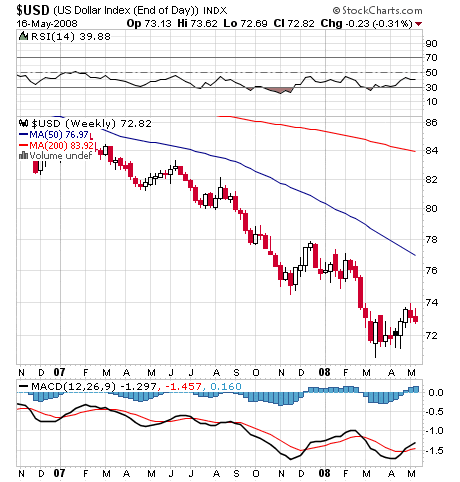 The US dollar is
in near freefall
The US dollar is
in near freefall
Inflation also has an impact
on the US dollar overseas, as its value drops further and further.
The dollar is the world's 'reserve' currency. This means more
trading is done around the world in US dollars than any other
currency. Remember that most consumer goods are now purchased
from overseas. A falling dollar makes foreign goods more
expensive. It keeps taking more and more dollars to buy those
foreign goods. The above chart measures the US dollar in relation
to a mix of other currencies. It is one of the most widely watched
of all economic indicators. Notice the direction of the trend.
Don't forget that most of our
oil is imported now. The price of oil rises in lock-step to a
falling dollar - again, above and beyond normal market forces.
These factors add to the fires of inflation even further because
a critical commodity like oil is used in so many products, a
rise in its price alone is going to force prices of nearly everything
up further. The rocketing price of oil is one of the biggest
cracks in the dike.
Adding it all up
We've reached a critical point
in our experiment in democracy. The Achilles Heal of free
enterprise is greed, and we are seeing insatiable greed
manifested on an unparalleled scale. The price of freedom is
eternal vigilance, yet we have unfortunately allowed the fox
to guard the hen house. We simply haven't been paying attention.
Basic freedoms are slipping away. We're out of money. In the
last 15 years America has gone from the world's greatest creditor
nation to the world's greatest debtor nation. America now owes
more money to more people in more places than anytime in its
history. The interest on the nearly 10 trillion dollar national
debt is pushing one half trillion dollars a year (third largest
federal budget expense item). Yet we have been told for years
that deficits don't matter. Oh yeah?
At some point the Chinese (and
the rest of the world) will not be willing to buy any more of
America's debt. But again, The Federal Reserve has made it crystal
clear what it will do when it comes to providing needed liquidity
to the economy; they will print money. The Fed will print
all the money required to bail out every Bear Sterns that comes
out of hibernation to 'fess up' about how much they have lied
about all the bad paper on their balance sheets. And, they will
print money for anything else related to keeping the economy
afloat. The current Fed chairman, Ben Bernanke, wants the same
thing Alan Greenspan wanted; keep the party going at all costs.
Don't let the forest burn. One thing is almost certain however...
the forest will eventually burn. I have written this article
because I believe we are close to that day, and if precautions
are taken you won't get as badly burnt as they guy down the street.
Now it's hard to tell exactly
how and when an economic bombshell will manifest itself. The
future is always in motion, so the key is to focus on the well
founded trends that are likely to continue. What's really interesting
by the way, is that the future can be considered as especially
unpredictable right now. A lot of the old rules don't apply.
We are in unchartered waters, with many changes coming upon the
earth. Climate changes, geologic changes, social changes, changes
in our solar system, and more. Therefore it's important to factor
that in to planning for the future. What I am trying to say is
that while the state of the economy alone necessitates precautions
be taken, the unpredictability of the near to intermediate future
not only does not invalidate the need to take precautions,
it underscores the need to do so. For the thinking person, uncertainty
begets contingency planning.
| COULD THE GREAT DEPRESSION OCCUR AGAIN? |
| You
should also know that a key piece of legislation put in to law
by FDR after the Great Depression has been systematically dismantled.
The 'Glass-Steagall Act' kept mortgage banking and investment
banking separate in order to mitigate the chances of another
depression. The law was mostly dismantled under the Clinton administration. |
The Trends Tell Us Our Immediate Future
Here is a list of what we can
likely expect as the future moves into present time (now through
2012):
- Inflation up
- Long term interest rates up
- Gold and silver up
- Energy prices up
- Unemployment up
- Volatility way up
- Food prices up
- Personal and municipal bankruptcies
up
- US dollar down
- Real estate down
- Equity markets down
- Personal freedom down
Inflation will continue to rise, at least for
certain sectors of the economy. The action of the Federal Reserve
dictates it will likely rise substantially over the next couple
of years, starting yesterday. Don't forget that the CPI
(Consumer Price Index) is compromised, and does not tell the
true story of inflation. Increased demand for resources will
drive prices up even further as literally hundreds of millions
of people around the world move from poverty to the middle class,
and will want the same things we want.
Long term interest rates
will rise as lenders
become convinced inflation is here to stay. Lenders will not
lend money at a loss (although short term rates may be artificially
tamped down by the Fed for the moment, the Fed has little control
over long term rates).
Precious metals are just that; precious. There
is only so much gold and silver, and that is why these metals
are such a reliable store of value. Real inflation of our currency
was not possible until gold was disconnected from the dollar.
A currency not tied to a solid commodity such as gold is doomed
to fail. History tells us that. And as high as gold and silver
have climbed so far this decade, they are destined to go far
higher. Inflation guarantees that.
Energy prices will likely go higher, though probably
not in a straight line. Energy pricing is affected by both monetary
inflation, a declining dollar, and natural supply and demand.
The perceived shortage of crude oil and other raw materials is
causing the price of these goods to rise. This perception may
or may not be correct, but it's perception that counts.
Unemployment will continue to rise as the economy
continues to contract. High food & energy prices and the
global credit crisis are two big factors. Unemployment begets
more unemployment as out of work Americans buy less. This also
increases foreclosures. Leveraged loans go into foreclosure quicker.
With a glut of empty houses on the market, the building trades,
lumber industry, et al start to recess. More unemployment. It's
a house-of-cards. The government can't stop this. They can only
make it worse.
Volatility will reign supreme. The markets have
much to digest as the various economic forces battle it out.
For a period of time, perception that the world economy as a
whole is slowing will drive the price of raw materials and finished
goods down (less demand). At other times real or perceived shortages
of the same items, due to demand, weather, war, or politics (a
form of war), will send prices through the roof.
Food prices are subject to the statements in the
previous paragraph but are a special case for several reasons,
not to mention that we need food every day to live. There are
a number of forces at work that may make food not only expensive,
but many items outright hard to buy at any price. That's scary,
but you must understand that we live in a "just-in-time"
economy. Costco does not make its products at the warehouse store.
Food is not grown in the back yard. It comes from other states,
and other countries. There is a complex pipeline that gets food
from the field to the grocery store, and there are cracks throughout
the system, from the genetically modified seeds planted in the
ground to the rising cost of getting
products to market. The food supply line is very tight at present.
Take wheat. Although a record wheat crop is projected for 2008,
we are at the lowest inventory of wheat in the US in 60 years.
The entire world has only a 60 day supply.
Personal bankruptcies will rise as a down economy leaves
many with no choice. City government bankruptcy filings will
go up dramatically as bad investments and a reduced tax base
break an already strained system of delivering basic services.
The dollar will continue to fall, again due to
the action of the Federal Reserve. It won't be a straight line
down, but the overall trend is down, down, down. This means the
price of imports - especially oil - go up, up, up.
Real estate may not come back for quite a while.
This is one sector that as you know is deflating, not
inflating. Rising mortgage rates, a population with less money
or no money and maxed out on credit, combined with a serious
oversupply of housing means we may not see new highs in residential
real estate for the foreseeable future. Commercial real estate
is not far behind.
The stock market is due to come down dramatically. Stock
prices are ultimately based on a company's earnings, and a slowing
economy means lower earnings. Although the market currently seems
to be looking ahead to better times (as of the first half of
08), think about all the warnings stated earlier in this article.
There is good reason to believe that the equities markets are
being propped up with large sums of money, making us believe
that investors value these companies higher than they actually
do. There is currently a very unusual divergence between consumer
confidence numbers (down) and stock indexes (up); further evidence
that the stock market might be weaker than it appears.
Personal freedom is likely to become even more restricted.
I personally believe that the threat of terrorism has been used
as an excuse to abrogate our rights. Keep your eyes open and
be prepared to exercise your right to protest. (Hint: Google
"RFID human rights" and/or "national ID card"
for starters).
Finally, let me underscore
one last time that it is the action of the Federal Reserve that
sets the biggest trend of all. The Fed can be counted on to bail
out failing institution after failing institution and prop up
the economy with inflated dollars. That's not good. It could
lead to hyper-inflation and/or a total breakdown of the all-important
trust factor. But the Fed just refuses to let the
party die. To continue the metaphor, the Fed is supposed to be
the designated "party-poopers" of the nation. They
are supposed to card the people entering the bar, and cut off
the booze when lampshades start getting unscrewed. Meaning, they
are supposed to crank up short term interest rates when inflation
rears its head. Fed Chairman Paul Volker did this in the 70's
to kill off what is known as stagflation (a recession with rising
prices). It worked. 20% interest rates hurt like Hell, but the
economy - just as the proverbial forest allowed to burn - came
back. But the current Fed, supposedly a team of professional
party-poopers, have turned in to party-promoters,
and now it may be too late. Example: The Fed is now swapping
US guaranteed securities in exchange for junk loans as a way
to get this garbage of the street, thus transferring the burden
of this bad paper to the US tax payer!
If the trust in our
system fails we will wake up to an economic nightmare. Everyone
will head for the exits at once. Meaning, people will try to
sell their stock before the other guy does. Folks will try to
get their money out of the bank ahead of everyone else. Families
will try to buy and hoard food and other commodities, forcing
control mechanisms into play as with the rice shortage scare.
What To Do?
All we can do is hope for the
best and plan for the worse. As a point of reference I will share
with you the best advice I have run across.
- Lighten up on equity investments
(securities)
- Buy gold and silver
- Buy food
- Become a farmer
- Stock up on the basics
- Keep some cash on hand
- Take some security precautions
- Buy a super-high gas mileage
vehicle like a motorized bicycle
- Conduct a "disaster preparedness
test"
Securities, once a safe bet,
are not so secure anymore. A number of things could bring about
a bear market, with many reasons listed throughout this article.
Many believe we are already in a bear market. Several likely
events could cause a sudden, precipitous drop in the markets.
The reverse is less likely. The best take on the stock market
I have heard is that we will undergo a stair-step drop in prices
over the next few years; i.e. a sharp drop in stock prices, a
sideways consolidation process, then another stair-step down.
So, you may want to think about allocating a portion of funds,
including any retirement funds you have direct control over,
to alternate investments. There are a couple of thoughts below,
but if you have a substantial nest egg I suggest you seek out
a financial investment counselor not wearing rose-colored glasses.
When paper money loses its
value people turn to real money. This means gold and silver.
History teaches us this. Buy gold. In fact, I was speaking
with a fellow investor a few weeks ago, and we both agreed that
if we could only invest in one single vehicle, it would be gold/silver.
Repeat, although a bit contrarian even with today's relatively
elevated precious metals prices, gold and silver are probably
the safest investments you can make. You will preserve
your wealth, and possibly multiply it. So. Did I mention... buy
gold.
Stock up on food. Fill the
pantry with foodstuffs that have at least a 1-3 year life span.
Fill the garage if you want. What will it hurt? If it's business
as usual over the next few years, your car gets a little oxidized
and you have a bunch of food to eat. But seriously, I often hear
advice that at least a six month supply is wise.
Plant a victory garden. There's
a novel idea. I remember moving into a new house in suburbia
as a six year old, and noting that my parents went to great lengths
to keep down the various vegetables that would sprout up through
the backyard lawn each year - in a prior incarnation the back
yard had been a vegetable garden. Everything old is new again.
It would also be wise to stock
up on staples in general. Toilet paper, candles, soap, gasoline,
propane, medicine, water. The stuff you take camping. Solar panels
and solar battery charges are a great idea.
Also think for a moment about
the security of your family. If there is an interruption of power
and/or food for more than a few days, there are unprepared people
who will begin to get desperate. Desperate people do desperate
things. In the event of a disaster, the local authorities and
rescue centers will be overwhelmed and can't be counted on. And
don't assume you can get cash out of the ATM. Keep some on hand.
Finally, think about conducting
a disaster preparedness test. Take a weekend home and see what
it is like to go without power and transportation. Yeah, turn
off the lights. The purpose of the test is to see if you have
all the stuff you need to survive off the grid if need be. It's
seems weird to talk about power interruptions but the electrical
power infrastructure is in a precarious state. The more self-sufficient
you become, the better you will weather the coming storm.
Final Thoughts
So what is the thin red white
& blue line? It's the distance between having the usual amount
of food on the table... or going without certain items. It's
the space between having the choice to drive your car as far
as you choose... or gas rationing. It's the difference between
having all the freedoms Americans have enjoyed for generations...
or seeing them evaporate under the guise of government protection.
There used to be a wall between these extremes. An impenetrable
shield between the thinkable and the unthinkable. But the wall
has shrunk to where we can now peer through its transparency.
To be fair, one could certainly
point out that the stage has been set in the past for some kind
of malady to befall us... yet it did not occur. Y2K would be
an example. However, the reason I feel the likely is likely
to happen this time around is that things are simply different.
There is a change in the wind. Many people I talk to feel it.
The earth is changing... people are changing. We seem to be approaching
a zenith. I urge you take precautions even if it appears for
a time that we are out of the woods.
I believe also that the future
is somewhat malleable. We tend to create our own realities...
our own futures. Although it seems impossible that we as Americans,
as well as a species, cannot avoid some amount of disruption
and discomfort over the next few years, regardless we must keep
a totally positive attitude. It's important that we all do so.
We must envision that the world is going to be OK. It will be.
It's just that we have reached an apex of selfishness and greed,
and it appears that a cleansing is coming.
The wisest words I heard lately
are these: In the next few years it's not going to be about where
you live, but about whom you live with. Make friends
with your neighbors.
James Macfarlane
Feedback to:
email: TheThinLine@hottrainingmaterials.com
 James
Macfarlane is a Systems
Analyst for a University and a daily reader of 321gold.com. He
recently wrote the above economic paper for the benefit of his
relatives who are not tuned into the kind of trends reflected
in the articles on this site. James
Macfarlane is a Systems
Analyst for a University and a daily reader of 321gold.com. He
recently wrote the above economic paper for the benefit of his
relatives who are not tuned into the kind of trends reflected
in the articles on this site.
Copyright ©2008 James Macfarlane.
All Rights Reserved.
321gold Ltd

|