HRA Dispatch - Jan 10
2010 - The Tricky Bit
David and Eric Coffin's
Hard Rock
Analyst Journal
Posted Jan 14, 2010
A year ago we said we believed a full
court press by G10 central bankers, finance ministers and governments
would succeed in at least halting the slide. It did, and markets
responded more strongly than even we had hoped for, and we were
among the more optimistic observers 12 months ago.
We also said a year ago that you were
unlikely to see a repeat of 2008. It’s safe to say the
same comment applies again. 2010 will not look like 2009.
Most markets experienced massive revision
to the mean last year. That may be repeated again on a smaller
scale, though this year that implies weaker gains for markets,
not higher ones.
2010 will, hopefully, mark a transition
to more normal economic conditions. That is positive, but it
should also mean some upward movement on the interest rates and
perhaps the US Dollar may have to be navigated.
Equity Markets:
At the start of 2009 we looked for gains
for most markets, and emphasized the likelihood of the developing,
creditor economies, and resources they need, to outperform. At
the time, commodity prices were nearing their bottoms, though
few could say how quickly they would recover. Seized-up credit
markets had halted trade and many were seeing the onset of Depression
in the numbers.
Markets had one more nasty down leg in
them, and didn’t turn until the US Fed finalized it’s
“too big too fail” list and started quantitative
easing in a big way. Other central banks joined in the rate cuts,
though the Bank of England was the only other to undertake QE
officially.
The scale of the move off the bottom
has many expecting the worst yet again. That’s an understandable
viewpoint. The percentage moves off the ultimate bottoms have
been very large by any standard.
The table below lists opening and closing
levels and percentage changes for 2009 for several exchanges.
Most exchanges suffered panic selling through February followed
by an equivalent bounce in March. Using calendar year stats in
effect cancels this out. That yields year/year gains that look
a bit less hair-raising than the percentage moves off the absolute
bailout bottom. This is arguably a more useful comparison; panic
selling (and buying) can generate price changes that say as much
about a given market’s liquidity as it does about underlying
conditions.
The table lists results for major G7
and “BIC” countries plus the TSX Venture which is
our proxy for the exploration sector. We italicized the results
for the BIC indices and the TSXV though the highlighting isn’t
necessary. The difference between the returns for these markets
in 2009 and the “debtor country” indices is dramatic,
to say the least.
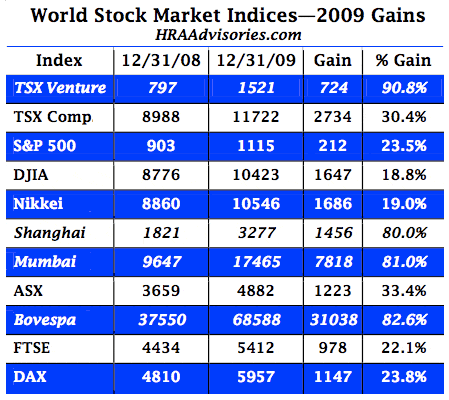
Debtor country indices averaged a 21.4%
return in 2009 while the BIC indices averaged 81.6%, fully 60%
higher. We didn’t include Russia’s RTS index to create
the more familiar “BRIC”, though that would have
generated an even higher average.
Though less mature bourses are inherently
more volatile, more it going on here. Part of the reason for
the difference is that none of the BIC countries saw the level
of panic selling the G7 markets did in Q1. India and Brazil had
far milder declines and the bottom in Shanghai actually came
in 2008. But the main reason for the difference is that these
economies had either very mild recessions or none at all.
Also of note is the roughly 10% out performance
by the indices in Toronto and Sidney. Canada and Australia (particularly
the latter) have heavier commodity weighting and were sustained
to a much greater degree by exports to China. Having banking
sectors that were not totally dysfunctional didn’t hurt
either.
As we expected, the highest percentage
gain was enjoyed by the TSX-V. We thought a bounce from a 75%
drop combined with good commodity prices should generate a large
percentage lift. That gain only brings the Venture index to half
of its 2007 level. There is plenty of repair work left. Gains
have been and will remain selective for some time yet, and no
one should be expecting a repeat of that move.
Equity Markets 2010:
We had been concerned about a revisit
to the 2009 lows but those fears have dissipated, somewhat. The
zero interest rate regimes brought a partial return of risk capital
and the steepest yield curve in history is allowing banks to
work on repairing their balance sheets.
No one should be complacent after a rally
like the ones the markets experienced in the second half of 2009,
but it doesn’t pay to underestimate the impact of zero
rates and cost cutting either. The 2009 rally was not just about
earnings expectations but about the interest rate used to discount
them. Zero rates allowed for P/E expansion even though the “E”
was actually pretty lame.
We expect earnings growth will be good
for at least a couple of quarters going forward. Cost cutting,
that reached panic levels across many sectors, and inventory
replacement should generate impressive looking Y/Y earnings growth
in Q4/2009 and Q1, and perhaps Q2. The bad news is that these
gains will have come at the expense of unemployment. The happy
Y/Y comparisons will dissipate as we get into H2 2010. Earnings
and economic growth can continue later in 2010 only if economies
begin to create jobs.
Employment growth may turn positive soon,
but it will still be weak in most industrialized economies. Debt
de-leveraging is far from complete and income growth will be
needed to pay down debts for some time yet. We don’t see
anything other than a large drop in the unemployment rate putting
an end to residential and commercial foreclosures in the US.
All in all, we think its possible Debtor
country indices can notch gains in the first bit of this year,
but whether those gains hold or melt away later in the year will
depend on the recovery broadening enough to attract re-investment.
Critical to this will be how the “sideline
money” reacts through the first few months of 2010. While
there is much concern about overly bullish sentiment in the markets,
the money flows don’t seem to bear this out. Volumes on
most major exchanges are extremely light. Even with a couple
of large money market funds imploding in 2009 money parked in
such funds is still near all time highs.
Investor surveys display bullish sentiment
towards equities, but retail investors put fifty times as much
new money into bond funds as they did into equity funds in 2009.
Clearly, many investors are still afraid
of equities. It’s hard to say what, if anything will change
this. A rally of close to 70% (from bottoms) hasn’t been
convincing. A large pull-back may bring in bargain hunters but
others may take it as proof they have been right to steer clear
of equities.
Ironically, an increase in bond yields
may drive some money back into equities. With rates at all time
lows, odds are bond funds will perform poorly this year. Whether
this generates new money flow into stocks at some point or investors
simply abandon mutual funds of all types won’t be known
until the worm turns.
If volumes do increase in the short term
it will be partially due to some expected selling by those who
did ride this rally. Funds that were smart or lucky enough to
catch the bottom now have large gains to protect. That may cap
near term gains. In short, while there may be more legs to the
rally, it’s simply prudent to harvest profits occasionally
and keep on your toes.
Even if the Y/Y change in the major indices
is not large there will be plenty of volatility along the way,
and continued light volumes will only enhance it. Note again
that the comments about volume do not apply to the TSXV where
trading volumes remained strong through 2009.
Currencies, Interest Rates and Gold:
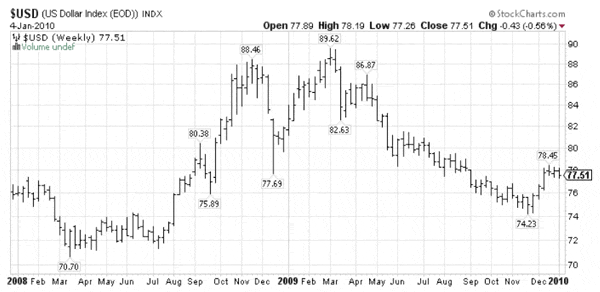
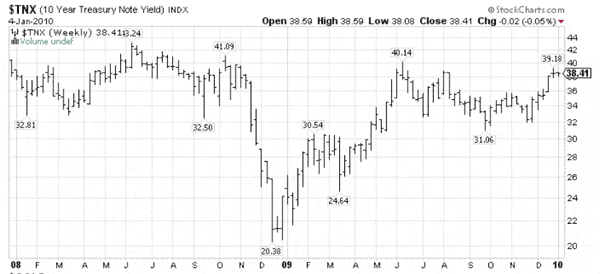
These are all inter-related to some extent
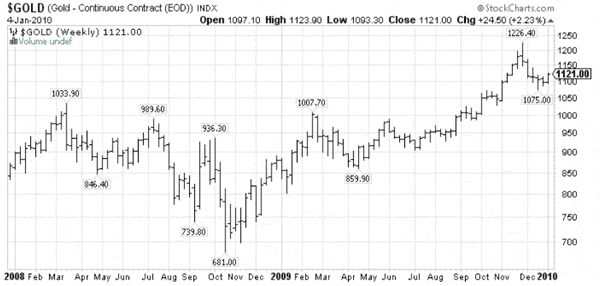
as can be seen from the charts below. One important take away
from these charts is that the relationships between the US$,
gold and Treasury yields have not been static. They have changed
and even reversed a couple of times in the past two years, and
are often different from how are sometimes perceived.
In particular, it’s worth remembering
that gold in fact rose when the market was at its most panicked.
The dollar held a strong inverse relationship to yields as money
poured in to the Treasuries market during the panic. Those relationships
appear to be starting to weaken and may potentially reverse.
The USD and US bond yields have both strengthened in the past
few weeks. This may be the bond vigilantes at work selling bonds
on stronger US economic stats, which is a potential concern for
2010.
The US has to sell $2.4 Trillion in T-bills
and notes in 2010 and has stated its intention to try and move
farther out the yield curve. The US Government has been “borrowing
short and spending long” for the past couple of years.
This is exactly the pattern that got bankers in trouble so
many times in the past. The question is whether bond buyers
will agree to purchase enough longer dated treasuries this year
at low yields.
We emphasize that we still see little
or no chance of the Fed wanting to raise rates any time soon.
The steep yield curve and near record low refinance rate are
just too important to a fragile economy. The real question is
whether bond traders do this in spite of efforts by the Fed to
avoid it.
One question that will be answered in
the first few months of 2010 is how much of the low rate environment
is due to brute force buying by the Fed itself as part of its
quantitative easing program. It's certainly been a force in the
market, but general caution and heavy inflows by private investors
and other central banks are at least as big a factor.
We think yields are going up, especially
if equities continue to do well, but probably not by more than
a percent or so on the 10 year note. More than that, or any news
that the bid to cover ratio on treasury auctions is weakening
significantly (a ratio of 2 or higher, signaling a strong market,
has twice as many bids than is needed to close the auction) should
be taken as a danger sign and a signal for profit taking. If
things get ugly, this could happen fast - better safe than sorry
when it comes to the bond market this year.
As far as the $US itself goes, the much
anticipated Dollar rally is upon us and not looking that impressive
so far. The Euro and Yen have been gaining again as those regions
released economic data less awful than feared. If US bond yields
stay under control, the growing US Dollar float will continue
to weigh on the greenback.
Many reasons have been given for a potentially
large rally in the Dollar but they all boil down to the same
thing: an assumption the Fed will be one of the first to raise
rates. We see little reason for the Dollar to gain if the interest
rate spread is not going to narrow in the near term. For all
of the certainty about a big surge in the greenback we noted
that large scale currency traders were pretty quick to close
out their long positions as soon as the upward trajectory seemed
to falter. There seems to be much less conviction about dollar
gains in trading pits than on the financial pages.
If China slowed its bond purchases enough
to send yields climbing in a big way, this might change. At this
point Beijing still seems intent on holding the Dollar peg and
is buying plenty of treasuries to recycle its current account
surplus. Outside of the developing nations the problem with excessive
debt is much the same across major currencies. It's still a question
of who will debase their currency faster, and the US still holds
a clear lead on this.
Gold
After reaching all time highs and overbought
status, gold pulled back in December. The price fell to $1080,
well below the 40 day moving average that had acted as a base
since the current up leg began in September. While a breech of
this trend leaves open the possibility of a move down to the
$1000 level that is not a necessity. The price has recently moved
back above $1120 and appears to be stabilizing.
Although the pullback is not large, it
seems to have served its purpose in quelling an overly bullish
market. Some of gold's new fair-weather friends made quick exits
and even gold timing publications have swung from highly bullish
to bearish in outlook. For a contrarian these are all bullish
signs.
Most of the large funds that became gold
proponents in the past few months appear to still be on board.
Some additional support also came from an announcement by the
Indian gold importers group that corrected the total 2009 Indian
gold imports to “300-350” tonnes from a previously
reported 200.
The gold price will fluctuate against
the Dollar, but it is increasing held as a hedge against all
currency defamation. Even if we think some of the romanticism
about gold is overdone, its supply can't be conjured out of thin
air like fiat currencies. This simple fact has attracted quite
a few converts to holding some bullion as a portfolio anchor.
We expect continued strength and perhaps new highs in 2010 because
of this. Importantly, at current prices gold mining can finally
function well.
Other Precious Metals
Silver, platinum and palladium had much
harder falls in 2008, but all have been gaining ground again
lately. Unlike gold, none of these precious metals are anywhere
near their 2007 highs and probably won't be soon.
Recent percentage gains are strongest
in platinum and palladium as industry and particularly the auto
sector shows signs of life globally. Neither of these metals
has large supply surpluses or ready sources of new cheap production.
They should see more strength as the world economy continues
to normalize.
Silver is the closest of the three to
recent highs and has held up fairly well during this correction.
We continue to consider above ground stocks a mystery, but new
base metal operations have been slow to come on stream since
last year which should help tighten the silver market.
(Click on image to
enlarge)
Base Metals
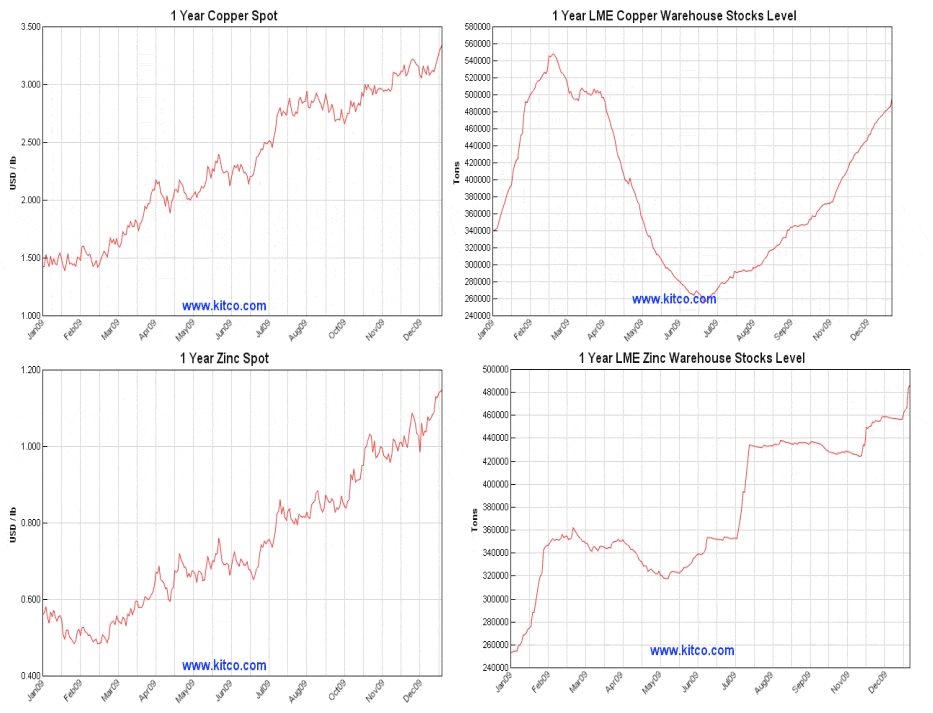
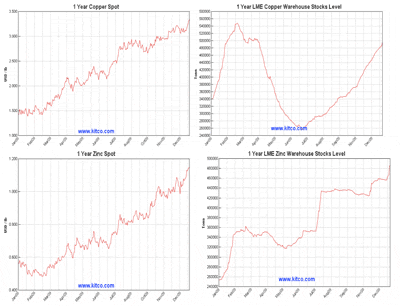
The one-year price and LME warehouse
inventory charts on this page tell you everything you need to
know about base metals, we’re just not sure exactly what
that is.
As 2009 began we found ourselves about
the only ones with anything good to say about base metals. Most
of them had seen their prices crushed in 2008. Because we didn’t
view them as being in bubble territory before the debt crisis,
we also didn’t expect it to take long for them to bottom.
Much like the growth economies that drive
them, base metals put in bottoms early in 2009 or in late 2008
in the case of copper. Most of them never looked back and have
climbed steadily since.
Although base metals had seen large percentage
price gains last year, most are still well off their highs. The
moves are pretty impressive nonetheless given demand for most
metals were below 2008 levels by a couple of percent or more.
Most metals saw relatively small increases
in supply in 2009 but recessionary conditions were enough to
keep warehouse inventories buildings after they based in Q1.
This was the reason we got cautious in Q3 though our caution
hasn’t been matched by others.
Notwithstanding almost constant increases
in warehouse inventories for most base metals, prices have continued
to rise. While we have only included LME warehouse and price
charts for copper and zinc the picture is much the same for all
of them.
Most base metals are at or near year
highs and inventory build appeared to be accelerating at year
end. We’ve said it before but we feel compelled to say
it again: Some caution is required given the current strength
of most base metal prices.
It may be that prices simply don’t
fall much. There may be enough buyers looking out a few years
and willing to hang onto excess metal in the meantime. That’s
distinctly possible but still doesn’t explain the climbing
warehouse inventories.
Skepticism about prices has been reflected
in the share prices of base metal producers which have been flat
for several months. The good news on the base metal side is that
higher prices do seem to finally be helping companies farther
down the food chain.
In recent weeks base metal explorers
have been raising money again. Most are not doing it at prices
they are happy about, but it’s still a vast improvement
over the situation they faced earlier in the year. There has
also been a marked increase in copper deals in the past month.
Some of those may make it onto these pages later. Promoters have
decided they can get attention for base metal deals again after
avoiding them like the plague for 18 months.
Though we don’t expect dramatic
drops in base metal prices we still think a period of price consolidation
is needed. “Non traded” materials like coal and iron
ore continue to fetch good prices and overall demand is solid.
This will not be a year like last year,
but we think it will be another with gains for the taking. After
a year of bubble talk by those who do not understand the mining
sector there seems to be renewed acceptance that prices did not
recover just because a couple of hedge funds stayed interested.
While we don’t expect large gains
for the major markets, they are not required for the sector we
deal with to do well. As long as major markets don’t hit
the panic button again, metals explorers and developers will
continue to be rewarded for discoveries.
As we expected, M&A activity continues
to build across the sector. Not only that, but deals are getting
done at very good prices. That generates free cash for new deals
and sends traders off looking for the next likely candidate.
Much of the recent market gains can be attributed to that sort
of buying and we think it will continue. As long as the bankers
don’t drop the ball again, the game is still on.
###
David Coffin & Eric Coffin
Editors HRA Journal
email: hra@publishers-mgmt.com
David Coffin
and Eric Coffin are the editors of the HRA Journal, HRA Dispatch
and HRA Special Delivery publications focused on metals exploration,
development and production stocks. They were among the first to
draw attention to the current commodities super cycle and have
generated one of the best track records in the business thanks
to decades of experience and contacts throughout the industry
that help them get the story to their readers first. Please visit
their website at www.hraadvisory.com for more information.
|
The HRA - Journal,
HRA-Dispatch and HRA- Special Delivery are independent publications
produced and distributed by Stockwork Consulting Ltd, which is
committed to providing timely and factual analysis of junior
mining, resource, and other venture capital companies. Companies
are chosen on the basis of a speculative potential for significant
upside gains resulting from asset-base expansion. These are generally
high-risk securities, and opinions contained herein are time
and market sensitive. No statement or expression of opinion,
or any other matter herein, directly or indirectly, is an offer,
solicitation or recommendation to buy or sell any securities
mentioned. While we believe all sources of information to be
factual and reliable we in no way represent or guarantee the
accuracy thereof, nor of the statements made herein. We do not
receive, request or accept compensation in any form in order
to feature companies in these publications. We may, or may not,
own securities and/or options to acquire securities of the companies
mentioned herein. This document is protected by the copyright
laws of Canada and the U.S. and may not be reproduced in any
form for other than for personal use without the prior written
consent of the publisher.
©2011 Stockwork
Consulting Ltd. All Rights Reserved.
|
Published by
Stockwork Consulting Ltd.
Box 85909, Phoenix AZ, 85071 USA
email: hra@publishers-mgmt.com
website: http://www.hardrockanalyst.com
SUBSCRIPTIONS 1-800-528-0559
321gold Ltd

|