|
|||
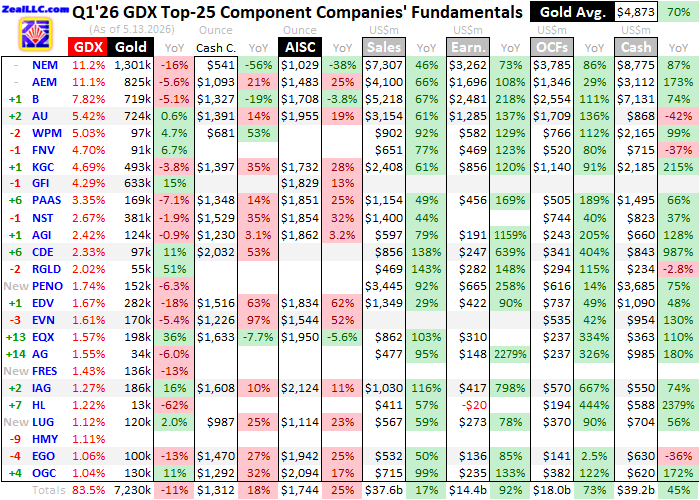
Gold Miners' Q1'26 FundamentalsAdam Hamilton The major gold miners just reported a truly-superlative-defying quarter, their best ever achieved by far. Q1's spectacular record gold prices translated into record revenues, record unit profits, record bottom-line earnings, and record operating cash flows among others. But astoundingly despite resulting record gold-stock prices, miners' valuations plunged to their lowest levels in at least a decade leaving them great buys. The GDX VanEck Gold Miners ETF remains this sector's dominant benchmark. Birthed way back in May 2006, GDX has parlayed its first-mover advantage into an insurmountable lead. Its $29.4b of net assets midweek dwarfed the next-largest similar competitor ETF's by over 9x! GDX is undisputedly the trading vehicle of choice in this sector, with the world's biggest gold miners commanding most of its weighting. Gold-stock tiers are defined by miners' annual production rates in ounces of gold. Small juniors have little sub-300k outputs, medium mid-tiers run 300k to 1,000k, large majors yield over 1,000k, and huge super-majors operate at vast scales exceeding 2,000k. Translated into quarterly terms, these thresholds shake out under 75k, 75k to 250k, 250k+, and 500k+. Those two largest categories account for fully 50% of GDX. Last quarter proved a wild ride for GDX, which typically mirrors and amplifies meaningful gold moves by 2x to 3x. Through much of January, GDX soared 30.8% shooting parabolic. Yet that seriously lagged gold's own popular-speculative-mania moonshot, which rocketed up 24.9% in that same short span! Then GDX quickly collapsed 17.6% into early February with gold, but only leveraged that downside by a mild 1.6x. From there GDX soared another 25.3% in just three weeks into the end of February, achieving two more all-time-record closes to add to January's streak of 13. Then Trump launched his war on Iran, leading to outsized central-bank gold selling slamming the metal in March. GDX plummeted another 30.8% over several weeks, amplifying gold's parallel 14.2% loss by 2.2x. Technically Q1 sure proved a whipsawing quarter! Despite that violent roller coastering, GDX still finished Q1 7.0% higher. And its average close of $98.53 last quarter proved a decisive record, a whopping 24.7% higher than Q4'25's previous one. That Q1'26 average skyrocketed a massive 143.7% YoY from the comparable Q1'25's! Some traders wondered if such huge moves higher were righteous, and gold miners' astounding Q1 results more than justified them. For 40 quarters in a row now, I've painstakingly analyzed the latest operational and financial results from GDX's 25-largest component stocks. Mostly super-majors, majors, and larger mid-tiers, they dominate this ETF at 83.5% of its total weighting! While digging through quarterlies is a ton of work, understanding the gold miners' latest fundamentals really cuts through the obscuring sentiment fogs shrouding this sector. This table summarizes the operational and financial highlights from the GDX top 25 during Q1'26. These gold miners' stock symbols aren't all US listings, and are preceded by their rankings changes within GDX over this past year. The shuffling in their ETF weightings reflects shifting market caps, which reveal both outperformers and underperformers since Q1'25. Those symbols are followed by their current GDX weightings. Next comes these gold miners' Q1'26 production in ounces, along with their year-over-year changes from the comparable Q1'25. Output is the lifeblood of this industry, with investors generally prizing production growth above everything else. After are the costs of wresting that gold from the bowels of the earth in per-ounce terms, both cash costs and all-in sustaining costs. The latter help illuminate miners' profitability. That's followed by a bunch of hard accounting data reported to securities regulators, quarterly revenues, earnings, operating cash flows, and resulting cash treasuries. Blank data fields mean companies hadn't disclosed that particular data as of the middle of this week. The annual changes aren't included if they would be misleading, like comparing negative numbers or data shifting from positive to negative or vice-versa. Given last quarter's epic record gold prices, the major gold miners' results had to be their best in history. And they certainly didn't disappoint, exceeding even my high expectations. Back in an early-April essay way before quarterlies would be released, I predicted Q1's GDX-top-25 results "will again prove utterly-record-shattering ... with upcoming record Q1 results likely to reveal another doubling in sector unit earnings."
Gold miners need to produce sufficient output to capitalize on record gold prices. The global benchmark for quarterly gold production comes from the World Gold Council in its fantastic quarterly Gold Demand Trends reports. In Q1'26, all the world's gold mines combined for 2.4%-YoY output growth according to that latest GDT. Yet the GDX top 25 fared far worse, their production plunging 10.7% YoY to 7,230k ounces! Such poor performance from the world's biggest-and-presumably-best gold miners would certainly be troubling if legitimate. Thankfully it is not, resulting entirely from two comparability anomalies. South Africa's Harmony Gold Mining often drags its feet on reporting, disrespecting its shareholders. Its next update including Q1'26 performance is due out Monday, well after the other major gold miners have reported. In Q1'25 a year ago, HMY mined 314k ounces of gold. That was followed by 368k in Q2, 390k in Q3, and 334k in Q4. That averages to 352k, which is about where Q1'26 will likely run. Without that latest data yet, we need to exclude Harmony's Q1'25 production for comparability. The other anomaly is a big composition change in the GDX top 25, with China's colossal Zijin Mining Group conglomerate finally booted. While Zijin mines massive amounts of gold including 613k ounces in the comparable Q1'25, that is only a small fraction of its vast diversified mining operations including copper, zinc, lead, lithium, silver, and molybdenum. That company never belonged in a gold miners' ETF, which should only include primary ones consistently generating over half their quarterly revenues from gold. I decried Zijin's GDX inclusion for years. That Chinese conglomerate was replaced with Mexico's Industrias Penoles and Fresnillo, which are more known for their huge silver production along with other metals. Still Zijin's colossal super-major-level gold production has to be removed from Q1'25's total since that company is no longer included in GDX. Without its and Harmony's year-ago outputs, the GDX top 25's Q1'26 total grew a far-more-comfortable 0.9% YoY. Interestingly the world's super-majors and majors certainly don't dominate global gold output. The GDX top 25's 7,230k ounces produced in Q1'26 ex-Harmony only accounted for 1/4th of the WGC's global total! Much gold is produced as byproducts for other primary metals, a lot comes from more-numerous smaller mid-tier and junior gold miners, and plenty is recovered in widespread small-scale artisanal gold mining. It's also important to realize global gold-mining output is somewhat seasonal, with Q1s the low ebb. Sequentially the WGC total world production plunged 8.6% from Q4'25 to Q1'26, right in line with the prior 15 years' average 8.4% drop across these same two quarters. During that long span, that Q1 -8.4% average is followed by +4.9% quarter-on-quarter in Q2s, +6.2% in Q3s, and -0.0% in Q4s. Why are Q1s so weak? That mainly has to do with northern-hemisphere winters. Over 2/3rds of this planet's total landmass is found in its top half, along with a presumably-proportional amount of its gold production. Winter weather slows mining operations, from bitter cold up north to heavy rains down south reducing the efficiencies of chemical reactions necessary to recover gold from ores. That also impedes physically hauling those ores. Unit gold-mining costs are generally inversely proportional to gold-production levels. That's because gold mines' total operating costs are largely fixed during pre-construction planning stages, when designed throughputs are determined for plants processing gold-bearing ores. Their nameplate capacities don't change quarter-to-quarter, requiring similar levels of infrastructure, equipment, and employees to keep running. So the primary variable driving quarterly gold production is the ore grades fed into these plants. Those vary widely even within individual gold deposits. Richer ores yield more ounces to spread mining's big fixed expenses across, lowering unit costs and boosting profitability. But while fixed costs are the lion's share of gold mining, there are also sizable variable costs. That's where recent years' raging inflation hit hard. Cash costs are the classic measure of gold-mining costs, including all cash expenses necessary to mine each ounce of gold. But they are misleading as a true cost measure, excluding the big capital needed to explore for gold deposits and build mines. So cash costs are best viewed as survivability acid-test levels for the major gold miners. They illuminate the minimum gold prices necessary to keep the mines running. In Q1'26 the GDX top 25's average cash costs soared 17.5% YoY to a record $1,312 per ounce. This was skewed high by Coeur Mining's eye-popping $2,032, which skyrocketed 52.8% YoY! Without that, the average falls to $1,267 which would've climbed 13.5%. And CDE's were a one-off outlier from its acquisition of great low-cost mid-tier New Gold, from allocating some of its purchase price to gold inventories. Coeur reported that added $689 per ounce to its cash costs, leaving the actuals near a normal $1,343. Interestingly the most-mentioned driver of higher cash costs in GDX-top-25 quarterlies over the past year is higher gold prices! Many gold miners pay royalties on some of their production, which rise in proportion with gold. Pan American Silver is a great example, as it breaks out royalty payments in its income statements. Its total royalties paid last quarter skyrocketed 126.1% YoY to $52m. On a mine-by-mine basis, PAAS disclosed higher royalties accounted for up near 2/3rds to 5/6ths of the jumps in unit mining costs from Q1'25 to Q1'26! IAMGOLD reported its Q1 cash costs with and without royalties. The former was $1,608, the latter $1,201. So fully 1/4th of IAG's operating costs come from royalties, they can be big chunks! While wading through miners' 10-Qs in recent weeks, I wondered about the potential impact of higher energy prices resulting from Trump's war with Iran. Most miners didn't mention that, but OceanaGold conveniently had a section titled "Iran Conflict" discussing mining costs. OGC reported in its operations diesel fuel represents about 6% of 2026's estimated unit mining costs despite having diesel hedges in place. Even with those offsets, OceanaGold estimated its 2026 per-ounce costs would climb $25 or just 1.4% if crude oil remains near $100 per barrel for the rest of this year. Related to the Strait of Hormuz shutdown, about half the world's seaborne sulfur trade flows through that chokepoint. But unlike copper recovery from ores which relies on sulfuric acid, gold heap leaching instead uses cyanide as its primary solvent. All-in sustaining costs are far superior than cash costs, and were introduced by the World Gold Council in June 2013. They add on to cash costs everything else that is necessary to maintain and replenish gold-mining operations at current output tempos. AISCs give a much-better understanding of what it really costs to maintain gold mines as ongoing concerns, and reveal major gold miners' true operating profitability. Cash costs are still the lion's share of all-in sustaining costs, with the GDX top 25's cash costs averaging 78% of their AISCs during 2025's four quarters. In my early-April essay on gold-stock green shoots, I said estimating AISCs "to be very conservative let's assume Q1'26's shake out near $1,900 well above midpoint guidance." That then averaged $1,788 through all of 2026, and Q1s' lower outputs tend to lift unit costs. So it was impressive to see the GDX top 25 report average AISCs of $1,744 per ounce last quarter. That still soared 24.9% YoY, the biggest jump in the last 40 quarters of this research thread! And it was a new all-time record high for AISCs. But with cash costs dominating AISCs and royalties soaring in proportion with gold, record gold means record AISCs. And actually that huge annual jump was distorted by an anomaly. A year ago in Q1'25 and for many quarters before, Peru's polymetallic Buenaventura ranked in GDX's top 25. An unusual non-primary-gold miner still choosing to report in gold-centric terms, BVN credits larger silver, copper, zinc, and lead production as gold byproducts. That drags its AISCs to super-low and even negative levels. In Q1'25 BVN reported -$852 per ounce, but slumped to GDX's 27th-largest component by Q1'26. Had it made the top-25 cut in this latest quarter, BVN's insane Q1'26 AISCs of -$5,909 per ounce would've been included! While it bothers me incorporating those, I have to for consistency's sake. In all 40 quarters of these analyses, I've always included all reported data and there have been far more high-outlier AISCs than low ones. Exclude BVN from distorting Q1'25's average, and GDX-top-25 AISCs rose 14.1% YoY. Absolute all-in-sustaining-cost levels are way less important than AISCs relative to gold. Last quarter's $1,788 actually fell to a record low 36% of quarterly-average gold prices! To illustrate how extraordinary that is, in the five years ending 2024 before gold really got moving this ratio averaged 64%. Mining costs essentially collapsed from roughly 2/3rds of prevailing gold prices to 1/3rd, fueling astounding sector profits growth. After my quarter-century-plus of intensely studying this sector, I've found the best metric for measuring gold miners' collective fundamental performance is their implied unit earnings. That simply subtracts the GDX-top-25 average AISCs from the quarterly-average gold price. This is way cleaner than bottom-line accounting profits, since a varying GDX-top-25 subset's are usually distorted by big noncash charges or gains. In Q1'26 gold averaged a stupendous record $4,873 which skyrocketed 70.0% YoY, the highest by far in the past 40 quarters! That less even those record $1,744 GDX-top-25 average AISCs still yields huge sector per-ounce profits of $3,129! That not only smashed Q4'25's previous record of $2,490, but also skyrocketed a biggest-in-at-least-a-decade 112.9% YoY! And shockingly that windfall isn't too unusual. Over the last eleven quarters ending Q1'26, the GDX top 25's implied unit profits have soared 87%, 47%, 31%, 75%, 74%, 78%, 90%, 78%, 83%, 106%, and that 113%! There can't be any other sector in all the stock markets even remotely competing with such massive consistent profits growth, it is phenomenal. And it ain't over yet, with this already-half-done Q2'26 tracking for the twelfth-consecutive huge growth quarter. Quarter-to-date gold is averaging $4,702, down from Q1'26's lofty peak which is healthy. Yet that is still 43% higher than comparable Q2'25 levels. The GDX top 25's current average 2026 guidance for all-in sustaining costs is running $1,703. And Q2s emerging from winters see gold miners average strong 4.9% quarter-on-quarter production growth, which tends to push Q2 average AISCs below the full-year guides. But to be conservative let's assume Q2'26 GDX-top-25 average AISCs come in around $1,800 when they are reported from late July to mid-August. If gold continues consolidating high mostly holding its quarter-to-date average, that implies the major gold miners will earn about $2,900 per ounce in Q2'26. That would make for another quarter of 56% year-over-year implied-unit-earnings growth, extending that long parade! There's almost no plausible scenario where gold could plummet enough in these next six weeks to scuttle gold miners' twelfth quarter in a row of massive earnings growth. And gold miners' incredibly-strong fundamentals in Q1'26 were confirmed in their hard accounting results reported to securities regulators under GAAP or other countries' equivalents. All key metrics soared to dazzling record highs with gold. The GDX top 25's total revenues surged 16.8% YoY to a record $37,602m. That is quite understated since Gold Fields, Evolution Mining, Fresnillo, and Harmony report in half-year terms per the rules of their countries so their quarterly sales aren't included. Also in the comparable Q1'25, that colossal Chinese mining conglomerate Zijin's revenues accounted for over a third of the GDX top 25's total distorting this comparison. These elite majors' bottom-line earnings skyrocketed 92.2% YoY to a record $14,393m, also excluding those same four companies! And they were very clean for major gold stocks, adjusting to a very similar $14,197m when large unusual one-time income-statement items are backed out. That's still up 90.7% YoY from the comparable adjusted Q1'25 profits. The miners are earning money hand-over-fist with gold so high. Interestingly despite recent records, gold-stock price levels are far from reflecting their epic profitability. Technically major gold stocks tend to amplify material gold moves by 2x to 3x, yet GDX's huge 347.1% bull run from early October 2023 to late February 2026 only leveraged gold's roughly-parallel monster record 196.4% cyclical bull by 1.8x! Despite huge gains, gold stocks have underperformed their metal for years. After the last 40 quarters' earnings seasons, I've collected the GDX-top-25 miners' trailing-twelve-month price-to-earnings ratios and averaged them. They are usually skewed high by some outliers, typically the royalty stocks like Franco-Nevada or some subset of these miners suffering low profits after writing down mines or deposits. Yet amazingly this week as Q1'26 reporting wound down, they fell to at least a decade low. That average valuation was just 20.2x earnings, really low for this sector given all the distortion within it. Plenty of major gold miners still have TTM P/Es in the low-to-mid teens, despite their stock prices recently soaring to all-time record highs! Astoundingly major gold miners are now as undervalued as they have been exiting at least 40 quarters. Their stock prices have a long ways to run to catch up with their epic profits. That being said, the smaller mid-tier and junior gold miners we've always specialized in have much-better upside potential. GDX's little-brother GDXJ ETF better reflects that world, and I plan to analyze the GDXJ top 25 stocks' Q1'26 quarterlies in next Friday's essay. Their latest-reported results and epic fundamentals ought to trounce GDX majors'. Like usual better trading opportunities exist in smaller gold miners, so stay tuned! Successful trading demands always staying informed on markets, to understand opportunities as they arise. We can help! For decades we've published popular weekly and monthly newsletters focused on contrarian speculation and investment. They draw on my vast experience, knowledge, wisdom, and ongoing research to explain what's going on in the markets, why, and how to trade them with specific stocks. Our holistic integrated contrarian approach has proven very successful, and you can reap the benefits for only $12 an issue. We extensively research gold and silver miners to find cheap fundamentally-superior mid-tiers and juniors with outsized upside potential. Sign up for free e-mail notifications when we publish new content. Even better, subscribe today to our acclaimed newsletters and start growing smarter and richer! The bottom line is the major gold miners dominating GDX just achieved their best quarter in history by far. Q1'26's astonishing record-shattering gold prices fueled record-shattering revenues, bottom-line earnings, unit profits, and operating cash flows for the gold miners. And this is nothing new for this high-flying sector, actually proving major gold miners' eleventh consecutive quarter of skyrocketing per-ounce earnings. And with gold consolidating high in this well-underway Q2, this unparalleled epic earnings-growth streak isn't over. High gold prices are enduring for the metal's own strong fundamental reasons, portending far-bigger gold-miner earnings in coming years than past ones. Despite soaring with their metal in recent years, gold stocks still need to continue revaluing higher to reflect their stellar fundamentals in this gold regime. ### May 15, 2026 Thoughts, comments, or flames? Fire away at zelotes@zealllc.com. Due to my staggering and perpetually increasing e-mail load, I regret that I am not able to respond to comments personally. I will read all messages though and really appreciate your feedback! 321gold Ltd |