|
|||
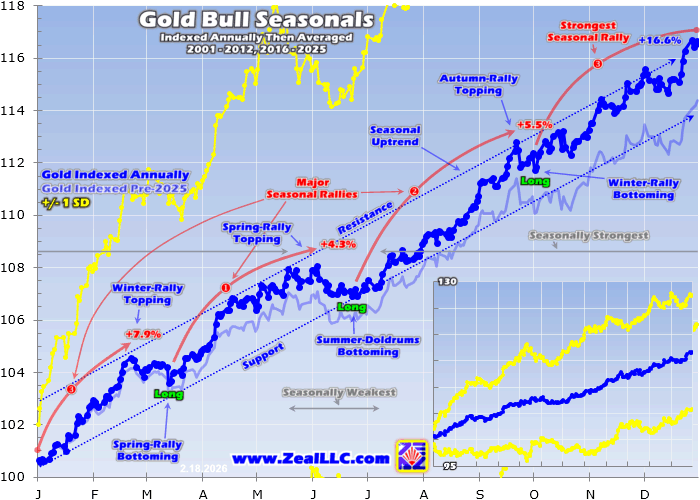
Gold Chinese New YearAdam Hamilton Chinese gold demand played a leading role in this metal's record bull run in recent years. And frenzied Chinese buying fueled gold's popular speculative mania in recent months, partially from preparations for Chinese New Year celebrations. Those play into gold's strong January seasonality, but are followed by a sizable seasonal slump. That could prove way worse this year out of gold's recent extreme overboughtness. From early October 2023 to late January 2026, gold soared 196.4% higher in its biggest cyclical bull ever in dollar terms! The first 24.5 months of that into mid-October 2025 grew increasingly impressive, but not extraordinary. Then in this bull's final 1.3 months from mid-December to late January 2026, gold rocketed up 24.3%! Nearly 1/3rd of this monster bull's entire gains were compressed into less than 1/20th of its duration! That terminal run was extraordinary, catapulting gold to its most-overbought levels seen in a whopping 45.9 years! Gold hadn't blasted 43.4% above its 200-day moving average since March 1980, soon after its notorious January 1980 bubble peaked and popped. Frenzied Chinese buying proved the dominant driver of this big-and-fast gold surge. In late January I wrote an essay "Gold's China Takeover" analyzing this. The great majority of gold's blistering terminal gains accrued in narrow time windows, overnight Sundays into Mondays New York time. Those are the only times when Chinese trading dominates global gold pricing unchallenged by major Western markets, which haven't yet opened for the week. The resulting surging gold prices soon attracted in momentum-chasing buying from Western traders, amplifying gold's gains. After peaking at an epic record close of $5,394 in late January, gold crashed 10.3% in a single day which was its third-worst daily loss since January 1971! That 10%+ selloff slayed gold's record cyclical bull. In the several weeks since, gold has mostly been grinding sideways on balance. With its powerful upside momentum broken, this Chinese New Year has real potential to soon pummel gold considerably lower. In China, Chinese New Year which is also called the Spring Festival is really important culturally. Back in 2000, China's government implemented three separate week-long holidays to boost domestic tourism and consumer spending. Called Golden Weeks, this Spring Festival is the first with all Chinese financial markets closed for this entire week! The second is Labor Day in early May, and the third National Day in October. Hundreds of millions of Chinese people take advantage of these entire weeks off work to travel with their families. While we don't get whole weeks off in America, we do similar things. Many parents travel with their children during their spring-break weeks, and tens of millions of families travel for Thanksgiving or Christmas weeks. Interestingly in 2025 both saw huge gold surges in light US trading thanks to Chinese demand. Spurred on by overnight China-Monday gold buying, gold blasted up 3.8% and 4.4% in these latest Thanksgiving and Christmas weeks! The China Monday leading into the latter catapulted gold up 2.4% to its first record close since mid-October's original peak. That day kicked off gold's terminal ascent into dangerous popular-speculative-mania territory, which I warned about in an essay written one day before gold crashed. Chinese New Year gold demand into this Spring Festival Golden Week and the subsequent slump in its wake have always had marked impacts on gold's seasonals this time of year. This gold-bull-seasonals chart distills those down. All bull years since 2001 are individually indexed to the prior year's close, which is recast at 100. That renders all bull years in like-percentage terms, regardless of prevailing gold price levels. Then all those individual-bull-year indexes are averaged together. The dark-blue line includes all 22 bull years in this past quarter-century, with 2025's astounding 64.3% gold gains now averaged in. The light-blue line shows last year's seasonals before 2025 was added, revealing the resulting massive change. Last year's huge gold rally proved super-outsized, with big Chinese buying playing a leading role in those gains.
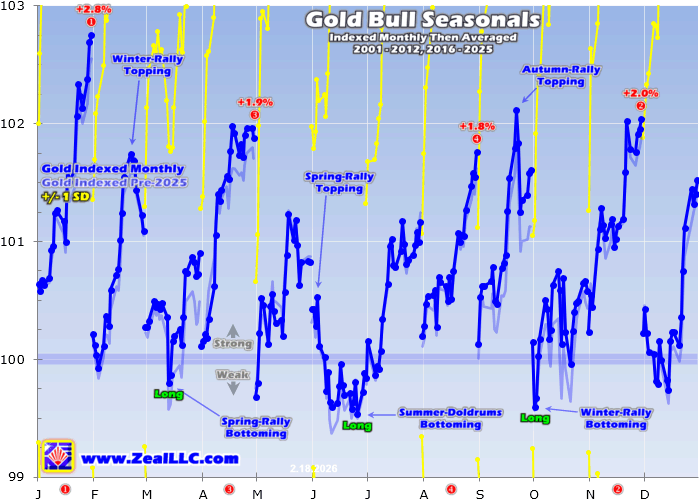
Incredibly in 22 of these last 25 years, excluding gold's 3 bear ones from 2013 to 2015, the yellow metal averaged remarkable 16.6% annual gains! That trounced the US stock markets' long-term average near 10% annually. Every investor needs significant-to-substantial portfolio allocations in gold, not just for its phenomenal performance but its unique roles as the ultimate portfolio diversifier and leading stock-bear hedge. During this long span, gold has enjoyed three distinct seasonal rallies around spring, autumn, and winter. The winter rally which typically runs from early October to late February is the largest by far, averaging hefty 7.9% gains in these 22 modern gold-bull years! Into Christmas, Western jewelry buying is the main driver. The World Gold Council publishes the best-available data on global gold supply and demand each quarter. Per these fantastic Gold Demand Trends reports, world jewelry demand accounted for 44.7%, 40.8%, and 32.8% of overall global gold demand in 2023, 2024, and 2025. After jewelry buying for Christmas gifts winds down, Western investment demand ramps up in January. That's when investors figure out how much surplus income they earned in the prior year after bonuses and taxes, and plow some of that capital into gold. But the dominant driver of gold's strong winter-rally seasonals is Chinese New Year demand running about a month into that Spring Festival Golden Week. The WGC employs great Chinese analysts deeply immersed in China's gold markets. Each year they write about the gold traditions surrounding the important Chinese New Year holiday. That leading-into month is typically gold's busiest buying season of the year in China! Chinese people buy extensive physical gold bars, coins, and jewelry to gift to loved ones in celebration of Chinese New Year. Gold gifts symbolize prosperity and good luck in the new year. As most stores are closed during that Golden Week, all that gold buying happens leading into it. Chinese investors also pour into gold bullion in that month leading into Chinese New Year, on that same year-end surplus-income principle. And because of China's enormous 1.4b-people population and the Chinese people's deep millennia-old cultural affinity for gold, their consumer demand leads the world. In 2023, 2024, and 2025, Chinese consumer gold demand including bullion and jewelry represented 29.0%, 27.9%, and 28.5% of that world total per the latest WGC GDT! Only India rivals that at 23.0%, 26.1%, and 24.4% of that same global total. For comparison US consumer gold demand in these last three years merely accounted for 7.6%, 6.8%, and 6.0% of the world's despite Americans' world-dominating financial wealth. The big Chinese buying into Chinese New Year festival week has made January gold's strongest month of the year seasonally in these same modern gold-bull years. This chart individually indexes each calendar month then averages them.
January tops the calendar-month list with big average gold gains of 2.8% in 2001 to 2012 and 2016 to 2025. November is a distant-second at 2.0%, also in gold's winter-rally timeframe. Big Chinese New Year gold demand is the primary reason January reigns supreme, but Western investment demand early in new years also contributes. January's underlying seasonal strength primes it for rare speculative excesses. But once this Spring Festival Golden Week hits, Chinese gold demand evaporates. Just like American investors mostly check out of markets mentally during Thanksgiving and Christmas weeks to spend time with their families, Chinese investors do too. And since China's financial markets are closed, they can't even trade if they want to. So normally gold suffers a sizable seasonal slump starting at Chinese New Year. That runs into mid-March. Averaging these latest 22 gold-bull years together, that post-winter-rally selloff is mild at 0.9%. But that still makes for one of gold's weakest times of the year seasonally, only slightly trailing June's average seasonal retreat of 1.0%. In normal years, gold's seasonal slump between its winter and spring rallies is no big deal. It has made for some good gold-stock buying opportunities in mid-March. But January's gold action was the most-extreme witnessed since January 1980, gold's biggest bull ever in dollar terms climaxing at gold's fifth-most-overbought levels ever! Nothing remotely close had happened in 46 years, so January 1980's aftermath is the only analog. And holy cow that wasn't pretty. In just 1.9 months after that epic bubble peak, gold plummeted 43.4% in a truly-horrific soul-crushing drawdown! A couple weeks ago I wrote an essay analyzing gold's subsequent drawdowns after all cyclical bulls since 1971, when dollar-gold history effectively began as the gold standard was severed. Following gold's next-ten-largest bulls after this latest monster, gold averaged 20.8% selloffs over just 2.1 months! Instead looking at gold's ten-most-overbought cyclical-bull toppings excluding January 2026's, the same thing happened. Those subsequent drawdowns averaged 20.7% over 2.1 months. Markets are forever-cyclical, endlessly flowing and ebbing. Extreme highs are always soon followed by often-proportional mean reversions and overshoots to deep lows. Those big-and-fast countertrend drawdowns are necessary to rebalance away both extreme technicals and overpowering herd greed seen at extreme toppings, and are inevitable after them. Since massive Chinese gold demand fueled the leading chunk of gold's monster record bull, and frenzied Chinese buying into late January partially on Chinese New Year sparked a popular speculative mania in gold, what happens when this week-long festival ends? Chinese markets were last open on Friday the 13th, and aren't reopening until Tuesday the 24th! How will that affect Chinese traders' gold psychology? Again Chinese gold demand normally pulls back significantly after Chinese New Year, driving that bigger gold seasonal slump. That's probably the best-case scenario for gold over these next several weeks or so into mid-March. The Chinese heavily pare their gold buying after this festival like usual, which would likely leave gold drifting lower. And after such crazy extremes, gold's downside should be bigger than usual. The Chinese people aren't going to ask for their gold gifts back, and Chinese investors probably won't feel compelled to slash their bullion holdings in this next month. But gold's popular-speculative-mania-grade blowoff top in late January was also fueled by reportedly-huge speculative demand from Chinese traders. Will they cool on gold after an entire week off to reflect on its big-and-fast gains to dangerous extremes? Chinese generally seem much shrewder on markets than Americans. Chinese culture has a way-greater emphasis on achieving success, both building wealth and looking prosperous for social standing which is incredibly important in China. So Chinese people seem more attuned to markets, understanding their inherent cyclicality and knowing there are times to sow and times to reap. Most likely aren't gold perma-bulls. Knowing full-well about the post-Chinese New Year slump in China's gold demand, Chinese speculators may return from Spring Festival Golden Week ready to lighten their upside bets. And boy if gold happens to fall significantly on Western selling when they are vacationing, that would likely spawn serious Chinese selling when China's markets reopen. Herd fear grows more rapidly when traders are unable to react to selloffs. While we don't have holiday weeks in America, some of the worst down days in US stock-market history happened on Mondays following weekends. If fear is mounting leading into weekends when traders can't react, they sometimes grow frantic to sell almost panicking as markets reopen. The worst S&P 500 day ever was Black Monday in October 1987, when it crashed 20.5%! Mondays have been brutal in modern panics. Surrounding the October 2008 stock panic, two of the S&P 500's worst down days were 8.9% and 8.8% both on Mondays! During March 2020's COVID-lockdown stock panic, the worst selling day was also a Monday where the S&P 500 plummeted 12.0%! All those happened after normal two-day weekends. Chinese traders will return next Tuesday after ten consecutive days unable to trade in their domestic markets! Gold was trading at $5,032 in dollar terms last Friday leading into Golden Week. This Tuesday as US trading resumed following a three-day holiday weekend here, gold plunged 2.9% to $4,885. While gold bounced back 2.0% on Wednesday, who knows where it will be next Tuesday as China's markets reopen. If gold falls significantly enough to spook Chinese speculators, they could run for exits when they get the chance. So there's a far-bigger-than-usual risk this year's post-Chinese New Year gold demand slump in China will prove much worse than normal. And since Chinese buying has been so instrumental in fueling both gold's record bull run and its January blowoff top, that really slowing or turning into selling would almost certainly drive gold considerably lower after recent extremes. History argues gold's drawdown is far from over. At worst so far that has only run 13.3% over 0.1 months, only two trading days right after gold's most-overbought close in 45.9 years. That's nowhere near deep enough by historical standards after other big-and-overbought cyclical bulls, which again averaged about 21% selloffs over a couple months. Extreme herd sentiment can't be rebalanced in a couple days, more like a couple months of overall selling are needed. And if gold heads lower still on Chinese demand slowing or reversing into selling, the gold stocks will amplify its losses by 2x to 3x like usual. Based on all this, it seems prudent to avoid deploying capital in anything precious-metals-related until at least mid-March. Hopefully by then we'll have more clarity on how gold's drawdown is tracking and whether its post-China New Year slump exacerbated any selling. Successful trading demands always staying informed on markets, to understand opportunities as they arise. We can help! For decades we've published popular weekly and monthly newsletters focused on contrarian speculation and investment. They draw on my vast experience, knowledge, wisdom, and ongoing research to explain what's going on in the markets, why, and how to trade them with specific stocks. Our holistic integrated contrarian approach has proven very successful, and you can reap the benefits for only $10 an issue. We extensively research gold and silver miners to find cheap fundamentally-superior mid-tiers and juniors with outsized upside potential. Sign up for free e-mail notifications when we publish new content. Even better, subscribe today to our acclaimed newsletters and start growing smarter and richer! The bottom line is Chinese New Year is a major driver of Chinese gold demand. January leading into this week-long holiday festival is not only China's biggest calendar month of gold buying, but the seasonally-strongest globally. Chinese demand played leading roles in fueling both gold's recent monster record bull and popular speculative mania into late January. That left gold at its most-extreme overboughtness in 46 years. Chinese gold demand normally fades after all the Chinese New Year buying, pushing gold lower in a seasonal slump. And this year's could prove much worse than usual after gold's recent extremes. If Chinese speculators in particular return from their long Spring Festival Golden Week ready to sell for any reason, that could quickly slam gold lower exacerbating its still-too-small and still-too-young post-mania drawdown. ### Feb 20, 2026 Thoughts, comments, or flames? Fire away at zelotes@zealllc.com. Due to my staggering and perpetually increasing e-mail load, I regret that I am not able to respond to comments personally. I will read all messages though and really appreciate your feedback! 321gold Ltd |