Financial
Market Update
XAU "A-B-C" Wave
2 Bottom and $29 Uranium
Edward Gofsky
June 2nd 2005
posted June 07, 2005
It looks like the wave (2)
bottom in the XAU that I have been looking for has finally happened.
Motive waves are the easiest to see on the chart, the classic
5 wave Elliott pattern. But it is the corrections that follow
the 5 wave impulse patterns that are so hard to figure out, most
of the time the true pattern will only show itself until after
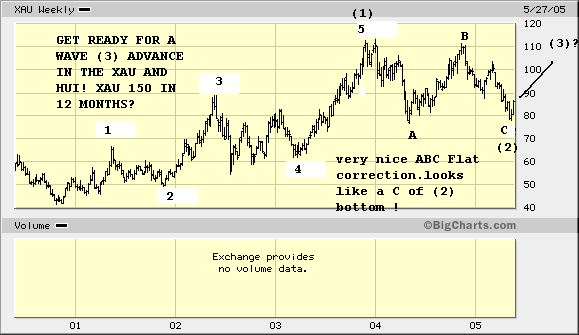
it has competed itself. This 5 year chart of the XAU gold index
is a text book perfect example of a classic ABC flat correction.
Anyone who owns Robert Prechters ground breaking book "Elliott
Wave Principle" (which was written in the late 1970's at
the top of the last gold bull market) can simply turn to page
45 for a complete description of an Elliott wave flat correction.
Also the C wave bottom also
marks the end of wave (2) and the start of wave (3) which author
and Elliott wave practitioner Steven W. Poser likes to describe
them as "The 3rd wave is the wave that elliotticians dream
about". With general psychology in the gold stock sector
very negative there is every indication that a wave C of (2)
has been put in place.
Let's go back into some of
the Elliott wave text books and take a look at Wave 2 bottoms.
P.77 of "The Elliott
Wave Principle". "Second waves often retrace so much
of wave one that most of the profits gained up to that time are
eroded away by the time it ends. This is especially true of call
options purchases, as premiums sink drastically in the environment
of fear during second waves. At this point, investors are thoroughly
convinced that the bear market is back to stay. Second waves
often end on very low volume and volatility, indicating a drying
up of selling pressure".
P.15 of "Applying Elliott
Wave Theory Profitably". " This leg will lead all brilliant
analysts to boldly announce that they "told you so."
Victory is at hand for the bears as the trend lower resumes.
Unfortunately, defeat shall be snatched from the jaws of victory
as prices never take out the previous lows. The drop should be
in 3 waves (remember that if we get an A-B-C zigzag down, wave
A would still develop in five waves, but the retrace amount of
wave 1 should be rater small by the time wave A completes). Volume
should be lower than it was during wave 1. Prices typically retrace
38% to 62% of the losses, and will often convince the crowds
that the previous down trend is alive and well. If we are fighting
off a major, entrenched bear market, or alternatively, are working
on a very short time frame, the retrace can easily exceed 62
percent. Wave 2 can never retrace more than 100% of Wave 1. There
are no exceptions to this rule; in general, if prices retrace
more than 62%, there is high risk that you count is incorrect
and that the bear market is actually alive.
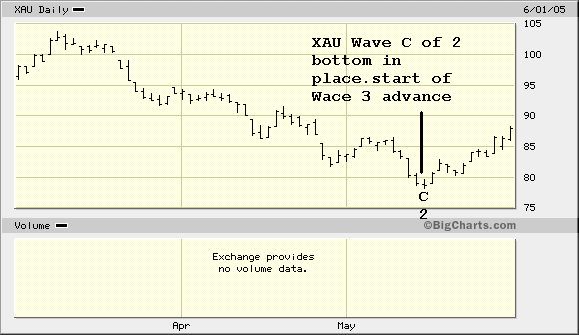
I truly believe that we have
already seen the Wave C of 2 bottom in the XAU and that we are
in the very early stages of a huge Wave 3 advance that should
take us to 150 in the XAU. Just remember that gold stocks are
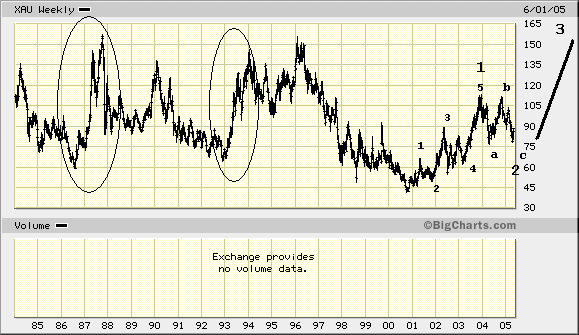
very explosive and can catch fire at anytime. As you can see
in the 20 year chart of the XAU below in late 1986 with the XAU
at 60 it only took about 1 year for the index to rocket up to
150. The same goes for 1993 when again the XAU went from around
60 to 150 in 1 year. I think we are at a similar time right now
where the XAU could make it to 150 sometime in 2006.
On April 14 2005 there was
an essay that was posted on Financial Sense Online by Frank Barbera
who had some of the best Elliott Wave charts of gold and gold
stocks that I have seen. His essay (The
Coming Bull Market in Gold Stocks) is a must read for every
gold stock investor or Elliott Wave student. His essay had 1
chart that I have been trying to find for years.
The chart is a gold stock index
going back to 1915. The chart clearly shows a developing five
wave Elliott pattern in the gold stock index with wave 4 bottoming
in 2001 which means that we are in the early stages of a huge
wave 5 blow off top advance that could last for another 10 years.
Why so long you ask? Well by looking at the 90 year old chart
you can see that the 2 previous gold stock bull markets, Wave
1 was (1917-1939) and Wave 3 was (1959-1980). These two bull
markets Wave 1 and Wave 3 where both around 20 years long, so
if the wave 4 bottom in gold stocks was in 2001 then you could
see rising gold stocks well into the next decade.
The price of uranium has recently
just hit a high of $29 a pound and has sent shock waves across
the energy sector. I have been investing in uranium stocks for
over 1 year and even I am surprised that the price of uranium
is moving so fast. With oil over $50 a barrel and other forms
of fossil fuel getting expensive or prone to terrorist attacks
in the middle east and Saudi Arabia (please read Robert Baer's
book "Sleeping with the Devil" to find out just how
vulnerable Saudi Arabia is for a massive terrorist attack on
oil infrastructure in an area that is the worlds #1 supplier
of oil.
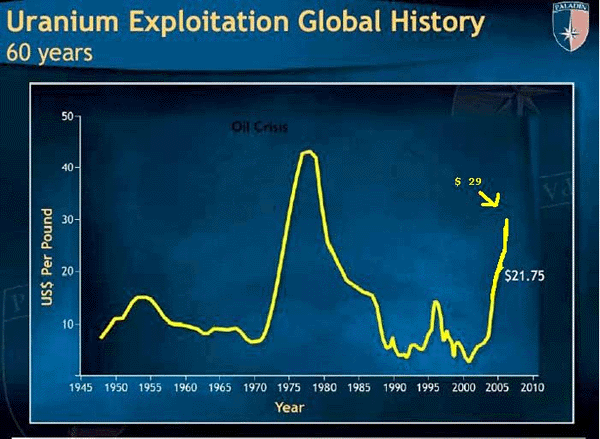
Uranium is just getting started
and I really think that the price will explode over the next
few years to get some balance back into the uranium market. Because
of the huge supply shortage.
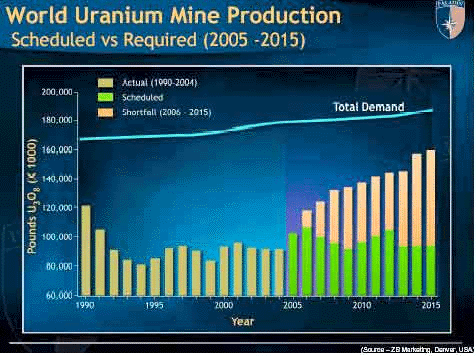
Over the next 10 years it will
really pay off to have some uranium stocks in your portfolio
to take advantage of this once in a life time supply crunch.
Once one of these small uranium companies finds a huge deposit
their stock price will explode and a mad rush will ensue to find
the next big uranium discovery.
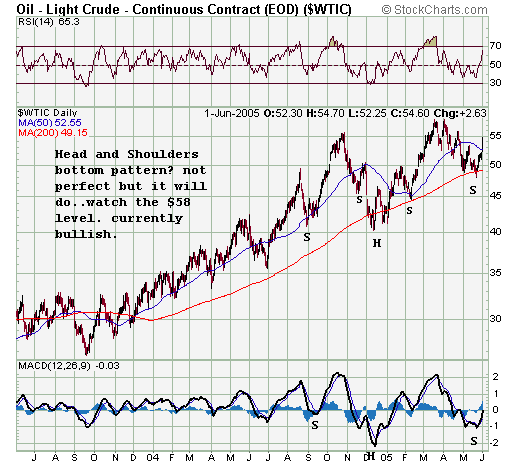
Finally oil looks ready to
explode to the upside once it passes through the $58 level. It
has formed an awkward head and shoulders bottom pattern with
the head of the pattern being a smaller head and shoulders pattern
on a smaller fractal scale. The pattern is bullish and has potential
to reach $70 by late summer.
What is the Elliott Wave Principle
and why do follow it and think it's the most valuable tool for
every investor? Here is the best description of Elliott Wave
Theory that I tell people.
Page: 121. of Robert Prechter's
1978 book "Elliott Wave Principle"
"In its broadest sense,
the Wave Principle suggests the idea that the same law that shapes
living creatures and galaxies is inherent in the spirit and activities
of men en masse. Because the stock market is the most meticulously
tabulated reflector of mass psychology in the world, its data
produce an excellent recording of man's social psychological
states and trends. This record of the fluctuating self-evaluation
of social man's own productive enterprise makes manifest specific
patterns of progress and regress. What the Wave Principle says
is that mankind's progress (of which the stock market is a popularly
determined valuation) does not occur in a straight line, does
not occur randomly, and does not occur cyclically. Rather, progress
takes place in a "three steps forward, two steps back"
fashion, a form that nature prefers. More grandly, as the activities
of social man is linked to the Fibonacci sequence and the spiral
pattern of progression; it is apparently no exception to the
general law of ordered growth in the universe. In our opinion,
the parallels between the Wave Principle and other natural phenomena
are too great to be dismissed as just so much nonsense. On the
balance of probabilities, we have come to the conclusion that
there is a principle, everywhere present, giving shape to social
affairs, and that Einstein knew what he was talking about when
he said, "God does not play dice with the universe."
The stock market is no exception, as mass behavior is undeniably
linked to a law that can be studied and defined. The briefest
way to express this principle is a simple mathematical statement:
the 1.618 ratio. The Desiderata, by poet Max Ehrmann, reads,
"You are a child of the universe, no less than the tress
and the stars; you have a right to be here. And whether or not
it is clear to you, no doubt the universe is unfolding as it
should." Order in life? Yes. Order in the stock market?
Apparently. "
You can e-mail me at eddy_gofsky@yahoo.com
Or you can visit my website
http://www.edwardgofsky.com/
Edward Gofsky
Edward Gofsky
lives in Vancouver B.C, Canada where he studies Elliott Wave
Theory and Classical Technical Analysis.
Copyright ©2005
Edward Gofsky. All Rights Reserved.
______________
321gold Inc

|