 Physical Bullion
Investments Physical Bullion
Investments
Which to Buy, Coins or Bars?
Michael B. Clark
Aug 19, 2007
Precious metals have been one
of the top performing asset classes over the past six years,
and investors wanting to add a precious metals component to their
portfolios are often overwhelmed by the number of investment
vehicles available to them today. Alternatives include precious
metals futures and options contracts, government certificates,
"digital gold," exchange traded funds (ETFs), mutual
funds, mining shares, as well as buying the physical bullion
itself. All enable an investor to gain exposure to the precious
metals markets and participate in what many investment experts
foresee as a continuing multi-year secular market.
Having exposure to gold, in
particular, the world's pre-eminent tangible asset, either through
a direct purchase of the physical asset itself, or by adding
one of the other aforementioned alternative vehicles, is highly
recommended in today's environment.
But to be sure, there is no
"holy grail" of gold investing; it should never be
an "either / or" scenario. Just as prudent investors
hold a range of investment types to minimize their dependence
on a single asset class in their overall portfolios, investors
should also consider further diversifying their holdings by acquiring
a number of these precious metals vehicles within this particular
component of their portfolios.
As an example, a smart, holistically
diversified investor might hold a combination of physical gold
in his/her personal possession, government certificates and physical
gold in an allocated account, and "digital gold," along
with some exposure to the mining sector via equities.
But, each of these vehicles
is unique and can be complex. Thus, investing in them requires
a thorough understanding of not only their various advantages
and potential rewards, but of their relative risks and individual
disadvantages, as well. Therefore, an investor should carefully
study, and perform proper due diligence on all aspects of a contemplated
gold investment. Credit risk associated with the company selling
the investment, the company (or companies) behind the offering,
and the custodian holding it, if applicable, should be of paramount
concern in the investor's mind, as a sound credit rating of these
entities is as important as their business history and professional
experience.
Ultimately, the crux of the
answer as to which to buy rests with the investment objectives
and risk tolerance of the investor. Indeed, there is no single,
correct answer for every investor, and seeking the assistance
of a reputable, trusted investment expert is the best approach
for most investors when contemplating making a gold or other
precious metals investment.
But for many investors, perhaps
the simplest and most straightforward way to gain exposure
to the precious metals markets, and eliminate many of the uncertainties
and/or complexities associated with the alternatives, is to own
physical precious metals outright, by buying gold, silver, or
platinum in the form of Bullion Coins or Bullion Bars.
But first, why would an investor
want buy physical precious metal commodities to begin with? Good
question
As a physical asset, bullion
is inherently valuable. This is to say, physical precious metals
have tangible, intrinsic and innate value in and of themselves,
and they are, therefore, the only asset class that is not some
outside entity's or third party's liability (as is the case with
a stock or bond). Thus, the investor who owns the physical asset
directly, and whether held in his/her personal custody or stored
safely in his/her name in an insured account at a qualified facility,
will enjoy the sense of security one derives from knowing that
their investment portfolio is strengthened by the presence of
an actual tangible asset with an intrinsic value, and not just
a piece of paper, or derivative product, that serves as a proxy
for precious metal.
In contrast, "paper precious
metal" investments present considerably different risk-reward
considerations. For example, buying shares in a mining company
provides ownership in an entity that produces gold or silver,
but not direct ownership of the commodities themselves. Management
and accounting competence, environmental risks, hedge book exposure,
potential political turmoil, and a host of other vital considerations
need to be taken into account when deciding to buy shares of
a mining company to add to one's portfolio.
On the other hand, precious
metals futures and options are legal contracts that can leverage
one's gains, but they can be complicated investments and they
can exacerbate one's losses.
Exchange Traded Funds (ETFs)
are derivative vehicles that track the price of gold and silver.
Two of the more popular are the New York-traded streetTracks
Gold Shares (NYSE:GLD) and the London-traded Lyxor Gold Bullion
Securities (LSE:GBS). As derivative products, they do not provide
their owners with title to the underlying asset, as one has when
holding gold in an allocated account or in one's personal custody.
Thus, ETFs are often used by day traders, hedge funds and institutional
players speculating on short term movements in the gold price.
From the investor's perspective,
although the price of a gold ETF will move in tandem with the
price movements of gold, owning an ETF is not the same as owning
gold directly. In fact, owning an ETF may defeat the very purpose
many investors buy gold as a physical, inherently valuable asset
(and tangible currency) to begin with. For many investors, the
primary reason to own gold is that it is the ultimate safe haven
physical asset to have in times of economic or geopolitical uncertainty.
ETFs, on the other hand, are a form of debenture.
Thus, should an ETF provider
go into liquidation, its investors will become general creditors
of that provider, since ETF assets are not held as allocated
assets, titled in the individual names of the investors. Direct
ownership of gold bullion, on the other hand, either by holding
it in one's personal custody or having it stored it in a physically
allocated account (and off the custodian's balance sheet), and
titled in the owner's name, insulates the investor from the potential
losses experienced by general creditors in bankruptcy scenarios.
In other words, owning the
physical precious metal directly removes most of these ancillary,
but critically important considerations.
So, once a decision has been
made to invest in physical bullion, bars and coins are the choices
available. But, which does one buy? Let's review their respective
characteristics.
Bullion coins are highly refined precious metal
products that are round in shape (as opposed [to] the rectangular shape of a bullion
bar), and produced to exacting specifications by numerous federal
governments throughout the world, specifically for investment
purposes. These coins are produced in large quantities and come
in a variety of sizes, which are convenient to own and trade
-- typically one, one-half, one-quarter, and one-tenth troy ounces.
Their content - that is, the weight and purity of precious metal
they contain -- is guaranteed by the governments that produce
them.
The United States Mint describes
a bullion coin as: "a coin that is valued by its weight
in a specific precious metal. Unlike commemorative or numismatic
coins valued by limited mintage, rarity, condition and age, bullion
coins are purchased by investors seeking a simple and tangible
means to own and invest in the gold, silver, and platinum markets."
Moreover, while bullion coins
are ascribed legal tender status in their country of origin,
they are actually valued by the market for their precious metals
content, plus a small premium representing the cost of production,
shipping handling and the seller's profit added to their price.
They are readily bought and sold by investors through a world-wide
network of precious metals retailers, wholesalers, banks and
brokerage firms. The current prices for most major bullion coins
are published daily both on the internet and in financial publications
such as the Wall Street Journal, internationally. Thus, bullion
coins are an excellent choice for most investors.
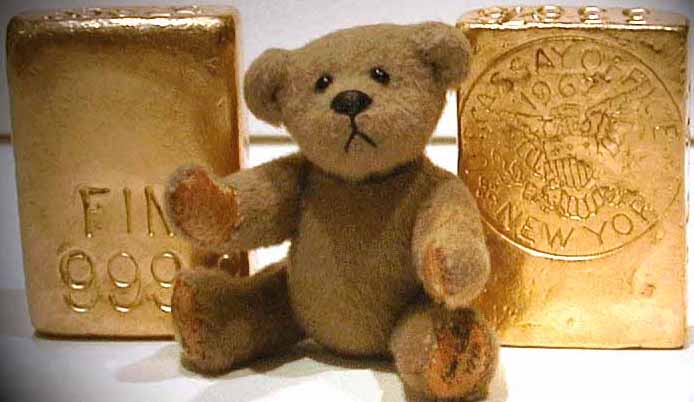
Bullion bars, on the other hand, are rectangular
blocks of investment grade precious metal (also referred to as
"ingots") manufactured by commercial refiners. (Note:
the most reputable and prominent commercial refiners have standing
with, and are recognized by the world's leading precious metals
exchanges.) Bullion bars are produced in a wide range of sizes
- from 1 gram (or less) to 400 troy ounces (or more). They typically
bear [Barb's
note: bear? ...can't resist this - click] four distinguishing marks that uniquely identify
them, including their refiner's mark (i.e., the bar's brand name),
the gross weight (usually in troy ounces), the metal fineness
(or "purity"), and the bar's serial number.
Having been produced commercially,
they have no legal tender status, but reputable refiners stand
behind the quality and authenticity of the bars that bear their
brand name. Both small and large sized bars are also highly liquid
and easily traded worldwide, provided the larger bars are not
held by the investor personally (more about this point appears
below). And, like bullion coins, the price of these bars varies
with the market value of the precious metals they contain, plus
a modest premium representing the cost of production, shipping,
handling and the seller's profit.
An important distinction between
coins and bars that a precious metals investor should understand
is that, while bullion coins produced by mints and small "investor
bars" produced by refiners are specifically designed to
contain an exact weight of the metal they contain (e. g., exactly
one-ounce or one-half-ounce of platinum), larger sized bullion
bars (e.g., 400-ounce gold bars or 1000-ounce silver bars) are
not. To keep production costs down and their associated premiums
to a minimum, large bar weights and metal purities are maintained
within internationally acceptable ranges. (Example: a so-called
"400 ounce" gold bar may actually weigh 404.360 troy
ounces and have a pure gold content of 99.65 %. By multiplying
the bar's gross weight and the fineness together, the investor
can calculate the exact amount of pure gold the bar contains
-- 402.944 troy ounces, in this example.) While this manufacturing
method keeps the premiums paid for these large bars low, thereby
allowing the buyer to get more precious metal in his/her investment,
it requires the owner to use fractions to calculate the bar's
absolute metal content. This may prove a confusing and inconvenient
requirement for some investors; thus, large bars are usually
traded among large companies and sophisticated investors.
There are, in reality, three
important aspects for an investor to consider when choosing between
bullion coins or bullion bars for investment. Each of these aspects
can affect the cost of the investment and affect the flexibility
the investor has over his/her investment. These considerations
include the following:
1) Premium -- as discussed
above, this refers to amount of money an investor is charged
for the product over and above the value of the metal the coin
or bar actually contains. As stated earlier, the premium represents
the cost of production, shipping, handling and the seller's profit.
A higher premium is normally paid for smaller-sized coins and
investment bars (i.e., 5% - 20% depending on size) than is paid
for large investment grade bullion bars (i.e., 2%- 5%). This
is because, like with most products, it costs the manufacturer
- in this case, a mint or refiner - more money to make, say,
400 one-ounce perfectly shaped, designed and inscripted pure
gold coins, than it does for that mint or refiner to produce
the single inexact weight and pure "400-ounce" gold
bar described above.
2) Custody -- An investor
may desire to hold his/her bullion coins or bars close at hand
and, therefore, may request personal delivery. This is fine for
bullion coins and small investment bars, as neither will typically
require assay (unless they are materially damaged) at
the time they are ultimately sold. But, because the content of
large bars can be manipulated or altered in ways that are difficult
to detect by visual examination, even by seasoned professionals,
a time-consuming and costly assay will be required if the investor
has taken personal possession of them and presents them to a
dealer for sale. Thus, investors who buy large bars for their
portfolios are advised to leave them in storage (in an insured
account titled in their name) at a reputable recognized precious
metals depository. If a large bar is kept in such a storage facility,
its liquidity will not be affected at the time of sale.
3) Flexibility -- Does
the investor intend to just buy, hold and then ultimately sell
his/her precious metals for profit? If so, then perhaps buying
bullion bars may be best, as the premiums paid at the time of
purchase will be lower. Or, is this a long-term investment that
may be a permanent part of one's estate that will be passed on
to a number of heirs? If this is the case, then buying bullion
coins may be preferred. One thousand one-ounce bullion coins
can be readily distributed among five heirs, where as two 400-ounce
and two 100-ounce bullion bars cannot.
To summarize, an investor should
carefully consider his or her investment objectives, the amount
of money he or she plans to invest, their need for liquidity,
and the current geopolitical, macroeconomic and systemic risk
when making an investment in precious metals. And while the variety
of bullion products may seem somewhat overwhelming, the "best"
product, in all likelihood, will differ for each investor. However,
it is the abundance of investment products available in the marketplace
that allows investors to tailor their portfolios to meet their
particular needs.
Consultation with a trusted
precious metals advisor can help the investor determine the best
precious metals products to satisfy their individual risk tolerance
and specific investment objectives.
Michael B. Clark
email: info@gold.ie
Michael B.
Clark is a consultant to Gold and Silver
Investments
Limited, Ireland's Asset Diversification and Wealth Preservation
Specialist. He is the President of Solidus Associates, LLC
of Wilmington, Delaware, and has served in the precious metals
industry for 25 years. He oversaw Deak-Perera's Precious Metals
Certificate Program, America's largest precious metals investment
program, in the early 1980s. Later he became Vice President of
Precious Metals at Wilmington Trust Company, and President of
both Delaware Depository Service Company and First State Depository
Company. He obtained licenses for Wilmington Trust and DDSC to
operate as Nymex and Comex depositories.
321gold Ltd

|