>


|
|||
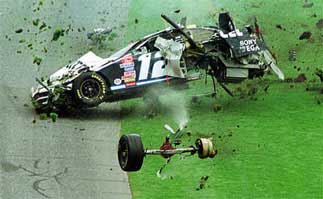
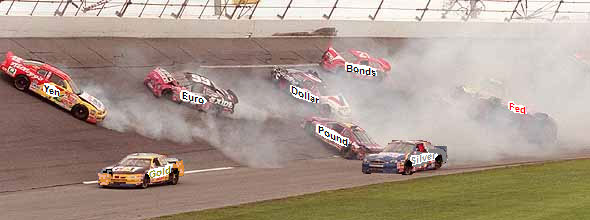
Making the Old Money NewDavid Chuhran I feel like I'm watching a NASCAR race at the Talladega or Daytona Super Speedways. The Federal Reserve car is leading the race because they refused to use restrictor plates like the rest of the field. Nobody else even bothers to complain anymore when the Fed's engine output is unrestricted allowing them an unfair power and speed advantage. Everyone knows the Fed team makes up their own rules as they go. They're always leading and never need a pit-stop. Their tires never wear; and it looks as if they ride atop a layer of thin air. You see, nothing they do is firmly planted on the ground and it's from this "thin air" that they also create the fuel necessary to run high speed circles---forever. At least, that's what they think. You may be thinking, "That would never happen. It wouldn't be fair!" That's the problem, it is happening, but not on the NASCAR circuit. Of course the Fed has no car, but that's how they run our monetary system. They make up their own rules and create money out of "thin air," but just as in the analogy above, few drivers complete a full career without suffering a rollover. Our Fed car is no different in this respect, and will eventually rollover. Just like the actual restrictor plate races, if one car crashes, it usually causes several other cars to crash along with it. If the lead car rolls, it could take out the whole field. What can we do folks? This system ain't workin'!
Do you recognize the problem? There's just something wrong with the idea of a handful of unelected and unaccountable people controlling the supply of money. It's not their money supply; it's our money supply. I mean, really, what's to stop them from just printing more anytime they choose and funneling this money to whomever, or for whatever they desire. Absolutely nothing is stopping them, of course. I don't mean to suggest that they're directly depositing funds in their friends' individual bank accounts, but there's certainly some profit in the favoritism of the money flows alone. I'm not going to rehash history. That's not to say that history isn't important, it is, but we need to collectively agree on how we're going to regain some sanity in our monetary system going forward from here. You may say, "What's wrong? The Fed car is in the lead." Unfortunately, most everyone suffers at least one "rollover" and we'd be foolish to have it occur while we're unprepared. It's not just our dilemma, it's a global problem; and while I disagree with those supporters of "One World Money," I only do so because they intend to make the "new" money out of "thin air" just like they do now. This "new" paper money will still allow the same temptations and evils to remain in place ensuring another "rollover" in the future. The powerbrokers don't care. It's the human condition. They want complete, concentrated, global control through their ability to set the value of that money by their arbitrary decree, or fiat, as well as keeping their power to create as much money as they want out of "thin air." I'm not opposed to universal money as long as nobody, but the open market, has control. We all must play by the same rules. Restrictor plates on, tires on the ground, and pit-stops can cause lead changes! "Money" must have control of itself with its value defined in the marketplace and its supply must not be created or corrupted. You may ask, "How could that possibly work?" The first thing we must agree on is the characteristics money should possess. To do that we need a working definition, but please understand when I was a young hockey player, we had a kid on our team that read a few pages from the dictionary everyday. He'd occasionally spout out an unrecognizable word in the locker room that left the whole team silently looking from side-to-side for some relief to our bewilderment. He'd break the silence with an incomprehensible definition resulting in him receiving a barrage of loose equipment and tape balls. If he wasn't the team's leading scorer, I think his fate would've been much worse. He's currently a Prosecutor and will make a fine Judge someday soon. Here's my rough definition of money meant to stimulate thought and encourage debate, because once we suffer a "rollover," it's too late to begin the discussion. The final definition needs to be brief, clear, and concise. This definition contains a partial list of the characteristics that I believe money should possess; and please don't throw anything at me---yet! Definition of Money: A measurable unit of value that has mass and is not denominated relative to any other thing of value, but is only denominated by its own weight. Money's value is derived not by artificial decree, but naturally by how other things of value adjust relative to Money. Money must be easily transported and universally recognized, without boundaries. It must be immediately accepted in exchange for other things of value. Money must be impossible to break, tear, or separate and should not lend itself to manmade reproduction. You may or may not agree on the worth of these attributes; and you may even think that the paper money we use now already has most of these characteristics and works just fine. I agree, to a certain extent, with a few exceptions. Our current fiat (value by decree) paper money can be torn, shredded, or even burned; and it's certainly forgeable, but the most notable exceptions are how money is measured and valued. The proper measurement of money contains two aspects: a unit of account and weight. The unit of account for our current fiat paper is easy, it's one dollar. The problem is there's no "weight" associated with the dollar meaning that it really measures nothing. You can't weigh a promise to pay. Thin air is weightless. Therefore, the dollar, while it's accepted in exchange for things of value, it is not truly money. For a true version of independent money, both the unit of account and the weight should be one in the same. In other words, the physical weight equals the recognized unit of account. This makes things easy to understand for everyone around the globe, because it needs no explanation and no conversion. It only requires a scale for weight and an assurance of purity, but nobody will carry a scale, so both of these can and should be guaranteed by a trusted mint. There's only one kind of money that fits this bill while containing all the attributes in the definition above. It's the "old" money---Gold. Assuming the Gold is pure (or fine), the weight is currently measured in troy ounces and the unit of account is the troy ounce. These two are inseparable, but it wouldn't matter if we changed it to grams. One troy ounce equals 31.103486 grams and we could shift the unit of account to a 30 gram standard, calling it the "metric ounce," without too much trouble. And, NO, the central bankers don't get to keep the difference. Then, for example, if we wanted to mint 3, 6, 15, and 30 gram coins, the unit still equals the weight. Here's the kicker, no arbitrary (fiat) value should be minted on the coins face, only the weight and purity. The weight becomes the value. In order for paper money to circulate, we have to have a face value. That "denomination" is set by government decree and only represents their "guarantee" or promise to pay. It's the government's promise; therefore, they own the money. With Gold, it's different. You own it! Once the weight and purity are established, your individual promise to pay is immediately fulfilled when you exchange your gold coin for something of value. You need not rely on anyone or any government to make good on your promise. The value of Gold will remain stable on its own, as it has for hundreds of years, but everything else should float. This fact makes Gold the perfect candidate to sit atop the World's monetary pyramid, it has a long and stable history in this role, and all other things will seek a value relative to Gold in the marketplace.
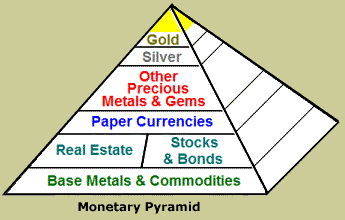
So, how could we value everything in Gold? As it stands now, most everything is valued in the World's Reserve currency, the US dollar. After that, all currencies are cross-compared in the Foreign Exchange markets as conversions exist between the yen-euro, euro-pound, yen-peso, ruble-yen, etc... but even Gold is primarily valued in dollars. What if we changed all that and allowed a natural market-based valuation to occur for everything based on a troy ounce (or metric ounce) of Gold? While I doubt we'll have the will to do this voluntarily, because it would likely cause a dollar whiplash and subsequent economic pain, I believe Gold is in the process of re-monetizing on its own. The problem is that it's happening without any definitive direction; and we must prepare for the possibility that Gold may rise to the top of the pyramid on its own through natural market forces. Physically placing Gold atop the global monetary pyramid would remove the necessity to pass things through the dollar or have complex monetary conversion tables. It also removes the reins of power from the central bankers. Everything everywhere in the World should be priced in both Gold and the local paper money, and payment should be accepted in either. The Gold prices for various things would likely remain constant and stable while the paper prices would fluctuate. The World over, you could pay in Gold, if you choose, and receive your change in local paper. You could also pay in local paper and receive Gold coins as change. The system would be simple and easy to understand after the rather tumultuous, but necessary, adjustment period. For example, it doesn't matter if you want to price things in ounces of Gold or show how many things one ounce of gold buys. Here's how it would look under that system: At the opening on Monday, 8 Mar, 2004, one ounce of Gold equals: $401 US This makes things plain, clear, and simple cutting across all economic, political, cultural, religious, lingual, and physical borders. There would no longer be a need for any other conversion charts or exchange rates. It's easy to see that $401 US=€322 Euros, 57.70 ounces of Silver=8.30 shares of GM, and £216 Pounds Sterling=10.78 barrels of Oil. If this were implemented and new Gold coins went into global circulation, then those undisciplined countries willing to debase or expand their money supply would be automatically punished in the marketplace as their currency's value would drop relative to Gold. Those countries who try to cheat by removing their restrictor plates, would find themselves alone on the track racing a race that has already ended. In reality, they actually just create an excess money supply that would be met with little additional demand forcing a drop in the value of their paper currency relative to Gold and everything else of value on the pyramid. You may think this devaluation would be equivalent to what's happening to the US dollar now, and that it would provide a competitive advantage in the global marketplace, but it would be different. The Gold price of everything would remain stable while the paper price would rise providing no long term advantage. Gold would be the "restrictor plate" making all paper currencies relatively equal allowing any imbalances to remain within a narrow and naturally correctible range. The main transitional difference for the dollar comes not from the supply side, but from the demand side of the equation. Currently, demand for the dollar remains high, for many reasons, even as it's being mindlessly created by the Fed's errant inflation of the money supply. There's no alternative; the dollar is the World's reserve currency, so many transactions, like oil purchases, still require a conversion to dollars for payment. That wouldn't be the case if Gold became the reserve currency. If that came to pass, the dollar would face a punishing decline due in part to the lack of transactional demand and money would flow away from the bond markets sending yields (interest rates) skyward. Even though the transition period would be painful, discipline would finally be restored in the monetary system forcing everyone, especially the Politicians, to act financially responsible. Gold alone can regulate the inflation of the paper money supply while also naturally setting interest rates. The Federal Reserve would no longer be necessary. The US Constitution made Congress, not the Fed, responsible for establishing and regulating our monetary system. This is clearly stated in: Article. I, Section. 8, Clause 5: To coin Money, regulate the Value thereof, and of foreign Coin, and fix the Standard of Weights and Measures. When the framers said, "coin," they didn't mean paper or wooden nickels, they meant Gold or Silver. Silver is a viable supplement to Gold, but not a replacement. In the same sentence, the Congress is also tasked with setting the "Standard of Weights and Measures" and with regulating the "Value" of money. Aside from the broader use of weights and measures, to me this means that the coins should have weight that relates to their value. In fact, one way to regulate the value of "foreign coin" is to make our coin's face value equal its weight and then place these Gold Coins atop the monetary pyramid valuing everything relative to that weight. Assuming the foreign coins are of equal fineness, then their value is only a function of their weight. The framers didn't intend for Congress to delegate this authority. Regardless, they cannot delegate their responsibility. And, the Fed was legislated into existence; it can also be legislated into extinction. The Fed has run our monetary system by their made-up rules ignoring the Constitution. That current system will eventually suffer a rollover. The Fed can try to keep this race going, or they can try to start a new race by creating"new" One World "Fiat" Money. Both options are desperate attempts to hold onto power by avoiding the discipline exerted by the honest and fair rules imposed by "old" Money. The Fed can, and probably will, cheat as long as possible. We should start our own race to prepare a final definition of "Money" in hopes of giving Gold the checkered flag and finally -- once and for all -- beating the Fed by... ...making the old Money new!
Picture modified, original courtesy of RPMAllen.com Can you find the Fed car? (Thankfully, no drivers were seriously injured.)
Copyright ©2004 David Chuhran. All Rights Reserved 321gold Inc |