Premature
Celebration: The Market and the Fed Premature
Celebration: The Market and the Fed
Joseph Brusuelas
Merk Hard Currency
Fund
Aug 8, 2008
The enthusiastic response of
the market to the moderation in the price of imported oil and
the Fed monetary statement is a bit overdone. It is based on
the hope that inflation will moderate rather than a hard-nosed
look at the pricing environment. Our Senior Economic advisor
Bill
Poole, who knows more than a bit about crafting a coherent
Fed statement, reminded the market recently that since August
2006 the FOMC in one way or another has been signaling that they
anticipate inflation will moderate in coming quarters. Yet, our
core inflation forecast suggests otherwise.
Our forecast implies that the
June consumer price index will show continued upward movement
in both the core and the headline. On a month over month basis
the headline should advance 0.5% and the year over year estimate
should increase to 5.2%. Using the Fed's preferred core measures
provides a similar result. The core CPI should increase 0.2 m/m
and 2.4% (2.481825) y/y with a real risk of a 2.5% posting, while
the core personal consumption expenditure deflator should advance
0.2% and 2.4% (2.395607) over that same period.
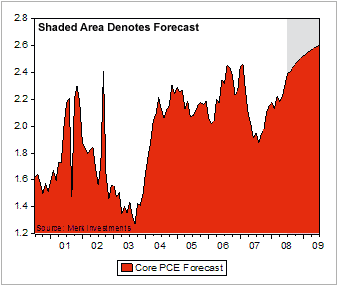
More unsettling is our dynamic
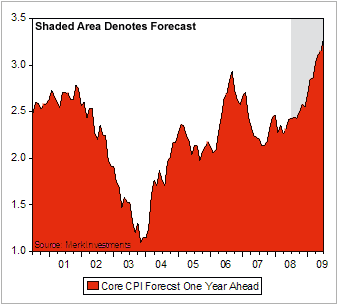
one-year ahead forecast. Looking at the CPI the core should surge
out well above 3.0% by the middle of next year and the core PCE
should advance to 2.6%. While some in the market may claim that
inflation roughly one half of one percent above the relative
comfort zones is an acceptable price to pay for stabilizing the
financial system and avoiding a deeper recession, we think that
this may be discounting the upside risk to these forecasts.
Headline inflation over the
next months may see some easing, if the price of oil continues
to fall. That is a very big "if." However, as implied
by our forecast that things may not be so quiescent inside the
twin core measures. First, the liquidity that the Fed has injected
into the system over the past year has not yet had its maximum
impact. Monetary policy acts with long and variable lags. Once
those 325 basis points of liquidity takes hold firms that have
watched their once potent profit margins collapse to razor thin
levels will attempt to regain some measure of pricing power.
Thus the risk for core pricing in 2009 is to the upside. Sound
monetary policy should always be constructed to prevent a breakout
in pricing. But due to the current systemic issues in the financial
system, the Fed cannot act in the timely manner that it would
prefer.
Second, the economic landscape
is littered with the debris of mal-investment in the housing,
autos and airline industries. The inventories in housing alone
will take the next few years to burn off. The supply of fuel
inefficient vehicles dwarfs the sagging demand left in the consumer
sector. Airlines now fly fewer miles, make fewer seats available
and charge a higher price for their diminished product. Thus,
the problem that economy faces is one of supply, not demand.
Once one factors in the increase
in the cost of energy into the equation, what one observes is
a supply shock that has forced the aggregate supply curve up
and to the left. This plainly suggests that situation faced by
consumers is one of higher prices and reduced supply. The accommodative
policy that the Fed is currently following to stimulate demand
in the aforementioned sectors will directly lead to inflationary
pressures in the non-financial corporate, ex-transportation sectors.
This is what is behind the debasing of the dollar and in our
humble opinion not the basis for sound money.
Joseph Brusuelas
Chief Economist
Merk Investments
Contact
Merk
©2005-2008 Merk Investments
LLC. All Rights Reserved.
Joseph Brusuelas is Chief Economist
at Merk Investments.
The Merk
Hard Currency Fund is a fund that seeks to profit from a potential
decline in the dollar. To learn more about the Fund, or to subscribe
to our free newsletter, please visit www.merkfund.com.
The Merk Hard Currency Fund is a no-load mutual fund that invests
in a basket of hard currencies from countries with strong monetary
policies assembled to protect against the depreciation of the
U.S. dollar relative to other currencies. The Fund may serve as
a valuable diversification component as it seeks to protect against
a decline in the dollar while potentially mitigating stock market,
credit and interest risks-with the ease of investing in a mutual
fund.
The Fund may
be appropriate for you if you are pursuing a long-term goal with
a hard currency component to your portfolio; are willing to tolerate
the risks associated with investments in foreign currencies; or
are looking for a way to potentially mitigate downside risk in
or profit from a secular bear market. For more information on
the Fund and to download a prospectus, please visit www.merkfund.com.
Investors should
consider the investment objectives, risks and charges and expenses
of the Merk Hard Currency Fund carefully before investing. This
and other information is in the prospectus, a copy of which may
be obtained by visiting the Fund's website at www.merkfund.com
or calling 866-MERK FUND. Please read the prospectus carefully
before you invest.
The Fund primarily
invests in foreign currencies and as such, changes in currency
exchange rates will affect the value of what the Fund owns and
the price of the Fund's shares. Investing in foreign instruments
bears a greater risk than investing in domestic instruments for
reasons such as volatility of currency exchange rates and, in
some cases, limited geographic focus, political and economic instability,
and relatively illiquid markets. The Fund is subject to interest
rate risk which is the risk that debt securities in the Fund's
portfolio will decline in value because of increases in market
interest rates. As a non-diversified fund, the Fund will be subject
to more investment risk and potential for volatility than a diversified
fund because its portfolio may, at times, focus on a limited number
of issuers. The Fund may also invest in derivative securities
which can be volatile and involve various types and degrees of
risk. For a more complete discussion of these and other Fund risks
please refer to the Fund's prospectus.
The views in this article were those of Joseph Brusuelas as of
the newsletter's publication date and may not reflect his views
at any time thereafter. These views and opinions should not be
construed as investment advice nor considered as an offer to sell
or a solicitation of an offer to buy shares of any securities
mentioned herein.
321gold Ltd

|