The Buck Stops Where?
John Browne
Dec 8, 2009
Last week, we witnessed Ben Bernanke's Senate confirmation hearings for a second term as Fed Chairman. The air was thick with hypocrisy, as Senators vied with each other to cast blame on the Fed Chairman for the fiscal mistakes of the Congress. As an overtly politicized figure who has looked to bolster the poll numbers of successive Administrations, Bernanke certainly should shoulder a large share of the blame for steering the United States towards the brink of bankruptcy; however, he did not act alone. Ironically, many of his co-conspirators are currently his harshest critics.
The truth is that if there were no debt from Congressional deficit spending, there would be nothing for the Fed to 'monetize' with the printing press. By behaving as the voters' 'best friend,' delivering both low taxes and generous entitlements, Congress forced the Fed to play the disciplinarian. Except, not wanting to spoil the party, it didn't. Ben Bernanke, like his predecessor Alan Greenspan, is an intelligent man who knows exactly where reckless spending will lead the country. Yet he refused to hit the brakes.
When former President Nixon broke the last ties between the U.S. dollar and gold, he opened the floodgates to Congressional abuse. Before the 'gold window' was closed, if the federal government ran up too much debt, other countries would start trading their reserves for our gold. Afterward, these creditors were left in something of a pickle: they held huge dollar reserves (built up on the belief that it was 'as good as gold') which now had a value dependent on being able to trade with Americans. This translated into a huge subsidy for America - quickly eaten up by a guns-and-butter spending philosophy directed by Congress.
Recently, under pressure from Wall Street, Congress repealed key provisions of the Glass-Steagall Act. Glass-Steagall created bank deposit insurance through the FDIC, while putting in place safeguards to prevent these now risk-free deposits from being used in speculative investments. Repealing Glass-Steagall without repealing deposit insurance created an environment of private gains and taxpayer losses.
Moreover, in an effort to sell an 'American dream' based on homeownership, Congress subsidized and guaranteed residential mortgages through Fannie Mae, Freddie Mac, and the FHA. This created a perfect speculative play for the combined investment/commercial bank behemoths emerging from the ashes of Glass-Steagall.
These major transgressions of government lie at the heart of the economic decline and financial crisis that now face America. They were the direct fault of Congress, not the Fed.
The main charge against the Fed is that it has ignored its vital independence. This began under the stewardship of Chairman Alan Greenspan and continued under his protégé, Ben Bernanke. Both Greenspan and Bernanke could fairly be labeled as 'inflationists,' in that they favor inflation over recession.
Thanks to Nixon, the Fed can create paper money out of thin air by means of book entries in the accounts of Fed member banks. Over the turn of the century, Greenspan, assisted by Bernanke, used this power to finance the greatest asset boom in world history. Today, Bernanke is financing a second great financial inflation, but this time in the face of an economic recession. This will fuel the worst of all worlds: massive stagflation.
Already, total American government debt, including off-balance sheet IOU's to the Social Security Administration, stands at between $56 and $110 trillion. Based on a gross domestic product of some $13 trillion, it is most unlikely that the debt will be repaid. Increasingly, it is being described as the biggest Ponzi scheme in history. This Rake's Progress is not lost on the markets. The U.S. dollar has declined precipitously, both in terms of gold and against foreign currencies, sapping the confidence vital for an economic recovery.
Regardless of who is to blame, Bernanke faces a decision. He may either continue to debase the currency or raise interest rates, likely forcing the Treasury into default. The latter may sound like a political impossibility, but consider carefully the alternative. In our present situation, many countries throughout history have simply revalued their currencies, wiping out a huge chunk of their debt, and started again. But the U.S. dollar has no fixed value, except the external fix of China's currency peg. Since China is our largest creditor, they could theoretically revalue our currency by adjusting the peg. This would have a tremendous impact on the American economy, and we don't get a vote!
The Fed did not create this crisis, but it did abdicate its responsibility to stop it. In doing so, it has essentially exported our major monetary powers to China. We're partying in a house that China owns. If we don't keep ourselves under control, they will wake up and impose some harsh discipline.
As they say, forewarned is forearmed, making gold possibly more attractive than even its present price indicates.
###
Dec 7, 2009
Click here
to buy Peter Schiff's best-selling, just-released book,
"How an Economy Grows and Why It Crashes."
For a more in depth analysis of our financial problems and the
inherent dangers they pose for the U.S. economy and U.S. dollar,
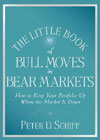
you need to read Peter Schiff's 2008 bestseller "The Little
Book of Bull Moves in Bear Markets" [buy
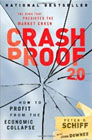
here] And his recent release "Crash Proof 2.0: How
to Profit from the Economic Collapse" [buy
here]
For a look back at how Peter
Schiff predicted the current crisis, read his 2007 bestseller
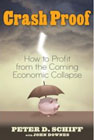
"Crash Proof: How to Profit from the Coming Economic Collapse"
[buy
here]
More importantly, don't wait
for reality to set in. Protect your wealth and preserve your purchasing
power before it's too late. Discover the best way to buy gold at www.goldyoucanfold.com, download our free
research report available at www.researchreportone.com, and subscribe to our
free, on-line investment
newsletter.
John Browne
Senior
Market Strategist
Euro Pacific Capital, Inc.
1 800-727-7922
email: jbrowne@europac.net
website:
www.europac.net
 John
Browne is the Senior Market Strategist for Euro Pacific Capital,
Inc. Mr. Browne is a distinguished former member of Britain's
Parliament who served on the Treasury Select Committee, as Chairman
of the Conservative Small Business Committee, and as a close associate
of then-Prime Minister Margaret Thatcher. Among his many notable
assignments, John served as a principal advisor to Mrs. Thatcher's
government on issues related to the Soviet Union, and was the
first to convince Thatcher of the growing stature of then Agriculture
Minister Mikhail Gorbachev. As a partial result of Browne's advocacy,
Thatcher famously pronounced that Gorbachev was a man the West
"could do business with." A graduate of the Royal Military
Academy Sandhurst, Britain's version of West Point and retired
British army major, John served as a pilot, parachutist, and communications
specialist in the elite Grenadiers of the Royal Guard. John
Browne is the Senior Market Strategist for Euro Pacific Capital,
Inc. Mr. Browne is a distinguished former member of Britain's
Parliament who served on the Treasury Select Committee, as Chairman
of the Conservative Small Business Committee, and as a close associate
of then-Prime Minister Margaret Thatcher. Among his many notable
assignments, John served as a principal advisor to Mrs. Thatcher's
government on issues related to the Soviet Union, and was the
first to convince Thatcher of the growing stature of then Agriculture
Minister Mikhail Gorbachev. As a partial result of Browne's advocacy,
Thatcher famously pronounced that Gorbachev was a man the West
"could do business with." A graduate of the Royal Military
Academy Sandhurst, Britain's version of West Point and retired
British army major, John served as a pilot, parachutist, and communications
specialist in the elite Grenadiers of the Royal Guard.
In addition to careers in British politics and the military, John
has a significant background, spanning some 37 years, in finance
and business. After graduating from the Harvard Business School,
John joined the New York firm of Morgan Stanley & Co as an
investment banker. He has also worked with such firms as Barclays
Bank and Citigroup. During his career he has served on the boards
of numerous banks and international corporations, with a special
interest in venture capital. He is a frequent guest on CNBC's
Kudlow & Co. and the former editor of NewsMax Media's Financial
Intelligence Report and Moneynews.com. He holds FINRA series 7
& 63 licenses.
321gold Ltd

|