Too Little Too Late
John Browne
Sep 25, 2008
Last week, Treasury Secretary
Paulson and Fed Chairman Ben Bernanke faced Congressional leaders
with a reported forecast that we are "literally days away
from a complete meltdown of our financial system." Apparently,
the politicians were stunned into a long silence.
If citizens across the country could glimpse the horror seen
by the Congressmen (of which we have long warned), then widespread
panic would truly be the order of the day. In particular, people
will be shocked to see how Paulson's seemingly vast request to
Congress for some $1 trillion is utterly dwarfed by the likely
problem.
Of course, Paulson does not want to scare Congress. So he has
offered them his own version of a teaser mortgage rate of just
$1 trillion. The true figure will only kick in later, like one
of the adjustable rate mortgages that tempted millions of optimistic
home buyers. Once Congress is locked in to a "blank check",
the funds will keep rolling until the presses run dry!
To put the problem into perspective, let's just consider some
base statistics.
The publicly issued debt of the Unites States was, until very
recently, a massive $5.3 trillion. The total debt, including
non-public IOUs and unfunded obligations including social security
and Medicare, is now a staggering $50 trillion! The total annual
wealth generation, or GDP of America, is some $14 trillion.
Contrast those figures with the current debt problem ascribed
to the reckless pursuit of predatory lending. Incidentally, predatory
lending was made illegal in most states until overridden by President
Bush to protect Wall Street profit opportunities.
The U.S. mortgage holdings are some $14.8 trillion, including
some $3 trillion of commercial mortgages. Local government debt
is some $3 trillion. But, even these gigantic figures pale in
comparison beside the $20.4 trillion of consumer and corporate
debt. Therefore, the total of non-Federal Government debt is
some $38 trillion!
Of course, not all of it will default. All things being equal,
possibly only a small proportion will fail, at least initially.
But today, all things are not equal. We know that we are heading
into a recession. This means that increasing amounts of debts
will default.
The main problem is that predatory lending incurs a high default
rate. So if only 10 percent of outstanding loans default, the
Government will have to raise some $4 trillion, or more than
5 times what Congress is being asked. It will increase the U.S.
Government public debt by some 80 percent.
This will threaten the triple-A credit rating of American Government
debt. It will also 'crowd out' corporations and entrepreneurs
from crucial debt funding. Finally, it will put upward pressure
on interest rates at precisely the time when lower rates are
called for to avoid recession slipping into depression.
If the economy moves into a severe recession and then depression,
default rates will explode. These, in turn, will cause stock
markets to implode, as they did in 1929. In addition, the U.S.
dollar is likely to plummet, driving up the trade deficit in
the longer term. Considering these factors, many of which the
Government prefers to hide, things look bad - very bad.
It does not take a rocket scientist to see that we face a very
serious situation and that the $1 trillion Paulson rescue plan,
although well intentioned, is far too small and too late to avoid
disaster. So what should investors do?
An old maxim is that, gold makes sense when nothing else makes
sense. Today, not much does make sense. Gold is likely to explode,
at least in the initial stages of panic. In a recession, cash
becomes a King. In a depression, gold is an Emperor.
In the current panic, many investors are jumping on U.S. Treasury
bonds as a perceived life raft. But teetering on the shaky foundation
of U.S. dollars, T-bonds are a trap to be avoided. As the U.S.
dollar is likely to erode fast, the sovereign debt of countries
with strong currencies, such as Swiss francs, are attractive,
even with a negative yield.
In these precarious times, think return of capital,
not return on capital.
***
For a more in depth analysis
of our financial problems and the inherent dangers they pose
for the U.S. economy and U.S. dollar denominated investments,
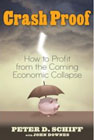
read Peter Schiff's book "Crash Proof: How to Profit
from the Coming Economic Collapse." Click here
to order a copy today.
 More importantly, don't wait for reality
to set in. Protect your wealth and preserve your purchasing power
before it's too late. Discover the best way to buy gold at www.goldyoucanfold.com, download our free
research report on the powerful case for investing in foreign
equities available at www.researchreportone.com, and subscribe to
our free, on-line investment
newsletter. More importantly, don't wait for reality
to set in. Protect your wealth and preserve your purchasing power
before it's too late. Discover the best way to buy gold at www.goldyoucanfold.com, download our free
research report on the powerful case for investing in foreign
equities available at www.researchreportone.com, and subscribe to
our free, on-line investment
newsletter.
Sep 24, 2008
John Browne
Senior
Market Strategist
Euro Pacific Capital, Inc.
1 800-727-7922
email: jbrowne@europac.net
website:
www.europac.net
 John
Browne is the Senior Market Strategist for Euro Pacific Capital,
Inc. Mr. Browne is a distinguished former member of Britain's
Parliament who served on the Treasury Select Committee, as Chairman
of the Conservative Small Business Committee, and as a close associate
of then-Prime Minister Margaret Thatcher. Among his many notable
assignments, John served as a principal advisor to Mrs. Thatcher's
government on issues related to the Soviet Union, and was the
first to convince Thatcher of the growing stature of then Agriculture
Minister Mikhail Gorbachev. As a partial result of Browne's advocacy,
Thatcher famously pronounced that Gorbachev was a man the West
"could do business with." A graduate of the Royal Military
Academy Sandhurst, Britain's version of West Point and retired
British army major, John served as a pilot, parachutist, and communications
specialist in the elite Grenadiers of the Royal Guard. John
Browne is the Senior Market Strategist for Euro Pacific Capital,
Inc. Mr. Browne is a distinguished former member of Britain's
Parliament who served on the Treasury Select Committee, as Chairman
of the Conservative Small Business Committee, and as a close associate
of then-Prime Minister Margaret Thatcher. Among his many notable
assignments, John served as a principal advisor to Mrs. Thatcher's
government on issues related to the Soviet Union, and was the
first to convince Thatcher of the growing stature of then Agriculture
Minister Mikhail Gorbachev. As a partial result of Browne's advocacy,
Thatcher famously pronounced that Gorbachev was a man the West
"could do business with." A graduate of the Royal Military
Academy Sandhurst, Britain's version of West Point and retired
British army major, John served as a pilot, parachutist, and communications
specialist in the elite Grenadiers of the Royal Guard.
In addition to careers in British politics and the military, John
has a significant background, spanning some 37 years, in finance
and business. After graduating from the Harvard Business School,
John joined the New York firm of Morgan Stanley & Co as an
investment banker. He has also worked with such firms as Barclays
Bank and Citigroup. During his career he has served on the boards
of numerous banks and international corporations, with a special
interest in venture capital. He is a frequent guest on CNBC's
Kudlow & Co. and the former editor of NewsMax Media's Financial
Intelligence Report and Moneynews.com. He holds FINRA series 7
& 63 licenses.
321gold Ltd

|