Who Will Suffer Least From
a Depression?
John Browne
Aug 28, 2008
Though few may have noticed,
the past few weeks may be regarded as a global economic turning
point. Evidence is mounting that the United States is entering
a recession, with increasing signs that it could morph into a
depression. While the current Administration appears resigned
to bail out or nationalize large tracts of American commerce,
the presidential candidates drift towards Great Society era spending
proposals. At the same time, America's principal economic rivals
appear to be charting courses that are not in line with U.S.
interests.
The Russian invasion of Georgia has revived tensions that have
not been seen since the most frigid periods of the Cold War.
With the Olympic Games over, China can relax and now exert its
muscle without risking any politically motivated boycotts. Between
them, these global players hold well over a trillion dollars,
or 10% of U.S. government debt, which they can use as
leverage in any strategic, economic or political confrontation
with the U.S. There is also evidence that America's economic
power is even waning in our own back yard. This week, Honduras,
a traditional U.S. ally in Central America, announced that it
was throwing its lot in with a Latin American trade bloc dominated
by Venezuela and Cuba!
For two years I have warned readers of a severe, real estate
led recession and encouraged extreme asset allocations to cash,
particularly short-term, hard currency government bonds, and
gold. Last year, I urged short positions in financials and U.S.
stock markets. Some ridiculed me. The financials are currently
down some 84 percent. Apparently, the real estate crash is biting
deeper than just about any market "expert" had imagined.
The size of the problem is enormous. A fall of just 20 percent
in U.S. house values, (which is confirmed by the latest Case
Shiller data release) wipes almost $5 trillion from the wealth
of American consumers and businesses. This amounts to more than
one third of America's GDP and half of the total U.S. Government
debt! How could the fallout be anything less than systemic?
Imprudent lending behavior, inspired by the housing boom, placed
the security of banks depositors and shareholders at undisclosed
and unprecedented risk. The banking problem is so large that
failures cannot be allowed. The government has bent rules regarding
financial reporting and the Fed's lending criteria to keep the
financial ship afloat.
The main focus for now is on government sponsored lenders Fannie
Mae and Freddie Mac, who are now understood to be hopelessly
undercapitalized. Despite the complete predictability of this
outcome, even conservative investors, including many banks, had
been persuaded that securities issued by both Fannie Mae
and Freddie Mac were risk free. And although shareholders for
both entities are likely to be wiped out, corporate bond holders,
and those individuals and financial institutions who hold mortgages
backed by both the GSEs, correctly assume that the government
will back their assets. However, hundreds of billions, perhaps
trillions, of Federal dollars will be needed to make whole all
who foolishly loaded up on Fannie and Freddie debt. Unfortunately,
the Federal cupboards are bare.
This week, the Federal Deposit Incurrence Corporation (FDIC)
announced that its problem list had increased from 90 banks to
117. Worse still, the FDIC announced its fund had fallen below
its legal deposit ratio, forcing it to increase its levy on member
banks. This, just when the net income of its member banks, in
desperate need of retained earnings, has fallen by some 86 percent.
As more banks begin to fail, the ultimate cost to the Federal
balance sheet is hard to imagine.
But, as the old saying goes, 'What's good for the goose is good
for the gander.' So, if government financial 'favors' are granted
to reckless investment firms (Bear Stearns) and now mortgage
borrowers, what about other economically vital 'multiplier' industries
like: automakers, airlines, credit card and insurance companies
and even corporate real estate lenders? The logical conclusion
for this current drift is hyperinflation. In order to make good
on its promises the Federal Government will have to resort to
the printing press... with a vengeance.
With America facing severe recession, many regions around the
world will suffer. So who will suffer least? Nations that have
run relatively prudent economic policies and those who 'produce'
goods required even in an economically depressed world will continue
to prosper increasingly, relative to the U.S.
The differential may become magnified as America's government
hyper-inflates. Investors will then increasingly dump dollar
paper assets and buy hard currencies, government bonds of 'producer'
nations and gold. Investors ahead of this depression curve will
likely suffer least!
***
For a more in depth analysis
of our financial problems and the inherent dangers they pose
for the U.S. economy and U.S. dollar denominated investments,
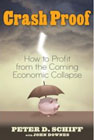
read my new book "Crash Proof: How to Profit from the
Coming Economic Collapse." Click here
to order a copy today.
 More importantly, don't wait for reality
to set in. Protect your wealth and preserve your purchasing power
before it's too late. Discover the best way to buy gold at www.goldyoucanfold.com, download our free
research report on the powerful case for investing in foreign
equities available at www.researchreportone.com, and subscribe to
our free, on-line investment
newsletter. More importantly, don't wait for reality
to set in. Protect your wealth and preserve your purchasing power
before it's too late. Discover the best way to buy gold at www.goldyoucanfold.com, download our free
research report on the powerful case for investing in foreign
equities available at www.researchreportone.com, and subscribe to
our free, on-line investment
newsletter.
John Browne
Senior
Market Strategist
Euro Pacific Capital, Inc.
1 800-727-7922
email: jbrowne@europac.net
website:
www.europac.net
 John
Browne is the Senior Market Strategist for Euro Pacific Capital,
Inc. Mr. Browne is a distinguished former member of Britain's
Parliament who served on the Treasury Select Committee, as Chairman
of the Conservative Small Business Committee, and as a close associate
of then-Prime Minister Margaret Thatcher. Among his many notable
assignments, John served as a principal advisor to Mrs. Thatcher's
government on issues related to the Soviet Union, and was the
first to convince Thatcher of the growing stature of then Agriculture
Minister Mikhail Gorbachev. As a partial result of Browne's advocacy,
Thatcher famously pronounced that Gorbachev was a man the West
"could do business with." A graduate of the Royal Military
Academy Sandhurst, Britain's version of West Point and retired
British army major, John served as a pilot, parachutist, and communications
specialist in the elite Grenadiers of the Royal Guard. John
Browne is the Senior Market Strategist for Euro Pacific Capital,
Inc. Mr. Browne is a distinguished former member of Britain's
Parliament who served on the Treasury Select Committee, as Chairman
of the Conservative Small Business Committee, and as a close associate
of then-Prime Minister Margaret Thatcher. Among his many notable
assignments, John served as a principal advisor to Mrs. Thatcher's
government on issues related to the Soviet Union, and was the
first to convince Thatcher of the growing stature of then Agriculture
Minister Mikhail Gorbachev. As a partial result of Browne's advocacy,
Thatcher famously pronounced that Gorbachev was a man the West
"could do business with." A graduate of the Royal Military
Academy Sandhurst, Britain's version of West Point and retired
British army major, John served as a pilot, parachutist, and communications
specialist in the elite Grenadiers of the Royal Guard.
In addition to careers in British politics and the military, John
has a significant background, spanning some 37 years, in finance
and business. After graduating from the Harvard Business School,
John joined the New York firm of Morgan Stanley & Co as an
investment banker. He has also worked with such firms as Barclays
Bank and Citigroup. During his career he has served on the boards
of numerous banks and international corporations, with a special
interest in venture capital. He is a frequent guest on CNBC's
Kudlow & Co. and the former editor of NewsMax Media's Financial
Intelligence Report and Moneynews.com. He holds FINRA series 7
& 63 licenses.
321gold Ltd

|