   |
||||||||||||||||||
J. Taylor's
GOLD & Technology Stocks
|



 You won't hear it discussed
in the mainstream press because they have a vested interest in
keeping you thinking things are going along well. The establishment
wants you to keep on charging those credit cards because if you
don't, given the enormous amount of debt held in America (now
totaling $43 TRILLION), we are heading toward a 1930s Great Depression
or worse!
You won't hear it discussed
in the mainstream press because they have a vested interest in
keeping you thinking things are going along well. The establishment
wants you to keep on charging those credit cards because if you
don't, given the enormous amount of debt held in America (now
totaling $43 TRILLION), we are heading toward a 1930s Great Depression
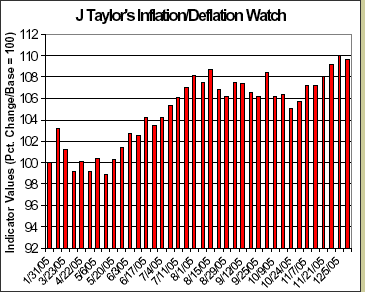
or worse!| S&P 500 +10.52% | |
| Commodities (Rogers Index) +14.72% | U.S. Long Bond +1.62% (Rates up) |
| Wal-Mart Shares +2.21% | Copper +35.94% |
| Housing Builders Index +9.88% | Silver +31.28% |
| Real Estate Index +15.29% | Silver/Gold +6.09% |
| Auto Industry (Toyota) +22.66% | Rogers (commodities)/Gold - Down 10.69% |
| India Equity ETF (+36.64%) | U.S. Dollar/Gold - Down 14.78% |
| China Equity Index (+15.64%) | U.S. Global Liquidity Growth - Down 34.35% |
| Lt. Sweet Crude +1.61% |
There were only three components of our "Watch" that pushed our reading toward deflation. First and most important was a 34.35% decline in the rate of U.S. dollar global liquidity from 14.47% to 9.67%. At one point, before I began calculating my Watch, this measure of global liquidity was growing at an annual rate of over 20% as Greenspan put the pedal to the metal to avoid deflation in 2003. But a growth rate of around 9% is not nearly rapid enough to stave off major liquidity problems, so I am anticipating that this measure of liquidity will soon start to rise again unless deflationary forces rip control away from policy makers. That is always possible but not likely in the near term. So although more modest U.S. dollar liquidity growth may account for the leveling off of energy and commodity prices during the past few months, I do not expect this to continue. The other two measures taking my Watch toward deflation have to do with gold relative to commodities and the U.S. dollar. Gold rose faster than both of those items, which we view as deflationary in our Watch.
Your editor's belief in the Kondratieff winter contraction remains intact. I just don't know when we will tip over into the cold winter deep freeze of the K-cycle. So what I needed was to find some mix of indicators that could give me a sense of what direction we are really heading, rather than where I think we must be heading based on K-cycle theory. The items in my Watch are believed to be forward looking and as such would seem to be telling us we are heading toward much higher levels of inflation next year. I know that isn't consistent with the propaganda you are hearing on CNBC. But it is what is really happening, which is why we are planning a more aggressive inflation hedging strategy in our Model Portfolio in 2006 and why we plan to start writing a newsletter in February 2006 titled, "J Taylor's Energy and Energy Tech Stocks." Our Model Portfolio in this letter will also reflect that view, though the new newsletter will provide more individual stock ideas in such sectors as uranium, oil and gas, and renewable sources of energy. On a positive note, we are very excited about the prospects of doing well in energy as well as gold and gold shares as we head into 2006.
Meanwhile, we will continue
to watch our Model Portfolio for clues as to when we might begin
facing the contraction phase of the current K-cycle. When that
happens, we will most certainly look to bail out of our inflation
hedges and move virtually all our assets into gold, gold shares,
cash, and quite possibly some silver and silver shares as well.
Dec 14, 2005
Jay Taylor
email: jtaylor9@ix.netcom.com
website: www.miningstocks.com
 J. Taylor's Gold &
Technology Stocks (JTGTS), is published monthly as a copyright
publication of Taylor Hard Money Advisors, Inc. (THMA), Box 770871,
Woodside, N.Y.Tel.: (718) 457-1426. Website: www.miningstocks.com. THMA provides investment
ideas solely on a paid subscription basis. Companies are selected
for presentation in JTGTS strictly on their merits as perceived
by THMA. No fee is charged to the company for inclusion. The currency
used in this publication is the U.S. dollar unless otherwise noted.
The material contained herein is solely for information purposes.
Readers are encouraged to conduct their own research and due diligence,
and/or obtain professional advice. The information contained herein
is based on sources, which the publisher believes to be reliable,
but is not guaranteed to be accurate, and does not purport to
be a complete statement or summary of the available information.
Any opinions expressed are subject to change without notice. The
editor, his family and associates and THMA are not responsible
for errors or omissions. They may from time to time have a position
in the securities of the companies mentioned herein. No statement
or expression of any opinions contained in this report constitutes
an offer to buy or sell the shares of the company mentioned above.
Under copyright law, and upon their request companies mentioned
in JTGTS, from time to time pay THMA a fee of $500 per page for
the right to reprint articles that are otherwise restricted solely
for the benefit of paid subscribers to JTGTS.
J. Taylor's Gold &
Technology Stocks (JTGTS), is published monthly as a copyright
publication of Taylor Hard Money Advisors, Inc. (THMA), Box 770871,
Woodside, N.Y.Tel.: (718) 457-1426. Website: www.miningstocks.com. THMA provides investment
ideas solely on a paid subscription basis. Companies are selected
for presentation in JTGTS strictly on their merits as perceived
by THMA. No fee is charged to the company for inclusion. The currency
used in this publication is the U.S. dollar unless otherwise noted.
The material contained herein is solely for information purposes.
Readers are encouraged to conduct their own research and due diligence,
and/or obtain professional advice. The information contained herein
is based on sources, which the publisher believes to be reliable,
but is not guaranteed to be accurate, and does not purport to
be a complete statement or summary of the available information.
Any opinions expressed are subject to change without notice. The
editor, his family and associates and THMA are not responsible
for errors or omissions. They may from time to time have a position
in the securities of the companies mentioned herein. No statement
or expression of any opinions contained in this report constitutes
an offer to buy or sell the shares of the company mentioned above.
Under copyright law, and upon their request companies mentioned
in JTGTS, from time to time pay THMA a fee of $500 per page for
the right to reprint articles that are otherwise restricted solely
for the benefit of paid subscribers to JTGTS.
Subscription rates: One Year $159; Two Years - $264; Three Years $360. Foreign delivery postal system, add 25% to regular prices.
For more information
about Jay Taylor and his newsletter please visit www.miningstocks.com.
You can subscribe online at his website here.
321gold Inc
