They Still
Do Not Believe
(Becoming
the gold disciple)
Olaf Sztaba
Olafinvest
Research
April 29, 2003
Posted May 03, 2003
Part I Imagine
Imagine that
it's the beginning of the 90s. Cisco is trading around $1.00
and Microsoft below $5.00. The Nasdaq oscillates around 500 points.
The high-tech index seems to be emerging into an uptrend. The
action takes place above the 30-month moving average, sentiment
is tempered and volume is slowly increasing. The primary trend
is clearly up. We all know what happened next. Those investors
who positioned themselves in the direction of the primary trend
and were disciplined about staying with their positions through
the 90s couldn't complain.
Now it's 2003. Gold is trading around $330. Caledonia Mining
trades around $0.25. Kinross Gold fluctuates around $8.50. The
majority of gold stocks broke out from multi-year accumulation
patterns with a huge volume. Gold's 30-month MA is trending higher
without any sign of turning around; MACD - a similar story. Sentiment
towards the yellow metal is still negative with popular descriptions
like "relic," "old story," etc.
Does this sound
familiar? It certainly does! Long-term cycles are not dead and
the big change has materialized but the change is still unnoticed
by mainstream analysts. We have entered a low-return cycle for
equities and we have started a huge bull market in gold. Since
2001 we have been advising our clients to take a position in
gold and to accumulate gold, as evidence has mounted that this
precious metal is under enormous accumulation pressures.
Part II They still do not believe
There are plenty
of technical and fundamental factors pointing to a long-term
bull market in gold. Most of the arguments have already been
presented in numerous publications and reports and we do not
need to repeat them. We would like to focus instead on things
that, in our opinion, are really crucial to understanding the
importance of that new, young bull market in gold.
Disbelief - this condition is
a "must" for every new bull market in order to be credible
and sustainable.
"Gold
is the only bull market driven by Mass Fear instead of Mass Greed,
meaning that it has some unusual characteristics that will blindside
nearly all money managers and advisors."
During the
astronomical bull market in gold in the 1970s, most of Wall Street
simply ignored gold. They started recommending gold shares when
the bull market was approaching its end. It's hard to believe
how history likes to repeat itself. Today, Wall Street is again
ignoring gold.
Gold was performing
well because we had tension in Iraq and a worldwide risk of terrorism.
Some argued that as soon as those conditions eased, gold would
plunge again to a new low. Here are a few of the most recent
quotes:
"As
more investors find that gold no longer does any of the things
that are expected of it, they will continue to be net sellers
of gold and the market decline will accelerate."
"What
do you think will happen to gold when world events stop propping
up the price?"
"Those
who expect too much of gold will inevitably be disappointed."
When flipping
everyday through numerous market commentaries, analyses and articles
we find more and more quotes like that and we are pleased with
them. It only gives us more confidence that the gold bull market
is still in its early stages. We know that the only reason the
bull market in gold continues is thanks to an army of gold bears.
One-by-one, they slowly (as the long-term up-trend is relatively
mild) leave the bearish camp and become buyers, pushing the price
of gold higher. We expect that in a few years the rate of gold
bears' capitulation will increase exponentially, causing an advance
in the price of gold to reach manic proportions. Disbelief is
one of the pre-conditions to feed the new bull market, especially
in the early stages but it is not the only one. There is another
equally powerful force, created by prolonged price depression...
Price drop
undershooting.
During the 20-year bear market, the price of gold went down so
drastically that gold shares undershot way below any undervalued
standards. When we examine the charts of most of the gold stocks,
we see stocks which at one point traded at $30, today selling
below $0.30. These vertical drops produce the conditions for
an enormous contra-reaction especially if this reaction has time
on its side...
Low-return
cycle for stocks.
One of the most important characteristics of the stock market
is that it always moves in cycles. There should be nothing more
important for every analyst than detection of the secular cycle
he has to operate in. Unfortunately, after experiencing an unprecedented
bull market in equities during the last 20 years, the majority
of strategists manically focus only on the short-term cycles,
strongly believing that an investment in stocks is the only way
to go. The effect of this approach is the buy-and-hold mantra,
which became disastrous for many individual investors during
the last three years of the secular bear market.
The history
of market cycles tells a totally different story. A bear market
follows every bull market. The bigger and longer the bull market,
the deeper and longer the bear market. Evidence mounts that stocks
are still in an OVERVALUED area and have a long way to go before
we could conclude that the current supply-demand adjustment process
is over.
The second
lesson that history teaches is that during a low-return cycle
for stocks, gold usually outperforms most assets. In 1988, two
scholars, Lawrence Summers and Robert Barsky wrote a very interesting
piece about gold called "Gibson's Paradox and the Gold Standard."
Of course, their work (due to the bear market in gold and the
negative sentiment towards the metal) did not gain much popularity.
That's too bad, because their findings were very interesting.
They argued that the performance of gold is inversely related
to the performance of alternative assets like physical capital
and bonds.
To sum
up, we believe that we have entered a decade of a low-return
for equities, at best, which should keep the gold on the right
bullish tracks, as investors look for alternative investments
especially in the light of...
U.S. dollar
malaise.
One of the greatest misunderstandings between market commentators
is linking the increasing price of gold to the tension in Iraq.
Without question, it has had some impact on gold but the main
driving force in the current bull market in gold is the deteriorating
price of the U.S. dollar. Technically, the greenback broke a
major long-term up-trend and all long-term indicators are pointing
to a much lower supply-demand equilibrium, in contrast to the
ancient metal of kings where the long-term...
Trend in
gold turned up.
Wall Street and the financial media focus almost entirely on
everyday market action forgetting about the long-term primary
trend, which is the real shaper of the market action. One day
we hear super-bullish comments about gold; the next day everyone
seems to hate the yellow metal.
There is no
successful analysis without the whole picture being apparent.
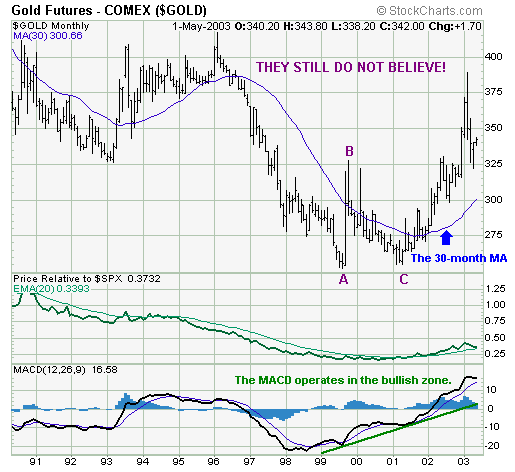
In order to provide perspective, we present gold's monthly chart
along with the 30-month moving average. Gold reached the bottom
of a 20-year bear market in August 1999 (A) at $252. A huge rally
followed, sending the yellow metal to an October 1999 high of
327 (B). Next, a dramatic pullback took gold to a low of 255
(C) in February 2001. Please note that this time bears were not
able to depress the price of gold below its previous low. This
was the point at which the real party started.
The best tool
to monitor the long-term market trend is the 30-month moving
average, which tells the whole story. The chart reveals that
for the first time since 1996, the 30-month MA of gold turned
up. Let's be clear here. This thing doesn't turn around very
often and when it does there must be powerful new forces at work.
From the standpoint of the market observer, the freshly turned
30-month MA (along with price of the commodity crossing above
this long-term average) means only one thing: a new bull market.
There is another sign which supports the bullish stance...
Gold stocks
are breaking out.
It's never easy to detect a new bull market. The latest gold
advance was accompanied by an army of sceptics who claim that
there is no longer place for the yellow metal in investors' portfolios.
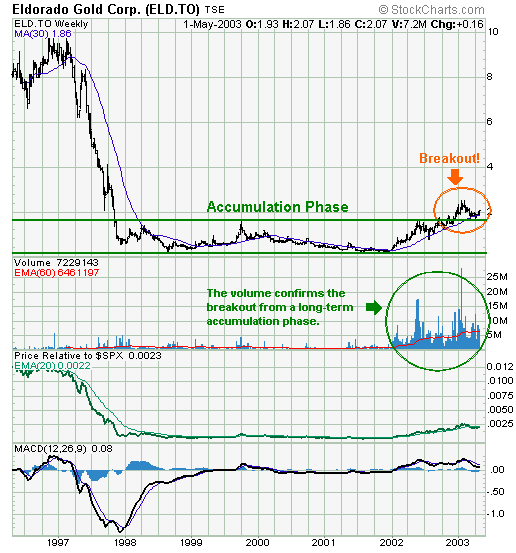
An examination of the market action of major gold stocks during
the last three years reaches totally different conclusions. Please
take a look at this example. The chart tells all.
Charts of the
majority of gold stocks show long-term accumulation patterns
and many stocks have already experienced long-term breakouts
similar to the one presented above. The evidence is here.
This new bull
market will have some fuel, or to be more precise, a small piece
of the $60 trillion estimate for all investment capital in the
world. A portion of this huge number will flow into...
Capitalization
of all mining stocks = ~ $100 billion. It's all about supply and demand.
Even if a small portion of the world's capital is being invested
in gold issues, the price of the stocks may move higher in an
unprecedented manner.
Part III The moment of truth
The most recent
intermediate-term correction in gold and gold stocks turned out
to be a pretty painful experience for the bulls. The dramatic
decline in the price of gold stocks belied the crucial fact that
the long-term bull market in gold is still intact. There is no
single piece of evidence suggesting otherwise.
Keep in mind
that the nature of every bull market is to disappoint and eliminate
the greatest number of investors. That's exactly what this young
gold bull market with its bellicose attitude does now. Many believers
are giving up, disappointed with the behaviour of gold stocks.
The stocks, however, are not being abandoned. They are, instead,
being constantly accumulated in a smart way, that is, without
unnecessary fireworks or publicity.
Those
who accumulate gold stocks know that "a waiting period"
may be long, that their patience may be tested to the limit,
but when the time comes the final payoff is going to be gigantic.
When the bull of all bulls returns, it will take only the most
loyal and most disciplined with it. Are you one of them?
-----------------------------------------------------------
Let's keep it simple. It's all about supply and demand.
Olaf Sztaba
April 29, 2003
E-mail: olaf@olafinvest.com
Website: www.olafinvest.com
About Olaf Sztaba
______________
321gold Inc Miami USA