Silver Set to Soar
as it did in the 1970s
Mark O'Byrne
GoldCore
Nov 3, 2009
Silver remains very undervalued
on a historical basis (charts below) and is undervalued even
against gold (chart below). While gold has begun to receive some
interest from a small minority of retail investors, silver remains
the preserve of relatively few contrarian investors and the media
and financial press rarely, if ever, covers silver. And yet silver
is quite likely in the intermediate stage of a bull market that
will rival or surpass that of the 1970s.
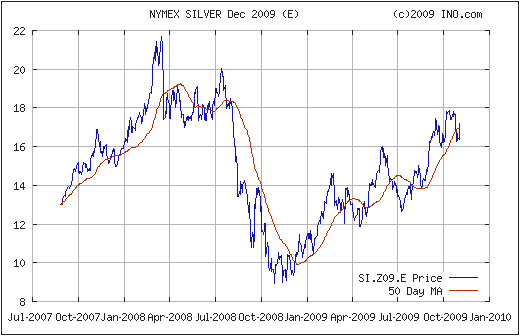
Silver is currently worth less
than $17.00 per ounce. It rose to a recent nominal high $20.88/oz
in March 2008. After an 18 month period of correction and consolidation,
silver looks set to challenge that high in the coming months.
We continue to be bullish on gold and particularly silver and
believe that silver will likely surpass its non inflation adjusted
high of $48.70 per ounce and its inflation adjusted high of some
$130 per ounce in the coming years.
Why Silver is in a Bull Market and
How High Could it Go?
Precious metals have
been the best performing asset classes in recent years with gold
and silver outperforming equities, property and most asset classes
over a 3, 5 and 10 year period. This outperformance looks set
to continue in the coming months due to the very bullish fundamentals.
The primary reason for our bullish outlook on silver is due to
the continuing and increasing global macroeconomic, currency
and geopolitical risks; silver's historic role as money and a
store of value; the declining and very small supply of silver;
significant industrial demand and perhaps most importantly significant
and increasing investment demand.
Gold, oil and nearly every
major commodity, stock indices and property market surpassed
their record highs in recent years. Favourable supply and demand
factors, continuing global macroeconomic and geopolitical risk
and concerns regarding the emergence of inflation and stagflation
as the massive global monetary and fiscal reflation affects the
value of fiat currencies all point to higher silver prices in
the long term.
In the 1970s silver rose from
under $1.50/oz in 1970 to nearly $50/oz in 1980. Thus, silver
rose by more than 25 times or by more than 2,400%. Were silver
to replicate its performance in the 1970s, it would have to rise
by more than 25 times again. The average price of silver in 2001
was $4.37/oz and a 25 fold increase would result in silver
rising to over $110/oz. While this price target may seem outlandish
to some, it is worth remembering that silver's record high in
1980 adjusted for inflation (according to US government inflation
figures) was some $130/oz.

SGS Inflation Adjusted
Silver Price (using more accurate government methodology of measuring
inflation that was used in 1980)
Admittedly, the final phase
of the silver blow off was a speculative bubble as the billionaire
Hunt brothers attempted to corner the silver market. Unlike in
1979, today there are hundreds of billionaires, some multi billionaires,
thousands of millionaires, hedge funds and many sovereign wealth
funds. Small allocations by any of these will see sharp moves
up in the price. Indeed, the silver market is so small that it
could very easily be cornered again (as appears to be happening
in the tin market in recent weeks).
Is Silver About Returns or a Hedge
Against Inflation & Systemic Risk?
Silver is a hedge against macroeconomic,
systemic and inflationary risk with the attractive added potential
for significant capital gains. Real asset allocation and prudent
diversification would be an important reason to have an allocation
to silver. Silver is highly correlated to the safe haven of gold
and is in effect a leveraged sister of the precious yellow metal.
Thus, informed investors use gold more for wealth preservation
purposes and silver in order to make a return.
Silver: Declining Supply
In 1900 there were 12 billion
ounces of silver in the world. By 1990, the internationally respected
commodities research firm CPM Group say that figure had been
reduced to around 2.2 billion ounces of silver. Today, that figure
has fallen to less than 1 billion ounces in above ground refined
silver. It is estimated that more than 90% of all the silver
that has ever been mined has been consumed by the global photography,
technology, medical, defence and electronics industries.
On current supply/demand trends,
the amount of above ground refined silver is projected to shrink
to even lower levels in the coming years. Industrial demand has
been outstripping mining supply for most of the last 20 years,
driving above ground supply to historically low levels. Few in
the investment world are aware of this important fact.
Silver production has been
flat in recent years while demand has been increasing. This hasn't
resulted in significantly higher prices yet because the world
has been able to fill the gap from inventories and official government
stockpiles.
However, today the U.S. government's
stockpile is all but gone, and sales from other official sources,
such as China, Russia and India, are declining, too. The decline
in refined silver stocks, from around 2.2 billion ounces in 1990
to around 300 million ounces today means that silver stocks are
near an all time low.
Very importantly, silver
is very unusual as its supply is inelastic.
This means that silver production
will not ramp up significantly if the silver price goes up. Supply
didn't increase significantly in the 1970s when silver rose more
than 35 fold in price - from $1.40/oz in 1971 to a high of nearly
$50/oz in 1980. Importantly, silver is a byproduct metal and
some 80% of mined silver is a byproduct of base metals. Higher
prices for silver will not cause copper, nickel, zinc, lead or
other base metal miners to increase their production. In the
event of a global stagflationary or deflationary slowdown, demand
for base metals would likely fall thus further decreasing the
supply of mined silver.
There are only a handful of
pure silver mines remaining - many with depleting reserves. This
inflexible supply means that we cannot expect significant mine
supply to depress the price after silver rises in price. It is
extremely rare to find a good, service, commodity or investment
that is price inelastic in both supply and demand. This is another
powerfully bullish aspect unique to silver.
Silver: Increasing Industrial Demand
Industrial applications for
silver have always been significant, but they have increased
significantly in recent years. Silver is used in film, mirrors,
batteries, medical devices, electrical appliances such as fridges,
toasters, washing machines and uses have expanded to include
cell phones, flat-screen televisions and many other modern high
tech devices.
Increasing industrial demand
for silver is forecast due to economic growth in China, India,
Vietnam, Russia, Brazil and other emerging economies in South
America, the Middle East and Asia. Growing middle classes are
now demanding the quality of life and standard of living enjoyed
by many in the West and thus the demand for silver will likely
increase.
Silver is known as the 'healthy
metal' and has many and increasing medical applications.
In a world that is showing
increasing concern about the spread of diseases and pandemics
such as swine flu, silver is being increasingly tapped for its
biocidal properties. Research is ongoing on the use of silver
and its compounds for therapeutic uses and on its potential use
as a disinfectant in hospitals and other medical facilities.
Increasingly, silver's antimicrobial
and antibacterial qualities are seeing it being used in all sorts
of medical applications and this looks set to become a very significant
source of demand in the coming years.
Silver has many unique properties
which make it ideal and indeed essential in global industry -
especially in the global photography, technology, medical, defence
and electronic industries. Yet, silver is a finite resource and
the supply of silver is increasing only very incrementally.
It is important to note that
silver, unlike gold, is heavily used in industry and because
of gold's much higher value, it gets recycled and all the gold
mined in the world ever is still with us but a huge amount of
silver has been used in photography, mirrors and other industrial
uses in the last 200 years. The low price of silver makes recovery
and recycling uneconomic.
Unlike gold, silver is like
oil - as it is consumed in these many industrial applications
it is gone forever.
Silver: Increasing Investment Demand
Investment demand for silver
has risen in recent years as investors concerned about the value
and safety of property, equities and deposits allocated funds
diversify to the finite commodities and currencies of silver
and gold. More recently, there have been increasing concerns
about the value of paper currencies themselves (voiced by many
including Alan Greenspan, John Paulson and George Soros) which
is leading to further diversification into hard assets and precious
metals.
There has been a marked increase
in investment demand for silver in recent years. Some of the
reasons why this trend is likely to continue are - the introduction
of ETFs that track the price of silver, a new global liquidity
bubble, the significant growth in the global money supply, the
proliferation of millionaires, ultra high net worth individuals
and billionaires, the proliferation of hedge funds and the exponential
growth in derivatives.
The Bank for International
Settlements has estimated that the total value of derivatives
contracts was $592 trillion at the end of 2008 (up exponentially
from $260 trillion in June 2006). Thus, dwarfing the GDP of the
entire world which was estimated at some $61 trillion at the
end of 2008.
There is still a debate as
to whether derivatives are a good or a bad thing. Alan Greenspan
recently warned they could lead to "cascading cross defaults."
Warren Buffett is similarly concerned and has warned that they
could trigger "serious systemic problems." Buffett
said that the derivatives genie is now well out of the
bottle, and these instruments will almost certainly multiply
in variety and number until some event makes their toxicity clear.
For this reason Buffett presciently
called derivatives "financial weapons of mass destruction"
in 2003.
Investors in silver bullion
coins and bars are hedging themselves against further deflation
and falls in property and equity markets. They are further protecting
themselves against rising inflation, possible currency devaluations
and still very prevalent geopolitical and macroeconomic risks
such those posed by the humongous global derivatives market.
Silver Undervalued Versus Gold
Silver is undervalued versus
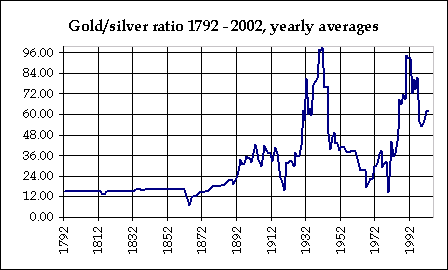
gold with the gold silver ratio at 60:1 ($1050oz/$17/oz). This
is particularly the case on a long term historical basis. The
long term historical average gold to silver ratio is 15:1 and
this is because it is estimated that geologically there are some
15 parts of silver in the ground for every one part of gold.
In 1980 the ratio nearly reached 15 ($850oz/$50oz=17) and the
average in the 20th century has been around 40:1.
Many analysts believe that
silver's ratio to gold will revert to its mean average, in [of?] recent years, below 40:1. Even if
gold only remained at some $1,000/oz this would see silver rise
to some $25/oz:-
($1,000oz/40=$25/oz).
A Picture is Worth a Thousand Words

A picture or a chart truly
is worth a thousand words and the chart above showing silver
prices adjusted for inflation shows how seriously undervalued
silver remains.
Conclusion
Silver is unique in terms of
being both a monetary and an industrial metal. Silver is priced
at less than $17/oz today. The average nominal price of silver
in 1979 and 1980 was $21.80/oz and $16.39/oz respectively. In
today's dollars and adjusted for inflation that would equate
to an inflation adjusted average price of some $60/oz and $44/oz
in 1979 and 1980. It is for this reason that we believe silver
will be valued at well over $50/oz in the coming years and silver
remains the investment opportunity of a lifetime.
GoldCore Recommendation
Prudent investors should have
an allocation to silver.
Buy Silver Eagles at the most
competitive prices for delivery or storage in one of the safest
international precious metal vaults in the world.
Silver Eagles are the official
silver bullion coin of the United States and are guaranteed to
contain one troy ounce of 99.99% pure silver. Since 1986 over
70 million American Silver Eagles have been bought by prudent
investors and savers. Silver Eagles have become the most popular
bullion coins in the world because of their beauty, quality and
the assurance of weight and purity by the U.S. Mint.
Silver Eagles are authorised
by the United States Congress and the American Silver Eagle bullion
coin may be used to fund Individual Retirement Accounts (IRAs)
and in many self administered pensions internationally.
Silver Eagles are issued by
the US Mint and are US dollar legal tender and can thus be imported
and stored in many jurisdictions (including with Via Mat Zurich)
without any VAT being applicable.
###
Mark O'Byrne
email: Mark.OByrne@goldcore.com
Please call
the GoldCore Bullion Services Team on:
(Irl) +353 1
632 5010
(UK) +44 203 086 9200
(US) +1 (302) 635 1160
Goldcore Limited
is regulated by the Irish Financial Regulator.
Goldcore Limited is registered in the Companies Registration Office
under Company number 377252.
Registered for VAT under number 6397252A.
Copyright ©2009 Goldcore Limited
321gold Ltd

|