   |
|||
We've All Been HadRob Kirby
Dim-Witted Deflationists Kirbyanalytics subscribers are already schooled on the inflation/deflation debate from a discussion and analysis laid out in the subscriber only version of Questions Begging Answers; but the following is a fuller discussion of the issue: The reason most mainstream market pundits are misreading 'where we are headed' is exactly because they have not acknowledged or accepted where we are and how we got here! Where we are headed is perhaps best summed up by Eric deCarbonnel in a treatise titled, How Deflation Creates Hyperinflation, where deCarbonnel "almost nails it" when he summarizes our current predicament,
Here is velocity defined by Wikipedia;
In the U.S. it is the St. Louis Fed who keeps 'official records' as to what the velocity of money is. The measure of velocity is captured in a monthly publication called Monetary Trends. Arithmetically it is measured by the equation:
Nominal GDP measures the value of current production in the monetary unit of the country. In an increasingly financial-ized economy where the growth in outstanding off-balance sheet notional derivatives [now measuring hundreds of trillions] has absolutely mushroomed since 1995 - nominal GDP does not and never has adequately attempted to capture or measure this. The OBSCENE growth in these derivatives, with the Fed's 'stooge surrogate institution' J.P. Morgan Chase leading the way, "IS" what predominantly has kept Wall Street fed for the past decade!!!! So how, in an increasingly financial-ized economy, can there be any valid reason for completely excluding them or their impact from nominal GDP? The point I'm trying to make is this; if derivatives were being accounted for in a just manner - the Numerator in the equation above would be much, much larger and measurable. Velocity would have been dramatically higher and flashing "red" signals long ago. Proper and just accounting / assimilation of derivatives into such measures as nominal GDP would have made a complete mockery of intentionally FALSIFIED [thank-you, John Williams] inflation data. Of course, monetary authorities are all-too-well aware of this. This, above all else, is why and how Alan Greenspan "fooled us all" - so frequently lobbying for there to be ZERO regulatory oversight of derivatives - it was all purposely designed to keep the focus and any intelligent discourse OFF derivatives!  So, perhaps the velocity of money is now falling or contracting in absolute terms; but from what level? [If my blood pressure "falls" from 250 over 175 to 200 over 125 - I would have falling blood pressure but would anyone claim that I have "low" blood pressure?] Scope of Derivatives The U.S. economy is financial-ized to the point where 5 institutions alone have created 175 Trillion worth of derivatives - quite a trick in a 13 Trillion economy, ehhh? 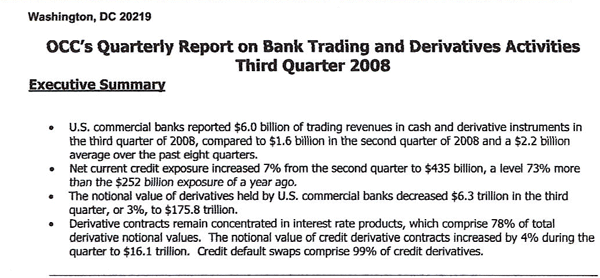  So, is it a stretch to say that the current production of the financial-ized U.S. economy "is" derivatives? So what share of this notional should we be adding to U.S. reported GDP [approx 13 Trillion] to adequately account for Derivatives? As it stands now, only revenue [8-12 billion per annum in fees] generated from trading these "off balance sheet" instruments is attributed - counted in bank revenues. But as we have learned in recent times; when things go awry with these instruments - many TRILLIONS of losses quickly materialize and migrate to these banks' income statements, negatively affecting GDP. Amazingly, folks who trade these instruments are widely referred to as "smart money", but the empirical evidence "screams" that these derivatives instruments are bought and sold [conjured] into existence by individuals who do not fundamentally know what they are worth. The dichotomy arises due to the manner in which mark-to-market accounting rules are applied - losses being crystallized and 'counted' on the income statement [negatively affecting nominal GDP] while gains are left to accrue off-balance-sheet where they are NOT MEASURED [no affect on measurable GDP], because doing so would be construed as a taxable event. This is and has been the root of a major dilemma in the accounting treatment of derivatives for YEARS. The fact that derivatives are treated in this fashion is not sound from a purely economic perspective but rather traditional from an accounting perspective. The observable implications are that these instruments always have had MUCH greater impact on nominal GDP than the current "practice" of recording trading fees as revenue only. It's all about gearing and the point from which you measure your base. Remember, for the past 15 years - right up until Q2/08 - these outstanding notionals have done nothing but mushroom - and in the past few years, leap by as much as 20 to 30 TRILLION in notional in a given year: 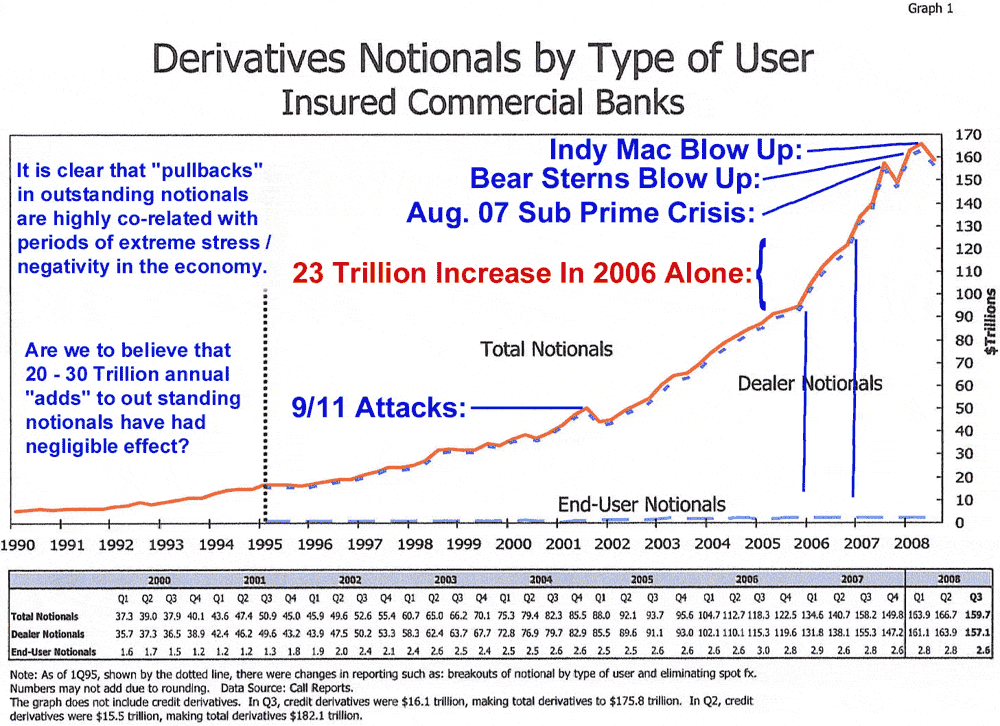 So then, what percentage of the growth of these outstanding notionals should be prudently attributed to GDP? Let's just say a small percentage of the growth in these notionals could amount to TRILLIONS in addition to annual nominal GDP. If measured, this would have had a material impact on reported numbers and quite possibly "red flagged" the inflationary spiral we are about to experience. You see folks; velocity of money, as it is currently measured, is no more honest-a-measure / accurate-determinant of inflation as Bernard Madoff was an honest stock jockey. What too many ignorant, compromised, or would-be-economists refuse to grapple with is the notion that ALL fiat money systems - like table cream - have "shelf lives". As Chris Martenson so eloquently sums it up,
Our current system has, arguably, already passed its expiration date. Derivatives have been used to obscure-the-curdles [rig markets]; but they cannot hide the rancid odor emanating from the rotting carcass of the fiat corpse of the Federal Reserve. Hence, "Velocity" as it is measured today - like CPI - is too low, and but another neutered and "unreliable" gauge in accurately determining anything - let alone inflation. I mentioned earlier that deCarbonnel almost nailed it; that's because he recognized the importance of a loss in confidence and its implications to velocity going forward. You see, the countless anecdotal reports from around the world reporting a global rush to physical gold bullion is empirical proof that confidence in "fiat money" is in the process of rotting-off-the-bone before our eyes. Here's what deCarbonnel says about the natural conclusion to this process,
Further adding,
Everyone should realize that fiat money - by its very design - has a PERFECT historical track record, where longevity is concerned, in that it has always failed - there are no exceptions. History dictates that pure fiat money systems generally have life-spans of 30-40 years. Folks would do well to remember that President Nixon closed the gold window in August, 1971 - meaning that our current U.S. Dollar-centric fiat money regime celebrated its 37th birthday back in August, 2008. One might hazard a guess that it would take some "real magic" for the current U.S. Dollar-centric fiat money regime to outlive its natural life-span. A Rabbit In Every Hat I'd like everyone to take note
of this revelation published in the UK's Daily Mail one week
ago: So, with that kind of impending financial calamity, back on Oct. 10, 2008, one might logically expect a rush to a safe haven play like gold bullion - and for the price to "really take off" in response - ehhh? Well, here's what happened to gold over those few crucial days: 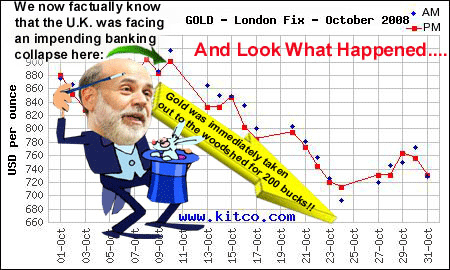 Now, I'm not sure sure how many more rabbits Sir Benedict of Benjamin Bernanke really has left in his sorcerer's hat - but the wretched odor emanating from its bowels bears an unmistabable and striking resemblence to vile, rancid, hubris. So, while everyone rejoices in the notion that "change has come to America" - I hope everyone takes time to remember the sobering thought; that while faces do change, the book remains the same!  Subscribers to Kirbyanalytics are educating themselves; not only about the merits of ownership of gold and precious metals - but valuable know-how on the merits of different forms of ownership as well as tips and guidance on the acquisition of physical precious metal. The remainder of this article for subscribers only contains larger picture issues in a section titled, Where This Is All Leading as well as new analysis of the recent oil price collapse. If you haven't got gold, you really have been had! Rob Kirby
Subscribe to the Kirbyanalytics News Letter; insightful proprietary economic analysis. Find out where we are headed -- subscribe here. 321gold Ltd |



 As world leaders gathered
over this past week for their annual wine-and-cheese ski-fest
in Davos, Switzerland - perhaps we, the little people, should
all take-stock [or a forensic account, perhaps?] of the cards
we've been dealt.
As world leaders gathered
over this past week for their annual wine-and-cheese ski-fest
in Davos, Switzerland - perhaps we, the little people, should
all take-stock [or a forensic account, perhaps?] of the cards
we've been dealt. email:
