From Bailouts to Boondoggles,
Betting on a 'B-Wave' Rally
Kurt Kasun
Feb 9, 2009
The following commentary
is a follow-up to One of Two Scenarios
is Developing.
First, again I would like to
make clear that I do not consider myself a trader or credentialed
technician (chartist) and I prefer to focus on the longer term.
But, as I stated in the referenced commentary above which I wrote
two weeks ago, it appears that one of two patterns is emerging,
and depending on which one prevails, it could determine how you
should position your portfolio over the next few years.
Starting with the price of
gold, it did in fact run quite quickly to $925/oz. before selling
off to its breakout price, just above $875/oz. As I write this,
gold is sharply once again up in an overall down market, but
finding stiff resistance at $925. A close above $930/oz. would
signal another "buy signal" on the expectation that
the March 2008 highs (over $1000/oz.) would be challenged in
short order. Goldbugs should be mindful that the a sustained
rally is not "in the clear" and a close below $880/oz.
would call into question this "pennant breakout" of
which a growing chorus of traders remind us in the financial
media. As one who is long gold, I would have preferred to have
seen the breach of the pennant occur on lower sentiment indicators
(too much positive sentiment). But things tend not to play out
exactly to script.
Regarding the popular averages
last week's S&P 500 move above 850, it can be characterized
as nothing more than a false breakout. As I write this, the average
is making another attempt to pierce through the 850-level. A
failure to make it through this time, or even worse, a "lower
high" would be bearish and likely set the stage for a move
back down toward 800. I don't like tests that fail.
A failure for gold to move
through 925 coinciding with the S&P 500 stalling at 850 would
call into question an "intermediate term reflation trade"
and lend support to the "resumption of the meltdown".
Read below to see why my money is still on the reflation trade.
Signs Point Towards a Reflationary
"B-Wave"
A chart of the Dow Jones Industrial
Average dating back to the 19th Century strongly suggests that
we have completed the fifth and final wave of a major up-cycle.
The two down waves, the second and fourth of the five-wave cycle,
occurred in the 1930s and 1970s, respectively. A downward "A-B-C
chart pattern" tends to occur after a fifth major up wave
has completed. The first "A-wave" seems to have been
marked by the move from the highs registered in October 2007
to the lows in November of 2008. If the "A-B-C pattern"
is to unfold as expected, then we should expect a counter-trend
"B-wave" up- rally before the final "C-wave"
down occurs. The "final C" should exceed the previous
lows established by the first "A-wave" down. C-waves
have a tendency to drop all of the way back to where the major
fifth-wave began. That would mean that the DJIA could retrace
all of the gains of the last 30 years and dip all of the way
back down to 1000-level.
Here, I wish to emphasize that
a dip to that level is possible, but is not a certainty. For
those who are quick to reject this "Elliott Wave Analysis"
I would suggest that you reconsider. I know for a fact that institutional
investors who manage billions of dollars pay very careful attention
to these chart patterns (among many other technical indicators).
Turning away from technical
analysis and back to fundamentals for a moment, the evidence
for strong and sustainable rally is forming. Please note that
most who "buy-into"/participate in the anticipated
rally are not thinking "B-wave rally coming", rather
they will be convinced that "the bottom" has been reached
and that they do not want to miss out on the start of the next
bull market. Otherwise, if everyone were thinking that the rally
was not long term in nature, then they would be quick to exit
and the rally would never get off of the ground. This likely
explains why the expected B-wave rally is so delayed in occurring.
But now with money being thrown
around like confetti - 2 trillion to bailout the banks and one
trillion for our politicians' favorite pet projects, all in the
name of stimulus - bond yields are moving higher once again with
the yield-curve is steepening. The Baltic dry freight index,
the price of oil, gold, grains, and other commodities are all
moving sharply higher, bouncing off their November lows. The
dashboard indicators are turning bullish as Wall Street eagerly
awaits the next banking bailout plan, destined to achieve the
same miserable fait as the preceding ones. Misplaced optimism
appears poised to rear its gullible head once again and will
likely lure the trillions of dollars parked in the bond market
and short-term money market accounts out their safe harbor and
into the inferno of money hell again in the form of a bear market
rally.
This could be the beginning
of "collapse of today's bond market bubble" and signal
the next phase of a "staggering rise in government debt"
as Carmen Reinhart and Kenneth Roggoff in their Wall Street
Journal editorial titled "What Other Financial Crises
Tell Us" assert:
"Perhaps the most stunning
message from crisis history is the simply staggering rise in
government debt most countries experience. Central government
debt tends to rise over 85% in real terms during the first three
years after a banking crisis. This would mean another $8 trillion
or $9 trillion in the case of the U.S... Needless to say, a near
doubling of the U.S. national debt suggests that the endgame
to this crisis is going to eventually bring much higher interest
rates and a collapse in today's bond-market bubble. The legacy
of high government debt is yet another reason why the current
crisis could mean stunted U.S. growth for at least five to seven
more years."
I think it is safe to conclude
that stunted growth and higher-bond yields are quite bearish
and set the stage for the final "C-Wave" down. This
is not "priced-in" as the perma-bulls continue to wrongly
and tirelessly assert.
Welcome to 'Club Goldbug'
Perhaps one of the most compelling
longer-term charts which I use to confirm my fundamental analysis
is the one provided by www.sharelynx.com
below.
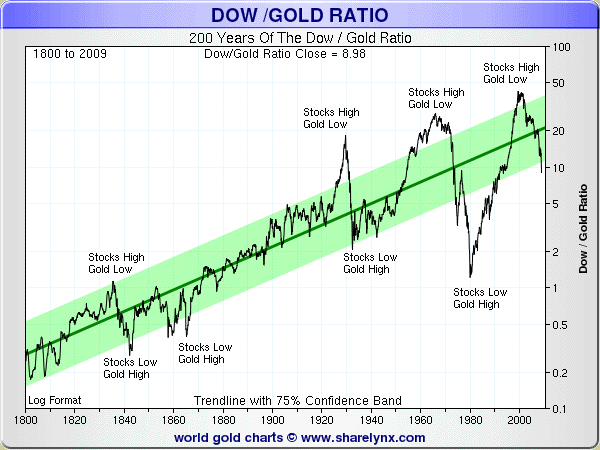
In a nutshell this chart suggests
that since the establishment of the Federal Reserve almost a
century ago, they have enjoyed success and failure in reflating
the economy: success as indicated when the Dow/Gold ratio is
moving higher and failure when it is moving lower. You can see
the relative stability of the relationship dating back to 1800
up until the 1920s. You can also see the pattern of a megaphone
forming shortly after the formation of the Fed. Extending the
line forming the bottom of the megaphone, we can expect the Dow/Gold
ratio drop to somewhere between 0.5:1 and 1:1 before turning
up again. This would undoubtedly wreak further havoc on an already
broken world fiat currency regime as money flees treauries and
equities and flocks into gold. Would it not be poetic justice
were a moumnetal change in the world's monetary system to occur
on the 100th anniversary of the creation of the Federal Reserve
in 2013?
We are starting to see some
mainstream economists acknowledge this looming reality. Quoting
Richard Duncan, in an essay appearing in October's Far Eastern
Economic Review titled "Time to Dump the Dollar Standard",
he makes the following points:
- The torrent of dollars unleashed
by the U.S. trade deficit fueled ever larger bubbles around the
world as credit expanded without limit. A crisis too big to be
inflated away has inevitably arrived.
- Why is the global economy
in danger of collapse? So far explanations have focused on the
proximate causes, like banks' imprudent mortgage lending and
use of complex financial instruments. But behind these missteps
lie deeper problems with the world's financial system, flaws
that made a crisis of this magnitude inevitable.
- The Austrian School of Economics
has long warned of the dangers of fiat money and excessive government
spending. Their warnings were mostly ignored in the Anglo-Saxon
world. The 37-year experiment in fiat money and floating exchange
rates has just come to a disastrous end. The lesson that policy
makers must learn from that experiment is that "free market"
capitalism under a paper money regime does not produce the same
benefits as true free market capitalism (free from government-created
money) does under a gold standard. Instead, it corrupts or overwhelms
a country's institutions and regulators, and ultimately ends
in catastrophe.
Another noted economi c historian,
Naill Ferguson, who Pimco CEO and co-CIO of PIMCO Mohamed El-Erian
says "... has an ability to understand both current issues
and historical trends. He reminds people that a catalyst for
a significant market move can be quite small. The smart money
likes to have a historical perspective," is quoted in December's
issue of Vanity Fair asking in an essay titled "Wall
Street Lays Another Egg, "Those few goldbugs who always
doubted the soundness of fiat money - paper currency without
a metal anchor - have in large measure been vindicated. But why
were the rest of us so blinded by money illusion?"
He spends the next several
pages attempting to answer the question - with a unique combined
understanding of historical cycles and trends and macroeconomics.
Perhaps his answer can somewhat be summarized in the following
passage:
This is no new insight. In
the 400 years since the first shares were bought and sold on
the Amsterdam Beurs, there has been a long succession of financial
bubbles. Time and again, asset prices have soared to unsustainable
heights only to crash downward again. So familiar is this pattern
- described by the economic historian Charles Kindleberger -
that it is possible to distill it into five stages:
(1) Displacement: Some change
in economic circumstances creates new and profitable opportunities.
(2) Euphoria, or overtrading: A feedback process sets in whereby
expectation of rising profits leads to rapid growth in asset
prices. (3) Mania, or bubble: The prospect of easy capital gains
attracts first-time investors and swindlers eager to mulct them
of their money. (4) Distress: The insiders discern that profits
cannot possibly justify the now exorbitant price of the assets
and begin to take profits by selling. (5) Revulsion, or discredit:
As asset prices fall, the outsiders stampede for the exits, causing
the bubble to burst.
The key point is that without
easy credit creation a true bubble cannot occur. That is why
so many bubbles have their origins in the sins of omission and
commission of central banks.
Post Boondoggle
Perhaps the economists desperately
trying to apply the stimulus to economies around the world will
succeed through a brew of supply-side and Keynesian solutions.
We continue to place our trust in their expertise and 'experiments'.
So far their efforts have resulted in one disappointment after
another. I tend to agree with Richard Duncan - "a crisis
too big to inflate away has inevitably arrived". Whenever
I see the Treasury Secretary, Federal Reserve Chairman, or official
economic spokesmen (in both the Bush and Obama administrations)
boldly advcocate their plan, I am reminded of the phrase "The
best-laid plans of mice and men/often go awry."
In a recent article written
by Michael Pento, Any Hope
for Job Growth? he keenly observes that "Growth
does not come from money printing or government deficit spending.
It comes from encouraging the private sector to create new technologies
and innovations that expand the amount of goods and services
available for consumption... Investors understand real growth
and they understand that some things take time and cannot be
forced or manipulated to occur by a central planning authority.
They understand that the private sector is best at creating jobs
that are viable and accretive to economic growth."
Democracies around the world
are demanding action, with riots occurring in places you would
have never imagined. Government officials and politicians are
not going to sit idlely by and allow the free market to work,
despite the fact that their solutions will likely inflict more
harm. You can rest assured that we are going to test the limits
of government debt in addressing our financial and economic travails,
as professors Rogoff and Reinhart caution us.
Feb 6, 2009
Kurt Kasun
email: KKasan@greenfaucet.com
Kurt Kasun is
strategically located in Washington, D.C., a key to maintaining
contacts and relationships which help Kurt understand global policy
and economic factors as they emerge. His investment approach has
always been macro in nature largely due to his undergraduate studies
at the U.S. Military Academy at West Point (B. S. National Security,
Public Affairs, 1989) and his graduate studies at George Mason
University (M.A. International Commerce and Policy, 2006).
321gold Ltd

|