Home Prices: More Downside To Come
Ronald R Cooke
The Cultural Economist
Posted May 6, 2009
A little over a year ago I compiled a spreadsheet of data on residential real estate and concluded from the scenario it produced that American single family home prices would decline – on average - by more than 30% from their high point in July of 2006. The February 2009 release of Standard and Poor’s Case-Shiller Home Price Indices suggest residential real estate prices have indeed declined by more than 30% in 20 metropolitan areas. (R1)
Good call. The assumptions used to construct my scenario proved to be correct. But that’s yesterday’s news. Investors, government officials, and just about every home owner or buyer wants to know : where do we go from here? To find out, I again fired up my trusty spreadsheet.
The short answer : the American residential real estate market will continue to decline.
The bad news is that 6 of the 20 markets in the recent Case/Schiller survey appear to be declining at a rate of more than 3% per month, and 9 markets are apparently declining at a rate of more than 2% per month. The good news is that the 5 remaining markets appear close to a bottom. The following graph of Case/Schiller data shows average residential prices declined by ~11% from March 2007 – February 2008. This was followed by a decline of ~17% during the March 2008 through February 2009 period. My scenario projects a further decline of ~ 8% between March 2009 and February 2010.
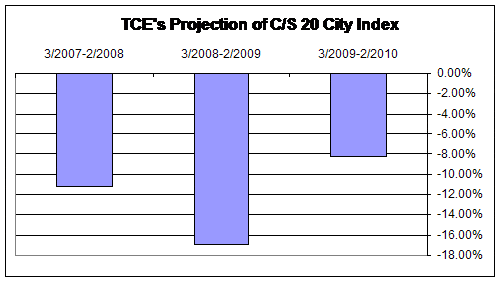
Based on my extension of the Case/Schiller 20 city composite index, and if everything goes well with the economy, it would appear the total national average price for a single family home will decline by ~38% from its high point in July of 2006. The bottom should be reached in 2010. Caution: these are not predictions. This is a possible scenario based on an analysis of existing data.
In order to improve on this scenario, one would have to make some very optimistic assumptions about employment and recovery.
Generally speaking, unemployed people are more likely to be renters, rather than buyers. Before a given real estate market can reach stability, excess real estate inventory that can not be sold to home owners has to be purchased by investors and converted into rental units. As I have discussed before, per square foot home purchase prices have to decline until they achieve a parity with the capitalized per square foot value of local home rental prices, before they (theoretically) become an attractive investment. (R2) Growing unemployment will continue to put downward pressure on home prices until rental parity is achieved.
In my opinion, TARP funds and other government stimulus efforts will not do much for local real estate markets. And if they fail – as is likely - then my scenario is much too optimistic. (R3) Throwing money at Wall Street and our banking system in the vain hope it will somehow help home prices is a really dumb strategy.
Neither Congress nor the Administration
appear to understand.
Local real estate problems are solved
one property at a time.
This is bad news for home owners. If we want to help main street, then we need to mobilize local real estate brokers, appraisers, lenders, trades people, and communities to get the job done. If the Federal Government had implemented a troubled asset program like the one I outlined in 2008, our residential real estate market would be in much better shape. (R4)
Although there are any number of alternative scenarios that could be used to describe the trend of American residential real estate prices, it would appear the downside risk will continue to be greater than the potential upside gain well into 2010. This is especially true if Federal policy fails to resolve the banking crisis. On the other hand, money supply expansion and/or a spike in oil prices will be highly inflationary. In this alternative scenario, hard assets, like good quality residential real estate, would increase in value.
So. What to do? It is prudent to assume some additional decline in residential real estate values within most – buy not all – markets. If you plan to invest in residential real estate rental properties, be sure the capitalized value per square foot is competitive with rental price trends in the surrounding neighborhood. If you don’t know how to do this, don’t invest. If you are buying a property for your own home, focus on property quality. In both cases, focus on the three most important elements of future value - location, location, and location – and keep your eye on inflation.
Every real estate market is unique, and so are its values.
***
Notes
R1: Housing price data is from Standard and Poor’s Case-Shiller Home Price Indices, a 20 city composite index. The S&P/Case-Shiller Home Price Indices measures the residential housing market, tracking changes in the value of the residential real estate market in 20 metropolitan regions across the United States.
R2: For more analysis, see “Home Prices: Where is the Bottom?”
http://tceconomist.blogspot.com/2009/01/home-prices-where-is-bottom.html
R3: According to a recent Federal Reserve report, most American banks (over 70%) expect loan delinquencies and losses to increase this year. Surveyed banks also reported they were making it tougher for consumers to get prime residential mortgage loans, despite hording over $1 trillion in cash (including injections of taxpayer money).
R4: See “Banks: Bleeding Value and Hiding Desperation”
http://tceconomist.blogspot.com/2008/03/banks-bleeding-value-and-hiding.html
Ron
Ronald R. Cooke
website: The Cultural Economist
email: tce@tce.name
About The
Cultural Economist - Ron graduated with an A.B. in Economics from
Bates College. He has been an auditor, line manager, computer
salesman, marketing manager, product planning manager, and V.
P. of Marketing. A management consultant by inclination, Ron
has a comprehensive background in business development, product
planning, market research, and industry analysis. He has authored
multiple market research reports, contracts, business plans and
operations research studies for corporate clients in 12 countries.
Prior experience includes technology assessment, the evaluation
of corporate financial performance, and the negotiation of corporate
acquisitions.
Ron is a former
instructor with UCSC, and developed the curriculum for a science
based approach to decision analysis. He has pursued the study
of Cultural Economics since 1969, and has authored "Oil,
Jihad and Destiny," [Amazon,] a thought-provoking
research report on oil depletion (Opportunity Analysis - 2004,
and revised in 2007), and "Detensive Nation," a book
that redefines the role of government in an Energy Detensive
EcoSystem (The Cultural Economist - 2007).
321gold Ltd

|