 Gold's Crazy Action Gold's Crazy Action
in the Week of 12/16/05
The Casey Files
By Bud Conrad for Casey Research
The
International Speculator
Dec 21, 2005
In the week ending December
16, gold ran up to $540/oz and then thudded back to $500. But
that's not all that happened. Volume jumped in a big way on the
COMEX and also on the TOCOM (Tokyo Commodity Exchange). The chart
below shows the price of gold in yen, the big volume and the
big price drop. What's going on?
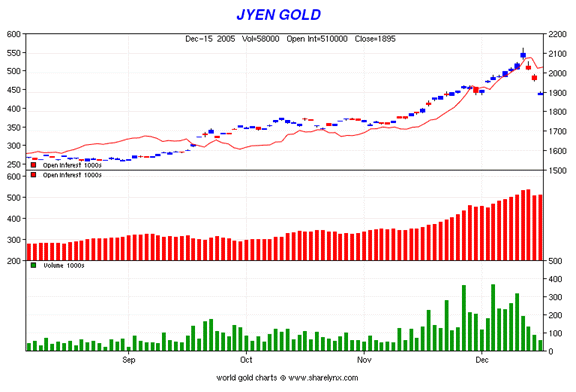
It's another indication that
for gold, times have changed: Japanese investors have become
busy players, doing most of their trading at the TOCOM, where
last week's limit-up price movements were followed by limit-downs.
Trading limits (how far settlement
prices can move in a day) are imposed by futures exchanges to
give traders on the losing side an extra day to settle in cash.
When a limit is reached, trading stops. Such events are rare
and usually mean that something abnormal is affecting a commodity.
This time the limit moves in
Tokyo were accompanied by big trading volumes. In the U.S., the
COMEX has also been experiencing unusually large delivery volumes,
a red flag that there is new demand for physical gold. Speculators
who just want to trade on the price are being joined by others
who want to own physical gold. But what has been stirring up
the action?
One clue is what happened last
week in the foreign exchange market-the biggest rise in the yen
in months, from $0.8370 to $0.8733.
The run-up to $540 per ounce
looked like a market out of control. One source of the action
is believed to be hedge players who were borrowing yen to buy
gold. The yen interest rate is still close to zero for short-term
credit, so the cost was small. And with the yen on a weakening
trend for most of 2005, the net cost of borrowing has often been
negative. As the yen depreciated from 105 to 120 to the dollar,
the borrower was able to pay off in depreciated yen, which added
to the profit for a dollar-based customer.
The other part of the maneuver
was gold, which in Tokyo can be traded with enormous leverage.
The one-kilo contract on the TOCOM (covering gold worth about
2,000,000 yen) requires a margin of just 25,000 yen. That's leverage
of 80 to 1! As gold was driven higher, this was a big-win opportunity
for a hedge play on both ends of the transaction. Now you have
the tinder for wild extremes, and the fires were burning, as
seen in the limit-up moves at the TOCOM and prices $30 above
New York.
As the week progressed, no
one knew where gold might run, having come up from just $420
in the summer. On Tuesday, the Fed raised the fed funds rate
a quarter of 1 percent, with little reaction until the sun rose
in Tokyo on Wednesday. On Monday, the TOCOM had doubled the margin
requirement for its gold contract, effective on Wednesday. Changing
the rules scares a market. http://www.tocom.or.jp/news/2005/20051212_02.html
Look at the intraday chart
comparing gold with the yen. The yen-gold carry trade was socked
on both ends.
The picture shows gold crashing
and the yen jumping up through the week.
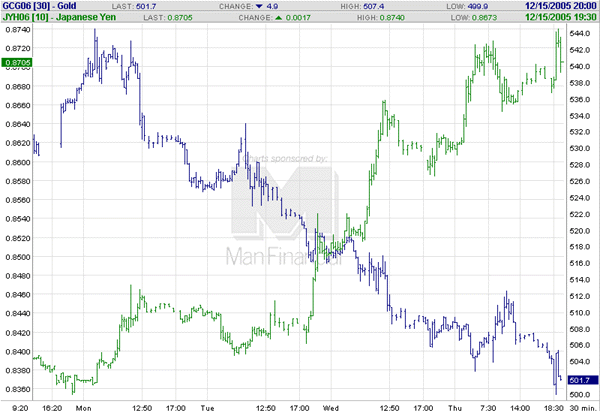 (Courtesy FutureSource)
My reading is that the managers
of the world markets, who have an interest in keeping gold contained,
took action to slow its rise. The evidence in the cross of the
yen against gold suggests that this big carry trade was forced
to liquidate, in a self-reinforcing retreat. Seeing that the
short-term run was about to abort, the hot money quickly dumped
positions. The chart shows the dumping of gold and the yen's
rise in the big movement for the week.
Has this done any real damage
to gold? The answer is no. It might even be evidence that bankers
and regulators who wanted to see gold stall needed to fire all
their guns. But delay is the most they can accomplish. The underlying
forces of government deficits in both the U.S. and Japan that
are diluting the value of paper currency are still far more powerful
than any disturbance from hedge fund unraveling.
A tougher question is whether
this hit to gold will affect the still big speculators, such
as the so-called "Non-Commercial Speculators" (identified
in the Commodity Futures Trade Commission's Commitment of Traders
report as holding large, long positions). This is a group that
can move markets, and many of its members tend to be trend followers.
If last week's jog was big enough to force unwinding by the highest-leverage
yen-gold carry traders, could the effect roll over to the Big
Specs? The jury is out on that, as gold ended the week a few
dollars up on Friday. The carry trade has been put out of business,
but the direction of the Specs is unknown.
The biggest players, of course,
are the biggest holders of gold; the world's central banks, and
they have been negative on gold for years. But there are signs
of change, as central bank holdings of dollars grow uncomfortably
large and inspire thoughts of diversification.
The theoretical questions are
whether bubbles can be detected and, if so, should they be popped?
Greenspan's position is that bubbles can't be recognized when
they are occurring and are best dealt with afterward, (as opposed
to being managed preemptively). In the stock market boom of the
1990s, Greenspan fretted publicly about "irrational exuberance,"
yet refused to raise stock market margin requirements (which
the Fed controls), properly fearing a stagnation similar to what
Japan was suffering.
The Fed's new head, Bernanke,
hasn't revealed his position on the bubble questions, but his
review of the 1929 crash with a Friedmanite criticism of the
Fed as the culprit of the depression indicates that he did not
focus on the stock market bubble of the late 1920s as a source
of trouble. That means he may not understand the bubbles ahead.
Did TOCOM's management take
on the job of bubble bursting? Oddly, there the futures exchanges
are their own regulator, and that partly explains the 80-to-1
leverage compared to the 2-to-1 margin requirement the Fed imposes
on the U.S. stock market. A fair read on TOCOM's actions is that
their increase in margin merely caught up with appreciation in
the underlying contract. But the timing and results indicate
that TOCOM management was indeed operating on bubble alert.
This incident has come and
gone, but it marks an escalation in the forces driving gold.
The tsunami hasn't been cancelled. What we saw last week was
just a blip on the way to much higher gold prices by the end
of next year.
-Bud Conrad
for Casey Research
About the Author: Bud Conrad holds a Bachelor of Engineering
degree from Yale University and an MBA from Harvard. Among others,
he has held positions with IBM, CDC and Amdahl. Currently he
serves as a local board member of the National Association of
Business Economics and teaches graduate courses in investing
at Golden Gate University.
His data and analysis regularly
appears in the pages of Doug Casey's International
Speculator, which is dedicated to uncovering gold and
silver stocks with 100% or better profit potential... and in
the pages of the Casey
Energy Speculator, which provides coverage of undervalued
emerging energy stocks. For more information, click
here.
Copyright Bud Conrad December
2005 for Casey Research
The author can be reached
at BudConrad@earthlink.net
321gold Inc

|