 Bullion Coin
Pricing Bullion Coin
Pricing
Coin Premiums
Michael B. Clark
Dec 6, 2007
Have you ever noticed that
two bullion coins which contain exactly the same amount
of the same precious metal, can sometimes sell for a different
price?
For example, at the time of
this writing, the spot price of gold is $787.50 per ounce. Yet,
numerous dealers quote a selling price of $830.80 for the one-ounce
American Gold Eagle, $826.90 for the one-ounce Canadian Gold
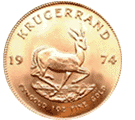
Maple Leaf, and $819.00 for the one-ounce South African Gold
Krugerrand.
Why might this be? After all,
each contains exactly one ounce of gold. Should not an ounce
of the same precious metal, like shares of the same company stock,
always have one price at any given time?
Certainly, it seems like it
should be that simple, but with precious metal bullion coins,
it is not. The fact is that an ounce of a given precious metal
- be it gold, silver, or platinum - can, for a variety of reasons,
cost either more or less than another ounce of the same metal
in the same market.
Where does the
additional cost for these gold coins come from in the first place,
and why do the amounts paid for the Gold Eagle, Maple Leaf and
Krugerrand all differ, even though each contains the same amount
of gold?
Well, it's all about a pricing
thing called "coin premiums."
A premium is the additional
cost of a bullion coin above and beyond the market value of the
precious metal commodity it contains. For example, with gold
at a spot price of $787.50 as mentioned above, an investor can
expect to pay a premium of $43.30 over the gold price to buy
the one-ounce American Gold Eagle. On the other hand, at the
same spot price, an investor will pay only a $39.40 premium (approximately
half a percent less than the Eagle) for a one-ounce Gold Maple
Leaf, and only a $31.50 premium (or 1.42% less) for the one-ounce
Gold Krugerrand.
In general, this additional
cost over the spot price for any bullion coin stems from a number
of factors, including the manufacturing, distribution, and administration
costs incurred by the mint or refiner in making the coin, plus
a "mark-up" representing the cost of sale and the profit
for the wholesaler selling the coin to a retail dealer. The retail
dealer, in turn, will also "mark-up" its wholesale
price of the coin to cover its own sales costs and realize a
small profit when selling the coin into the investor market.
This series of incremental
price increases applied to the coin as it passes through the
distribution chain is a typical market mechanism present in virtually
every other industry in existence, from food to auto parts, and
houseplants to sporting goods.
And, just as market forces
of "supply and demand" largely determine the value
at which all goods and services can be sold in their respective
markets, the level of a given coin's availability (supply) versus
its popularity (demand) also directly influences the prices at
which different coins will sell for in the market place, even
though they may contain the same amount of the same metal!
In fact, in some unusual market
conditions, the available supply of a given coin, when balanced
against its market demand at any given time, can have a pronounced
impact on the coin's premium. Unusual demand for a specific coin
type can drive its premium level significantly higher
than that of very similar coins in certain circumstances.
Such a disparity occurred between
the American Eagle and the Canadian Maple Leaf bullion coins
at the end of 1999, when concerns over potential Y2K-related
computer debacles created widespread fear about the stability
of the US banking system and world economy as the new millennium
approached. This fear, in turn, led to an unprecedented demand
for U.S. American Eagle Silver coins, in the belief that their
owners could spend these U.S. government-guaranteed bullion coins
in the surviving economy for the food and other necessities they
would require to live should the banking system fail. At the
same time, the Silver Maple Leaf legal tender bullion coins,
which not only contain the same amount of gold and silver, but
were minted in higher purities, were left sitting in dealers'
vaults.
Specifically, in late 1999,
the premiums for the 99.9% pure (i.e., "3 nines fine"),
one-ounce Silver Eagle coins were at one point 300-400% higher
than were the premiums on the 99.99% pure (i.e., "4 nines
fine") one-ounce silver Canadian Maple Leaf coins, even
though the price of the one-ounce of silver they contained changed
very little during the period. While the prevailing spot price
of silver averaged about $6.50 per ounce during this time and
the price of the silver Maple Leaf remained in the $7.50 vicinity,
inordinate demand drove the price of the Eagle to more than $12.50
per coin at one point. Astonishingly, many investors were willing
to pay up to four times more in premium costs than they had to
for a silver bullion coin in the belief the American Eagle would
be readily negotiable in whatever economy might be functioning
in post January 1, 2000 period.
[Note: these inflated premiums
collapsed to their more rational market levels immediately after
January 1, 2000, when it was clear that an economic and banking
Armageddon was not going to occur.]
On the other hand, a lack
of market demand, or the outright dumping of a particular
coin by market participants, can create a negative premium, causing
the coin to sell at a price that is actually less than the current
"spot price" of its metal content. This is what happened
to the gold Krugerrand when its importation into the United States
and numerous other countries was banned by many national governments
in 1985 to demonstrate their countries' displeasure with the
former apartheid policies of South Africa, the home of the Krugerrand.
Few investors wanted to buy the Krugerrands that continued to
trade in local markets, and dealers would only buy them at prices
discounted below the prevailing "spot" price of gold.
It was truly one of the few times that gold - in the form of
Krugerrands -- has traded in the market below the spot price.
In fact, as noted at the outset
of this article, though its premium has long since been positive,
the Krugerrand continues selling at a lower premium than do the
Eagles and Maple Leafs, reflecting its diminished popularly among
investors and dealers still today.
Because coin premiums can vary
significantly among coins and in different market conditions,
they are an important aspect for buyers of bullion coins to understand
today. Investors are well advised to inquire about and compare
coin premiums before making their purchase of bullion coins.
And as always, it is best to seek the advice of a reputable and
trusted bullion dealer concerning any aspect of precious metals
investing.
Michael B. Clark
email: info@gold.ie
Michael B.
Clark is a consultant to Gold and Silver
Investments
Limited, Ireland's Asset Diversification and Wealth Preservation
Specialist. He is the President of Solidus Associates, LLC
of Wilmington, Delaware, and has served in the precious metals
industry for 25 years. He oversaw Deak-Perera's Precious Metals
Certificate Program, America's largest precious metals investment
program, in the early 1980s. Later he became Vice President of
Precious Metals at Wilmington Trust Company, and President of
both Delaware Depository Service Company and First State Depository
Company. He obtained licenses for Wilmington Trust and DDSC to
operate as Nymex and Comex depositories.
321gold Ltd

|