 Physical Bullion
Investments Physical Bullion
Investments
Should You Own PMs in a Retirement Account?
Michael B. Clark
Sep 28, 2007
In recent years, a growing
number of countries have permitted their citizens to establish
personal retirement accounts and allow them to choose the investments
they may hold, including precious metals. But should an investor
include a precious metals component in his or her long-term investment
plan? And if so, how does one decide which precious metal investment
product to own for retirement purposes?
Introduction
In the mid 1970s, the United
States Congress enacted the Employee Retirement Income Security
Act (ERISA), which among other things, created the Individual
Retirement Account (IRA) for American workers. The purpose of
the IRA was to enable individual Americans to save for retirement
on their own in special tax-deferred, personal investment accounts
available through commercial financial institutions, and allow
workers who changed jobs to preserve their employer-sponsored
retirement plan assets by permitting them to transfer (or "roll-over")
their plan balances into IRAs.
Over the past several decades,
the IRA and other so-called "self-directed" personal
retirement plans, such as the 401k, have grown immensely popular
among American workers, as they've been modified to include greater
flexibility and expanded investment choices. In 1986, for example,
the U.S. Tax Code was amended to allow IRAs to hold American
Eagle Gold and Silver bullion coins, in addition to equities,
fixed income, real estate investment trusts (REITS) and money
market investments. These options were broadened further in 1997,
when Congress also authorized the inclusion of investment grade
gold, silver, platinum, and palladium bullion bars and coins
in IRAs. More recently, other countries have followed suit. For
example, Canada created the Registered Retirement Savings Plan
(RRSP) several years back, and England recently established the
Self-Invested Personal Pension (SIPP) as personal retirement
savings vehicles for their respective investing citizens. Each
of these plans permits precious metals investments, as well.
Precious Metals As Retirement Assets
There are many advantages to
including a precious metals component within one's retirement
investment portfolio. For example, because precious metals are
negatively correlated to "traditional" investments
like stocks and bonds - that is, their market prices tend to
move opposite those of stocks and bonds -, studies have shown
that portfolios having modest amounts of precious metals exposure
will experience less overall volatility and greater long term
returns than will those same portfolios without the precious
metals included. Also, owning precious metal investments can
further diversify one's retirement holdings by adding a tangible
asset that, unlike stocks and bonds, has inherent (i.e., innate)
value.
And another important consideration,
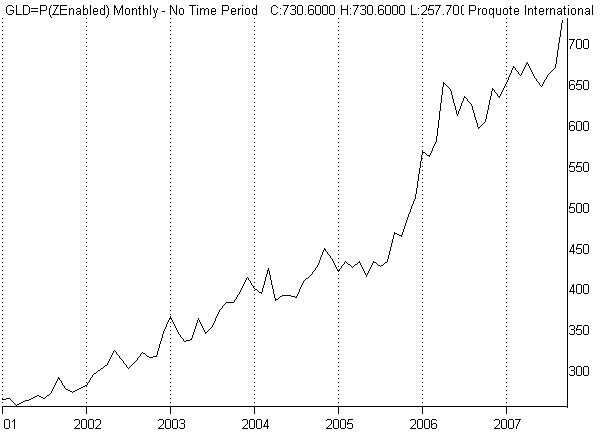
particularly in light of the seven-year precious metals bull
market we are currently experiencing - the gold price has increased
on average more than 15% annually over the past seven years -
is the fact that while one may pay income taxes on withdrawals
from the account once retired, the market gains made on precious
metals investments held in a retirement plan are exempt from
capital gains taxes. The value of this provision is further highlighted
when one considers the fact that in America, gains of precious
metals, including ETF's, held outside of an IRA are taxed at
the 28% "collectable" rate, as compared to the normal
capital gains rate of 15%. This feature can result in enormous
savings and add considerable value to one's retirement investments
over the life of the plan, especially under current market conditions.
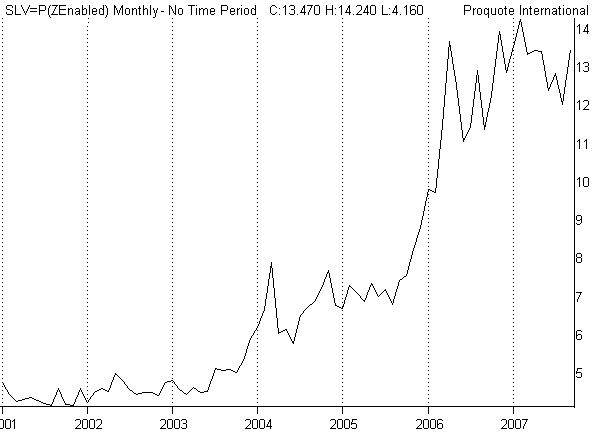
Note the strong price performance of gold, silver and platinum
since 2001 in the charts that appear below.
Some Basics
Once an investor decides to
include a precious metals component within his or her individual
retirement account, a decision as to how to make that investment
- that is, which metal invest in and what vehicle to buy - must
be made. And to be sure, the choices are many. But before considering
the alternatives in detail, let's review some basic guidelines
concerning precious metals investing for IRAs
In the U.S., an IRA investor
may currently invest $4,000 of his or her pre-tax income if under
the age of 50, and $5,000 if age 50 or over, each year. Moreover,
balances from corporately sponsored 401k or other retirement
plans can be transferred into a personal IRA under certain circumstances,
and as a result, the IRA may contain considerable asset value.
As with all investment portfolios,
it is generally prudent for the investor to diversify the holdings
in his/her retirement account. Accordingly, the retirement investor
may include a precious metals component by acquiring precious
metals mining stocks or mutual funds, Exchange Traded Funds (ETFs),
investment grade gold, silver, platinum or palladium bullion
bars and coins, or other instruments, such as the Perth Mint
Precious Metals Certificate.
As with all IRA investments,
precious metals investments of any kind must actually be bought
for cash from the retirement account by a qualified IRA trustee
- investors cannot deposit precious metals they may already own
into an IRA account - and held by a qualified custodian, which
may also be the IRA account trustee. In the case of physical
precious metals, the investor can designate not only what product(s)
the trustee should purchase for his/her IRA account, but also
specify the precious metals dealer or broker from which the trustee
should acquire them.
Also, it is important to note
that taking personal delivery of physical precious metals made
as an IRA investment is prohibited; doing so is considered an
"early withdrawal" from the retirement account by the
Internal Revenue Service, and will result in penalties and taxes
being assessed.
Which Is The Best Investment Alternative?
Regarding the appropriate precious
metals vehicle to own for retirement savings, the IRA investor
should understand that, as is the case with all investments,
each choice will have its own particular advantages and shortcomings.
The investor needs to decide the vehicle most appropriate for
his or her retirement account based on his/her personal knowledge,
comfort level and risk tolerance associated with each alternative.
The table below briefly highlights
just some of the primary features and more significant
disadvantages of each of these choices.
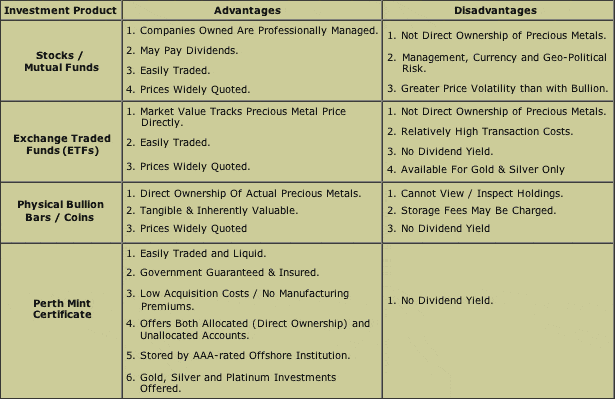
Perhaps the preferred choice
for most retirement investors may be the Perth Mint Certificate
Programme, as it is among the safest and most flexible of all
alternatives. The Perth Mint was established in 1899, is government
owned, is insured by Lloyds of London and has a AAA credit rating
from Standard and Poor's. However, please note, the table above
lists but a few of the factors individuals should consider
when making a long term investment in precious metals. While
a precious metals component clearly has a place in most every
retirement portfolio, retirement investors should ensure all
of their questions and concerns relating to these investments
are satisfactorily and completely answered.
How to Invest in PMs in an
IRA
Establishing a Gold-Silver
IRA account is very straightforward and it can be done with Sterling
Trust Company. Sterling Trust Company is one of the largest independent
self-directed retirement custodians in the U.S. and administers
accounts for individuals and businesses in all 50 states. Sterling
Trust is regulated by federal and state agencies who oversee
regulatory compliance of directed trustees and custodians.
Setting up a self-directed
IRA with Sterling Trust Company is quite easy. First,
call or email Gold Investments and request an IRA packet, which
will be emailed or mailed immediately. (If you are interested
in a Roth IRA, ask for a Roth IRA packet.)
Three simple steps are involved
in setting up a gold-silver IRA with the Sterling Trust Company:
1. Submitting completed paperwork
to Sterling Trust Company
2. Wiring funds to Sterling Trust Company
3. Directing Gold Investments which precious metals or PMCP product
to buy
The procedure is similar in
the UK, Ireland and other jurisdictions. To learn more about
adding precious metals to your retirement portfolio (be it an
IRA, SIPP or other plan), readers should feel free to contact
Gold & Silver Investments Limited for a free consultation.
Michael B. Clark
email: info@gold.ie
Michael B.
Clark is a consultant to Gold and Silver
Investments
Limited, Ireland's Asset Diversification and Wealth Preservation
Specialist. He is the President of Solidus Associates, LLC
of Wilmington, Delaware, and has served in the precious metals
industry for 25 years. He oversaw Deak-Perera's Precious Metals
Certificate Program, America's largest precious metals investment
program, in the early 1980s. Later he became Vice President of
Precious Metals at Wilmington Trust Company, and President of
both Delaware Depository Service Company and First State Depository
Company. He obtained licenses for Wilmington Trust and DDSC to
operate as Nymex and Comex depositories.
321gold Ltd

|