Standing in the Vortex
David Chuhran
Archives
March 29, 2004
You need to look no further
than the airlines for the primary reason the Transports failed
to confirm the recent DJIA high. The airlines have been under
pressure since well before 9-11 and many factors, both internal
and external, have had a negative impact on the air carriers.
In addition to the two major airlines (UAL and UAIR) operating
in bankruptcy protection, revenue is being influenced by many
other factors, including internet pricing, inefficient hub models,
the rise of the low cost carrier business model, and rising fuel
prices. Ticket price increases have repeatedly failed, time after
time, as one or more carriers refuse to follow the herd forcing
all to withdraw their modest increases. With enhancements to
the revenue side long ago exhausted, and pricing power lost,
airline managements have turned their focus to attacking the
cost side of the equation.
The cost cutting has left relatively few areas untouched. In
fact, many companies have cut through the muscle and into the
bone as employees have primarily born the brunt of these cost
reduction measures. Managements, either operating in or threatening
to enter bankruptcy, have forced deep concessions across the
full spectrum of compensation. The cost cutting has also spread
to aircraft lessors, vendors, and contractors that have left
everyone in direct contact with the industry financially weakened.
While the airline industry comprises a relatively small portion
of our economy and is only one sub-sector of the Transports,
it touches a broad range as it gauges the movement of people
and goods throughout our country and the world.
The extensive scope of the Transports is why Dow Theory considers
the DJIA and the Transportation Index as mutually dependent for
confirmation of primary market trends.
Here's a quick review of the basics of Dow Theory:
- The Dow Theory looks at only
the movement of the Dow Jones Transportation and Industrial Averages.
Under the Dow Theory, no other Averages are used for interpretation
purposes.
.
- These two Averages discount
everything. The fluctuations of the daily closing prices of the
Industrials and Transports take into account all hopes, disappointments,
and knowledge of all market participants.
.
- There are three movements
to the market. The most important movement is the market's primary
trend, a broad trend lasting from less than one year up to several
years. The second movement is the secondary price movement, usually
lasting from three weeks to three months. The third movement
is the daily price movement, which has very little long-term
forecasting value under the Theory.
.
- Both the Industrial and Transportation
Averages must confirm. The movements of both the Industrials
and Transports should be considered together. Conclusions based
on the movement of one Average, unconfirmed by the movement of
the other, are often erroneous.
.
- The primary trend remains
intact until a change in that trend has been given by the Theory.
The last major signal remains in force until a new signal develops.
Many analysts believe that a bull market must always be moving
to new highs. However, the market can undergo extended periods
of sideways or lackluster trading without the primary trend changing.
If the last major signal under the Theory was bullish, the primary
bull market trend remains in force until a bear market signal
is given.
In addition to the airlines,
the Transportation Index includes shipping and rail companies
making it a widespread gauge of the overall health of the economy.
Simply stated, you can't have a healthy economy if things aren't
moving; healthy transportation stocks are the sign of a healthy
transportation industry.
Here's a list of the DJTA components:
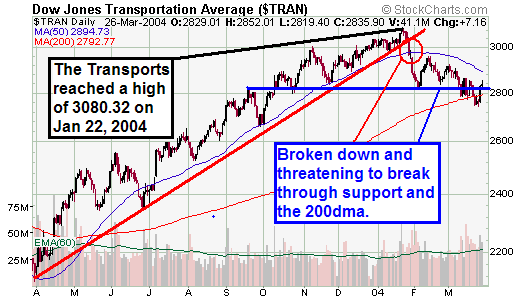
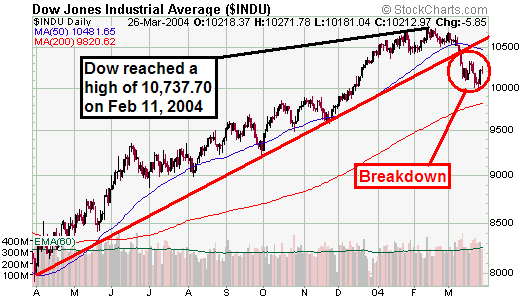
Looking back on the recent DJIA high, the Transport Average failed
to confirm as it broke down more than a month prior signaling
the likelihood of a corresponding breakdown in the DJIA.
(All charts courtesy of
StockCharts.com)
While there's widespread technical
trouble in many of the individual Transport stocks, I want to
focus only on the passenger airlines which are the heaviest drag
on the Index.
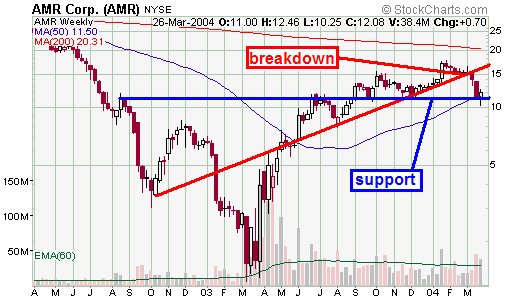
AMR, the World's largest airline, broke through
its trend line after the Transports dropped, but it's currently
holding right at support.
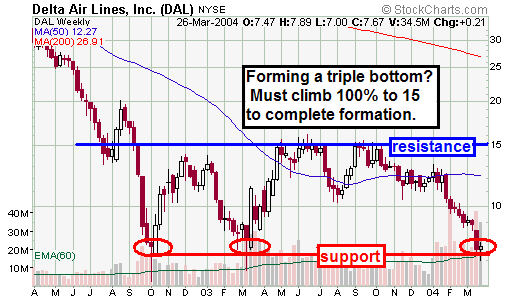
Probably the ugliest of all
the charts is Delta. As the World's third largest carrier,
it stands at a critical level. If this support level falters,
then DAL may be in the process of being priced for bankruptcy.
On the other hand, if support holds, then a triple bottom may
be forming. This chart was weak and deteriorating long before
either the Transports or the Industrials broke down with Delta
losing nearly half its value in 6 months.
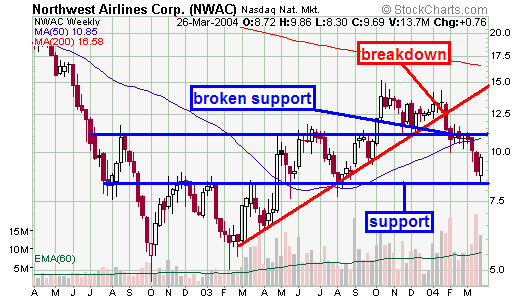
Northwest has broken down through its trend
line and first level of support simultaneously with the Transport
Average. It also sits just above the next support level with
nearly a 30% loss coming since its recent highs.
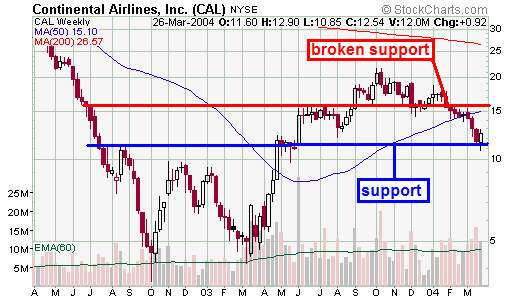
Continental appears to have been topping for sometime
with the support breakdown coinciding with the Transport's breakdown.
Also, notice it sits on top of the next support level with around
a 40% loss since the top in October 2003.
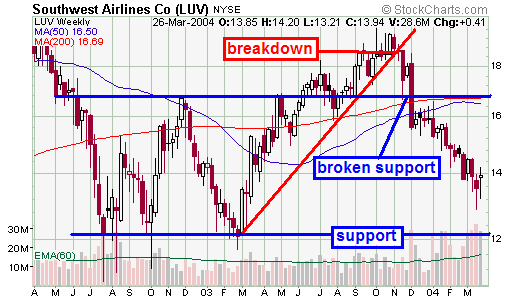
Finally, Southwest,
which is typically the darling of Wall Street, is looking extremely
weak. Support was broken decisively on heavy volume in early
December. The entire current downtrend has occurred on above
average volume with LUV losing 25% since November. It will take
a climb above the broken support to positively reverse this trend.
In summary, the airline stocks are weak and deteriorating with
many sitting on critical support levels. Under these circumstances,
a quick reversal in the DJTA is unlikely, so any corresponding
upward move in the DJIA will go unconfirmed. Furthermore, the
airlines represent a systemic problem that may begin manifesting
itself throughout the economy.
There's clear evidence that a lack of pricing power currently
exists affecting the entire airline industry's revenue generation.
Moreover, the government has blocked all consolidation attempts
necessary to achieve economies of scale and eliminate supply
overhang that would restore some level of price stability. This
widespread problem has forced the carriers into a defensive posture
causing them to attack the cost side. This cost cutting has reduced
revenue generation for support companies as well as disposable
income for employees. This could metastasize to other sectors
ending in a contraction of the money supply as people and businesses
have less money to spend. It's because of this contraction that
the deflationary forces have the airline industry...
...standing in the vortex.
March 29, 2004
David Chuhran
Archives
email
Copyright ©2004 David
Chuhran. All Rights Reserved
321gold Inc

|