US Bonding Glue US Bonding Glue
Der Invest
Informant
Randy Buss
1 December 2004
Mea Culpa. Mea Culpa. In response to yesterday's article I was
chastised by a US reader as being a "Euro-weenie."
Whatever that is, or what his intent was, I am not sure. In my
response, I kindly pointed out that I am not pro-european or
pro-american or pro-asian or pro-anything. I am neutral and just
report what I see in the markets and what others have told me
through first-hand knowledge. So much for not impaling the bearer
of bad tidings on a wooden pole. It is interesting though how
defensive some people can get at other people pointing out the
obvious. To bring up a german(e) quote "Wahre Bildung kennt
kein Neid" or "True knowledge, or education, knows
no envy" is something I always try and adhere to. Moving
on to the markets:
Continuing our Stephen Roach
of Morgan Stanley theme, here's a snippet of one of his latest
articles on the US consumer excesses:
Financial markets
have an uncanny knack in restoring a sense of order to a dysfunctional
world. The dollar is now center stage in this global wake-up
call -- as well it should be, in my view. But dollar depreciation
is not the endgame of global rebalancing. It is the means toward
the end -- a potential trigger for a long overdue realignment
in the mix of global saving and consumption. By failing to face
up to the imperatives of rebalancing, the world has collectively
created the ultimate moral hazard -- a US consumer that is now
"too big to fail." This is a serious warning sign.
The key to a successful global rebalancing, in my view, hinges
critically on facing up to the risks of the world's most serious
excesses. The over-extended American consumer is at the top of
that list. And a weaker dollar could well be key in forcing the
interest rate adjustments that might well temper the asset-driven
excesses of US consumption. This is a shared responsibility that
the world must now collectively redress.
Long ago, I
learned that most of the time it doesn't pay to bet against the
American consumer. There are rare occasions, however, when that
rule doesn't apply. That was the case in the early 1970s in the
aftermath of the first oil shock. Back then, as a young staffer
at the Federal Reserve Board, I was chastised by Fed Chairman
Arthur Burns for being too negative on the US consumer. He argued
that I didn't appreciate the unflinching cyclical resilience
of the US consumer -- a resilience that, ironically, was about
to give way to America's first consumer-led recession. A lot
has changed in the ensuing 30 years. But for very different reasons,
I now believe that another exception is in the offing. The American
consumer is an accident waiting to happen. The sooner the world
comes to grips with this problem, the better the chances of a
successful rebalancing.
Now, as I pointed out in yesterday's
article, although the US consumer is certainly on the top of
the list of things to be corrected, as Mr. Roach points out,
the US consumer could likely not give a damn. The consumer, being
human and being lazy, will not do anything. The fiscal authorities
managing over the US Dollar are going to need to find the political
wherewithal from within and hence force that consumer to "get
with the program" as it were. How to do that? Here comes
the "wherewithal" part. The US authorities are now
backed into a fiscal corner: the consumer will only respond -
i.e. cut back consumption - on pain. Debt pain. That is done
with rising interest rates. Make it so damn painful that easy
credit is cut off and credit cards "hurt" when not
paid off promptly. Make it hurt so much that saving is better
than piling up debt at 2% rates. But wait, if rates rise then
that starts to kill the housing construction market, kills the
home mortgage owner and kills a lot of other things based around
easy credit - autos, toys for big boys, etc. The so-called paper
millionaire home owners, would then become only pauper hundred-thousand
home owners. At which point many might simply be buried under
their over-expensive house (not good for the politicians next
election). This in turn toughens any fledgling economic recovery
to say the least. The US consumer has simply had it too good
after the 2000 market crash as fiscal authorities could not face
up to the true facts and pumped billion dollar liquidity into
the markets. That liquidity and laziness is now coming home to
roost on the USD Index.
Getting back to at least part
of the "global imbalance" solution. Higher US interest
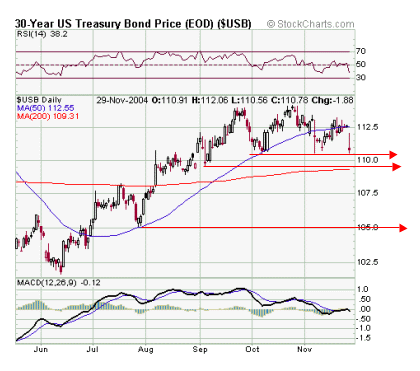
rates. In looking at the long-term US bond, I observed yesterdays
drop - what a doozy. We see a bearish formation in progress which
the markets seem to be hinting at.
With the upcoming FOMC meeting
in December and the US jobs report out this coming Friday, it
will be interesting to see what happens. If the jobs report comes
in "ok" then we might see a 25 bp rise - in line with
so-called Greenspan "paced" increases. If the jobs
report comes in bearish, then will the economic recovery be stuck
in the mud? Surely the movement in the US long bond will be a
forbearer of the ungluing of the US economy - and hence the US
consumer. The only question is for me, will the US fiscal politicians
have the wherewithal to stomach a further US Dollar fall and
the accompanying consumer pain? I really have my doubts - so
again it comes down to the market itself. I think the market
will do what is finally necessary - fiscal authority tinkering
- or not.
30 November, 2004
Randolph Buss
Any remarks or comments - All feedback is gladly accepted (good,
bad, indifferent). editor@dinl.net.
The DII is a free newsletter.
It deals with international issues of The Markets - Economic
Outlook - Finance - TA & Charts - Politics - Life, Culture
& Technology - Geopolitics - Security - Freedom.
If you would like to be on our MAILING LIST, please send an email
to diiportal@dinl.net.
Place "free newsletter" in the Subject Line of your
mail, or click here.
Thank you.
Disclosure
and Disclaimer Statement: This document is intended for informational
purposes only. DINL is not a registered financial advisor in
the USA. Not advice or intended as advice. The author has not
received any payment or reimbursement of any nature for writing
this article. The author's objective in writing this article
is to raise awareness within the reader and to further their
understanding of international and/or monetary issues and to
encourage their own further due diligence / research. Neither
the information nor the opinions expressed should be construed
as a solicitation to buy or sell any stock, currency or commodity.
Investors are recommended to obtain the advice of a qualified
investment advisor before entering into any transactions.
© Copyright 2004 DINL / R. Buss
Further dissemination and publication of this document is legal
but must contain the full title, date, editor's name and full
email address. Otherwise please contact the editor for express
written consent.
321gold Inc

|