Fed Poker II - Inflation Revisited
Der Invest
Informant
Randy Buss
Oct 24, 2005
More Evidential Considerations
In recently having perused
a book on Kondratieff cycles, I was reminded that nearly all
the K-cycles were accompanied by parallel technological advances
of some sort which increased, however dramatically, the productivity
at the given time. One could therefore argue that the main productivity
gains of the last 20 years to worldwide business, since the coming
online of personal computers to the mainstream and with it the
ubiquitous usage from both consumer and businesses, that this
technolgical advancement may be coming to slowing down and with
it a concurrent Autumn to Winter change in the K-cycle. By
that I do not mean that technology is stopping, but merely that
the rate of change and its follow-on productivity gains may fall
with respect to that of previous levels.
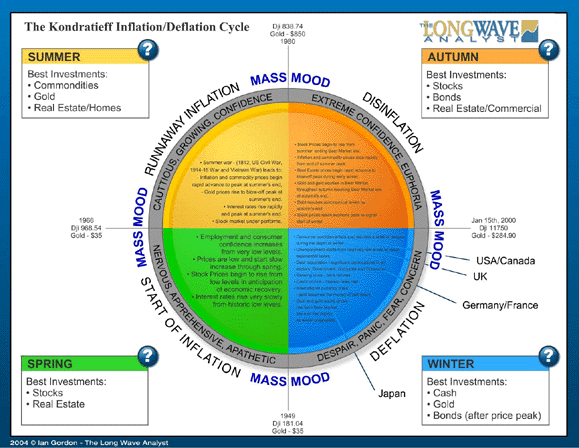
In looking at the excellent
graphic provided by Ian Gordon, with whom I spoke last year on
this subject at a European conference, he has labelled the chart
with a few dates. The dates from 1949 to 2000 show an average
of 17 years between seasons, whereby here I must emphasize it
is an average and therefore just a gross guideline.
 Source:
Ian Gordon, Long Wave Analyst Source:
Ian Gordon, Long Wave Analyst
I would nevertheless argue
that this graphic may be potentially "corrupted" due
to monetary policy. This hypothesis is simply based on the fact
that US Federal Reserve monetary policy since the 1920s has been
altogether subjected to various "flavours" from Fisher
to Keynes with likely influences of Friedman, Stiegler and others.
Hence, we can logically suppose that business cycles, or K-Cycle
seasons, are not totally insensitive to such monetary backdrops.
In referencing a Working Paper_ from Prof. Antony Mueller,
Adjunct Scholar of the Ludwig von Mises Institute, he quotes:
Since its inception, modern
central banking has gone through various fashions and has adopted
opposing paradigms. In the 1920s, the U.S. central bank had a
deeply Fisherian character, as Irving Fisher laid it out by promoting
the central concepts of modern monetary policy such as the "price
level" (Fisher 1922). In the great wars of the first half
of the 20th century, central banking has adopted a political
character and its role became that of supporting the war efforts.
In the 1960s and 1970s, many central banks adopted a Keynesian
perspective only to make a 180-degree turnaround in the late 1970s when they
embarked upon the monetarist experiment. [Fed Gov. Volcker's high interest rates
R. Buss] Since the late 1980s most central banks, and prominently
the Federal Reserve System, have turned away from the monetarist
quantity formula and have focused on "price-level stability"
in the form of a pragmatic inflation targeting approach. Central
banking has gone full circle and since the 1990s it has become
"Fisherian" again.
Although this may sound like
a bunch of mumbo-jumbo from the stacks of some crusty old university,
it is in fact, highly relevant. The Fed is not just "fooling
around" like some staggering alcoholic - although I'm sure
some would violently disagree - the Fed has a strategy in mind,
even though that strategy may in fact be long-term detrimental
to monetary stability as we currently know it, or it may turn
out fine, we don't know at this juncture and neither does the
Fed. Equally, nobody ever said the Fed was apolitical, and currently
the US is facing longer-term military "endeavours"
abroad which must be taken into account with regard to funding
while maintaining price stability at home. Fisherian indeed.
So when looking at the K-Cycle
Autumn description above, we see obvious signs of both Autumn
and Winter happening in parallel, and some would even argue that
we are facing Summer's runaway inflation, which then puts into
question the entire K-Cycle ordering being relevant in today's
highly dynamic and very interconnected world. Remember that
past K-Cycles were not likely subjected to such intense globalisation
forces and were to a large part, historically seen, theorized
at a time of gold backed currencies and trade. This is no longer
true today, so at best, I see the K-Cycle as being historically
interesting but have my doubts as to it being 100% relevant in
today's more complex financial world. I am not dismissing it
but rather keep it as a valuable guideline.
Getting back to the question
of inflation revisited. I again quote from Prof. Mueller's Working
Paper:
Under the condition of major
cost reductions due to intensive technological progress or because
cheaper factors of production become available, a monetary policy
oriented at price stability is prone to initiate an unsustainable
boom. Instead of allowing
deflation to run its course, monetary authorities pursue so-called
stabilization policies. This way they push the economy on a path
to debt
accumulation. The more
intensive the technological advances and the cost reductions
will be, and the longer the period will continue when monetary
policy holds down the interest rate, the more the economy will be
induced to increase its debt levels. The size of the debt level relative to the
productive base at the peak of the boom will make monetary policy
ineffective once the contraction phase takes hold.
In the case of a dearth
of productivity gains and under the condition of rising labor
costs, the inflationary bias of modern central banks produces
inflation and stagflation, as expansive monetary policy feeds
directly into higher consumer prices. It is mainly under the
conditions of high productivity gains or when other factors bring
down production costs on a large scale that central banks have
an easy shot to achieve "price-level stability" or
rather hold the inflation rate within the established target.
This way, however, central banks are misled about the consequence
of monetary expansion, as it does not yet show up right away
in the consumer price index. By ignoring the role of the interest
rate on the capital structure, monetary policy amplifies the
economic expansion that began on the supply side and turns it
into a demand-driven boom based on credit creation.
The critical stage and the
turning point take place when the phase of concentrated technological
progress ends and/or when an adverse supply-shock occurs. Then,
the foundation on which the pyramid of debt was erected breaks
away. Debt-free growth could have been achieved if the central
bank had let work out the short-lived deflationary episode, but
instead the monetary authority, in their endeavors to fight deflation,
have created a credit driven boom. At the first stage of the
monetary expansion, the managed interest rate produces an economic
boom; at the peak of the boom, the debt-load has made the economy
vulnerable to adverse supply shocks. Shocks that would hardly
affect a robust economy now represent a threat. Central bank
management becomes increasingly precarious and the tendency increases
to fight as long as possible against any potential downturn with
further increases of the money supply.
In terms of the capital
structure of the economy (Garrison 2001, 2005), both, the goods
nearer to the consumption side and those nearer to the investment
side with a larger time horizons get the main incentives from
monetary expansion. For the consumer, consumption goods become
more easily attainable, while for businesses the acquisition
of better capital goods that render higher productivity can be
financed more easily. With authentic savings, savers reduce their
potential consumption and provide funds for investment and/or
consumption by the credit takers. With monetary expansion, more savings
appear to be available than there are in terms of the availability
of resources, and demand for investment goods (particularly at
the early stages of the production process) will increase along
with the demand for consumer goods.
At the end of the boom phase,
productivity gains will peter out or adverse supply side shocks
will occur that no longer can be easily absorbed. With the absence of
compensating productivity gains, monetary impulses now feed directly
into the goods prices.
In the model the aggregate supply curve moves to the left. When
central banks continue with monetary expansion, inflation will
result. With inflation rising, the monetary multiplier and the
velocity of circulation tend to increase and drive furthermore
the price level upward. When instead central banks try to counter
the higher price level, a contraction of the monetary multiplier
and the velocity of circulation will amplify the restrictive
stance of monetary policy.
With respect to the last highlighted
sentence, is this what we are currently seeing? Even as productivity
gains may be waning with respect to technology, the last gasp
may be taking shape in the form of "global enterprises"
which outsource manufacturing to low-wage countries. Although
this may be considered a productivity gain of sorts, it is made
on and at the expense to internal capital investment. If long-term
internal investment is neglected for shorter term profitability,
then this may cause the company to be a stock market darling,
but the productive capability more or less resembles an empty
shell in terms of sustainability and is subjected to the fiscal
and social vagaries of the country in question, likely SE Asia
or elsewhere.
Fed's Viewpoint
As to whether we are witnessing
inflation or not, we have done further research and reading and
found that even the Federal Reserve sees inflation in the short
term but less so in the longer term. In referencing a piece
from the Federal Reserve's own research [2] we were "highly
amused" at the following paragraph:
Inflation expectations give
a reading of how credible the public believes monetary policymakers
are in their commitment to fight inflation; as a result these
expectations are an important gauge used in the practice of monetary
policy. That is,
if the public believes monetary policymakers are credible in
their stated goal of keeping inflation low and stable, then inflation
expectations will stay low and stable. One reason credibility is important is that
containing inflation expectations can be a first step in containing
inflation itself. This is because expectations of higher future
inflation might be negotiated into various sorts of pricing contracts,
such as labor contracts, thereby creating the expected inflation.
Which is truly incredulous,
for all its infinite wisdom and history, the Fed seems to believe
that the consumer is in fact the one responsible for inflation.
If he/she believes it, then it will come about, if not, it won't.
So, now we know. Have they divorced themselves completely from
the effects of their own monetary policy and left it in the hands
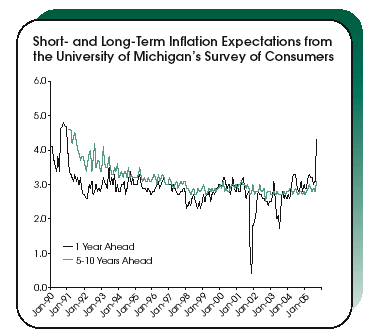
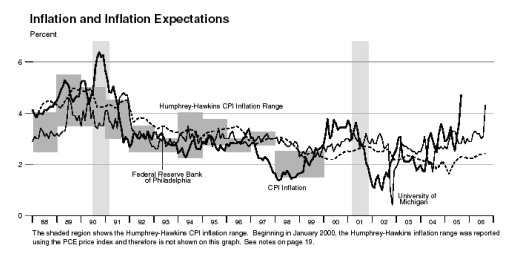
of consumers? According to a 20 year study, the Michigan Survey
of Consumers has been shown to be as accurate as those produced
by professional forecasters. Thus we now see, that consumers
see short term inflation here and now but do not foresee it in
the future. My question is, is this a case of simply: a) wishful
thinking on part of the consumer, b) an illiterate consumer as
to the effects of Fed induced liquidity, or c) both of the above
?
Source: Federal Reserve
Source: Federal Reserve
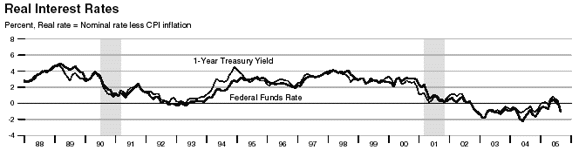
The final things we look at
are the consumer interest rates. As can be seen by chart below,
despite the current trend in place of continuing FFR (Fed Funds
Rate) incremental rate hikes, the true (real) interest rates
have been and remained negative since mid 2002. If we are to
take the Fed's FOMC statements seriously and the recent statements
from Greenspan regarding the asset markets (bubble) and removing
"accommodation" in the marketplace, then surely we
must foresee considerable rate increases in order to at least
get us back to par (0 level), since obviously inflation (CPI)
is eating into the current FFR.
If the consumer index survey
(Michigan) shown above, is seen as a valid indicator of inflation,
as apparently it is, then the FFR must be seen to rise rates
considerably in order for the accommodative interest rates to
be removed from the consumer, i.e. rates must rise considerably
in order for asset markets and continued housing speculation
to be effectively defeated, or at least engaged head on.
 Source:
Federal Reserve Source:
Federal Reserve
In conclusion, despite what
K-Cycle Season we want to call it, be it Autumn or Winter or
a combination thereof, one of the most important points to remember
now is what the 1-3 year outlook suggests for our investment
portfolio. I believe the evidence is pointing to further increased
inflation no matter what the consumer thinks or not. The liquidity
overhang caused by the feed through mechanism of negative real
interest rates on the price of goods can only mean more easy
money chasing a finite amount of goods. Consider also that lag
times are involved with regard to policy change. Combining this
monetary outlook with the increased demand for real / commodity
goods in Asian economies and we have the making for non-negligible
if not considerable inflation. I am not talking yet about a
hyperinflationary backdrop as I believe that could still be much
further along in the pipeline, if ever. The potential exists
of course, but still a lot of water must pass down the Rhine
River before we can begin to contemplate that outlook seriously.
To summarize from [1]:
Great economic booms are
characterized by high productivity gains due to new technology
and often by a concurrent increase in the supply of cheap labor.
By not allowing deflation to run its course under these conditions,
central banks boost the boom even when they meet their inflation
target. They provide ample liquidity in a situation where deflation
would be required. The expansion of the money supply beyond authentic
savings comes along with increasing debt levels. In such a situation, manufactured
by central banks, when an excessive debt level relative to the
productive base has been reached, deflation indeed becomes a
problem. In a low-debt economy, the positive effects of deflation
in terms of increased purchasing power outweigh its negative
side and will be beneficial. In a high-debt economy, deflation becomes
vicious. Therefore, modern central banks will be inclined to
make the debt surge go on as far and as long as they can.
As we have seen in the last
Letter - Fed
Poker, 19 October, most consumers are now considerably both
into debt and have zero savings. This might be a recipe for
consumer and national disaster. The ball is now squarely in
the Fed's court to do something accordingly. The biggest short
term "if" I see is who will now take over the reigns
at the Fed upon Mr. Greenspan's departure. This will be a delicate
call at a time of great imbalances.
- - - - - - - - - - -
I now feel that this further
explains my outlook and position on what we may soon be facing
with regard to the Fed and their strategy. Nothing is a given
in the investment business and we must constantly observe to
recalibrate the outlook.
As quoted by the economist
John K. Galbraith, who said, "Over all history, money has
oppressed people in one of two ways: either it has been abundant
and very unreliable, or reliable and very scarce."
Ps. I think we are now in the
"abundant and very unreliable" phase
References
_ Mueller, Antony (2005): Monetary
Policy in a Hayekian Supply Side Model
_ Federal Reserve (2005): Are
Inflation Expectations Rising from the Ashes?
Well, that's it for today...
for more on this article and more charts please visit the homepage
www.dinl.net in the Latest
Letter box.
More on this in upcoming issues
- if you would like to know more, please sign up for a free subscription
to Der Invest Informant here.
As well, please visit the site
daily and read my Latest Letter.
23 Oct, 2005
Randolph Buss / Berlin, Germany
email: editor@dinl.net
For more detail and more charts on this and other articles
please visit the homepage www.dinl.net
in the Latest Letter / Weekly Outlook section.
More on this in upcoming issues
- if you would like to know more, please sign up for a free subscription
to Der Invest Informant. As well, please visit the site daily
and read the latest information and inputs.
About: The Der Invest Informant
is a website www.dinl.net and accompanying newsletter.
It deals with international issues of: The Markets · Macro
Economic Outlook · Finance · TA & Charts ·
Politics · Life, Culture & Technology · Geopolitics
· Security · Freedom · Fundamental Market
Research · Portfolio Investments
Weekly Outlook
& Latest Letter & Portfolio: Our goal is to inform readers and investors
about the markets and events which may affect their investment
activity. We provide information AS IS as it becomes available
to us from worldwide resources and provide a dedicated and professional
analysis / synopsis. Our goal is to be profitable both in the
long and short terms with respect to our portfolio. We examine
both technical and fundamental aspects along with related geopolitical
background or risks. Our portfolio may or may not contain every
recommendation and we take no responsibility for trading losses
that may be incurred.
© Copyright 2004-2008, Der Invest Informant: All material
at our website is copyrighted and may not be copied, distributed
or further disseminated, in full or part, without the written
consent of Der Invest Informant and/or its representatives. Please
be advised that posting extracts or articles taken from Der Invest
Informant for distribution at other web sites or blogs or similar,
is prohibited. If you would like to do so, please contact Der
Invest Informant for explicit permission at editor@dinl.net - we are reasonable individuals.
Disclosure and Disclaimer Statement: This document is intended
for informational purposes only. Not advice or intended as advice.
The author has not received any third party payment or reimbursement
of any nature for writing this article. The author's objective
in writing this article is to raise awareness within the reader
and to further their understanding of international and/or monetary
issues and to encourage their own further due diligence / research.
The editor, employees or its associates may have positions in
equities or investment vehicles mentioned herein and may make
purchases or sales in such equities. Neither the information nor
the opinions expressed should be construed as a solicitation to
buy or sell any equity, currency or commodity. Individuals are
recommended to obtain the advice of a qualified investment advisor
before entering into any financially binding transactions.
Sources: Prior to the time of publication, information
gathered for research and contained herein has been obtained from
various national and international sources deemed to be both reliable
and accurate but may not necessarily be complete.
Subscribe: If you would like to be on our MAILING LIST,
please visit the Der Invest Informant homepage www.dinl.net and click on the Subscribe
Free tab. Thank you.
Recent Gold/Silver/$$$ essays at 321gold:
Jun 07 US Stk Mkt, Oil & Gold What Now captainewave 321gold
Jun 05 Gold Stocks: Ready To Rally Morris Hubbartt 321gold
Jun 05 Gold Summer Doldrums '26 Adam Hamilton 321gold
Jun 02 Golden Tools For Golden Money Stewart Thomson 321gold
May 31 L@@K Amazon Kindle and Paperback Books by... Bob Moriarty 321gold
May 29 Gold Stocks: Is The Correction Over? Morris Hubbartt 321gold
|
321gold Inc

|