|
|||
Forbidden FruitDer Invest
Informant In real world anecdotal evidence brought back from colleagues in the US, the feeling is that there is a considerable maladjustment within the US taking place. The imbalance is causing an even more polarised society to manifest itself. The issues are centered around the strategy and politics for the War on Terror and the economic landscape. Leaving the politics aside for now, as has already been reported upon in a previous Letter, the top 1%, or top 10%, of individuals within the US, is gaining ever more wealth while the lower 60-80% are struggling to keep status quo or, in fact, are not able to maintain a status quo. Nevertheless, even while the wealth rate seemingly climbs, the infrastructure of the middle class seems to fall further into disrepair. Health, education, social organisations all fall further behind and polarise to the "have more" and the "have less". In an economy over the last 15 years or so which has transformed itself from a "manufacturer of wealth" to a creator of "wealth", (note quotation placement) this holds alarming consequences for the masses, not the top 1% or 10%. This I believe is a direct outgrowth from two significant facts : an oversupply of labor and an oversupply of liquidity. One can be controlled and one cannot. The so-called deflationary force of labour oversupply (cannot be controlled) is something that has recently come about after the fall of the Cold War in 1989, with the opening of the Berlin Wall. This opened the entire Eastern Europe and set in process also the re-alignment of communist China. This occurred in conjunction with the parallel rise of India at near the same time. A conducive factor in this picture has been the rise of the internet technologies and the ability to provide both instantaneous and secure communications but also the transport of knowledge and news in real time. During the market euphoria/crash of 1999/2000 respectively, the Fed embarked upon a path to mitigate the aftermath of the biggest bubble in history by dropping the interest rates to historic lows and thus providing sufficient liquidity to the "system" (can be controlled) in order to stabilize or rather, defend against, undue pain on the part of individual investors who were the main holders of internet/technology stocks. Meanwhile, the market place in middle America, due to the internet advances and labour supply, were (and still are) subjected to some deflationary forces of outsourcing due to labour arbitrage (cost disadvantages) but also are subjected to the new threat of Return on Investment. Traditionally a society is built upon the money and risk of investors within a community. Inward investment produces goods of value which are consumed and sold at a profit all the while producing jobs and tax revenue for the said community. With the advent of labour arbitrage and financial over liquidity, two fundamental things for inward investment were taken away. Cheaper labour implied greater profit for equal investment, but elsewhere not at home. Hence the ROI could be maximised elsewhere even when taking into consideration any cross currency or legislative risks. This necessarily forced capital investment away from inland and the more expensive labour. The second force at work, over liquidity engineered by the Fed, has been turning the society from a manufacturing base to an asset or financial base. The reason for this is that the ROI could be more easily obtained and with less risk in an environment conducive of "free money". Why dirty ones hands with risky manufacturing enterprises inland when cheaper and more profitable enterprises can be done overseas? The downside of course is, I know of no economic empire created and maintained on consumption and inward asset management (the equivalent of cutting each other's hair). The result has been an impressive growth in the financial and asset sectors in the US, but mostly driven by the housing and asset sectors of which no meaningful long-term GDP can be derived or meaningful products manufactured. Likewise, the housing bubble will drive an even greater wedge between the middle class unable to afford such continued higher prices and those wealthy individuals who are able to better control the risks in this game. The follow-on effect of the asset bubble will be (is) the accompanying debt bubble which naturally occurs for most consumers unable to provide reasonable down payments of 20-25% or able to handle an attendant rise in rising mortgage rates. So moving from one liquidity issue to the next, the Fed is now faced with an even more cantankerous issue of how to deflate a debt bubble of the consumer without bringing down the inherent backers of that risk, the banks and equity houses who have passed the debt along through their books. The seemingly only way possible for this situation to be solved will be a continued liquidity creation by the Fed. Meanwhile the fallback solution of saving and inward investment to re-build the middle class is lacking. What could the US convincingly build and export at a profit verses China or India or SE Asia? (As technology and society moves forward, the pyramid of technology slows and becomes more expensive while needing ever fewer workers to provide that expertise). Who would be the issuers of such investment capital / credit? Could a better and less risky ROI be obtained elsewhere by international investors? Why would inland investors risk capital here when investments within asset management sector earns a higher rate of return? The forbidden fruit of the Fed was to take and bite the obvious low-hanging "liquidity apple" during the 2000 crash. What the Fed maybe did not realize, or decided to disregard, was the need for a backup plan to re-establish credibility once the crisis dissipated. Unfortunately the liquidity spill over from continued low interest rates has now taken on a life of its own with no Master Exit Plan. The Exit Plan for extraction from this situation will become more painful and more risky as time moves on. With every increase in the budget and trade deficits, with every increase in debt to foreign owners of US Dollars, and the servicing of that debt, with every decrease in national savings the room for maneuvering by the Fed (and consumers) becomes less and less. It has always been my premise, and still is at this moment until I see significant progress or evidence to the contrary, that the end game for the Fed will amount to continued and significant liquidity pumping in an effort to stave off pain for the consumer and its backers. The result may very well be: "The extreme of any position will ultimately become its opposite." In other words, that what they are trying to solve, no deflation, will only become more of a problem, raging deflation, albeit at a later date. It is a very difficult situation about which to come to any certain conclusion, but at this point, I still maintain that the Fed will create the environment for a type of hyperinflation in conjunction with higher interest rates but likely not high enough to really bring the situation under control, as this would likely crush the consumer. It will be a "twilight zone", neither here nor there. The lynchpin for the US economy may very well controlled by foreign creditors, and as usually is the case, one thinks first of himself and then his friends, if at all. International economics and economic competition is not known for its magnanimous gestures throughout history. The deficit charts relating to political parties in office is only intended to provide visual support and is in no way indicative of a bias for the democratic or republican parties - the graph is simply for illustrative purposes only. United States National Debt 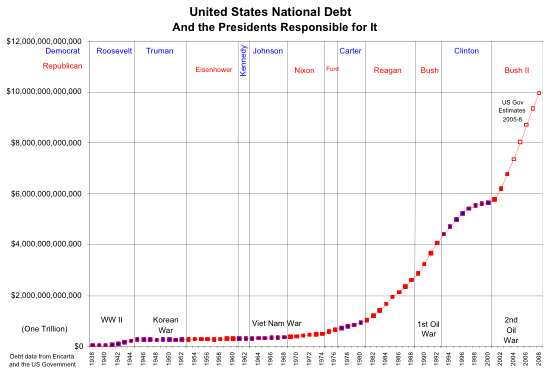 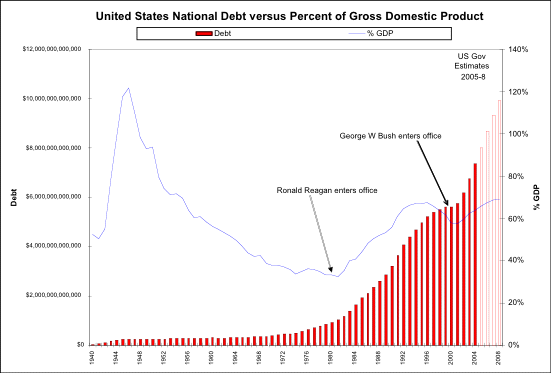 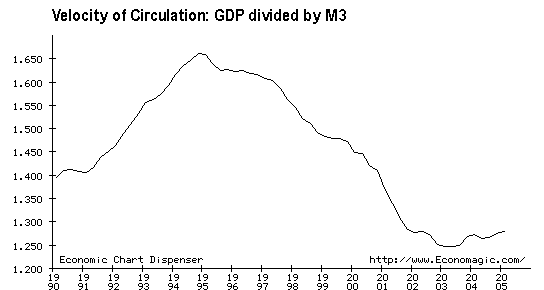 Well, that's it for today...
for more on this article and more charts please visit the homepage
www.dinl.net in the Latest
Letter box. email: editor@dinl.net More on this in upcoming issues
- if you would like to know more, please sign up for a free subscription
to Der Invest Informant. As well, please visit the site daily
and read the latest information and inputs. Weekly Outlook
& Latest Letter & Portfolio: Our goal is to inform readers and investors
about the markets and events which may affect their investment
activity. We provide information AS IS as it becomes available
to us from worldwide resources and provide a dedicated and professional
analysis / synopsis. Our goal is to be profitable both in the
long and short terms with respect to our portfolio. We examine
both technical and fundamental aspects along with related geopolitical
background or risks. Our portfolio may or may not contain every
recommendation and we take no responsibility for trading losses
that may be incurred.
321gold Inc |