Bernanke Presses His Luck
John Browne
Dec 24, 2009
The vast majority of economists now say that the recession is over. Many expect nominal GDP growth as high as four percent in 2010. Now, with the economy assumed to be back on stable footing, some in the private sector are starting to talk about inflation.
While agreeing that growth has returned, the Federal Reserve and the Obama administration do not see inflation as a threat. To them, the political costs of ongoing recession far outweigh any medium-term considerations about the value of the dollar, hence their determination to hold short-term interest rates to around zero. This has created unnatural conditions in the U.S. Treasury market and is limiting the prospects for real growth.
The Fed lending at zero enables the major banks to invest in long-term Treasuries at a huge risk-free spread of nearly four percent. In addition, the Fed is - for the first time - paying interest on bank reserves deposited with the Fed. In such a 'la-la' world, why would any bank take the needless risk of lending to small businesses, the main creators of new jobs? For all but the largest corporations, who can also access the bond markets directly, credit is tight. The lack of private-sector bank liquidity has hurt job creation, consumer demand, and is adding mightily to recessionary pressures.
What's worse, this monetary treadmill has disrupted market signals about coming inflation.
When the vast sums lent to the banks are recycled back to the government, the money remains exclusively a part of the monetary base, but never enters the money supply. Only when the banks are induced to lend to the real economy does the 'rescue' money flood into the market and drive up consumer prices.
Currently, inflation appears low. But if the Fed decides to raise interest rates, the risk-free trade between the short end and long end of the yield curve will be eliminated. At that point, banks will have to start lending to small business and to individuals. The whole inflation picture will be changed dramatically.
More importantly, what if Bernanke is not fully in control of interest rates? For instance, as investors grow wary of growing federal deficits, the potential for high inflation, and the looming probability that the Fed will raise rates, they may exert selling pressure, particularly at the long end of the yield curve. Indeed, with some four percent yield differential between short and long Treasuries, the curve is steeper than it has been for years. This selling pressure could force Bernanke to raise short-term rates.
Evidence of increasing inflation could also drive Bernanke to raise interest rates before he plans to do so. If the Fed is compelled follow such a course, several things are likely to occur.
First, there would be a rapid sell-off in overpriced long-dated Treasuries. This would be the 'bond market crash' that we have long envisaged.
Second, American equities will likely experience downward pressure as the discount rate, used to assess the present value of dividends, rises.
Third, a rise in interest rates could trigger a crisis in interest rate-dependent derivatives held by banks, similar to circumstances of the last credit crisis.
Finally, and most concerning, higher rates would increase the debt burden for the U.S. government, which is increasingly sold in short-term notes. With a stagnating economy, the tax base will be unable to shoulder this extra weight. This could potentially lead to the largest sovereign default in history.
Many commentators are arguing that hyperinflation cannot happen in the midst of a second credit crisis. In fact, hyperinflation tends to happen in rapidly contracting economies: Zimbabwe, Weimar Germany, Argentina. These countries have negative productivity growth and thus cannot 'soak up' the excess currency being printed to keep prices stable.
Based on his perceived diagnosis of the Great Depression, Bernanke is betting the house on his War on Recession. Despite the media's faith that he has an ace up his sleeve, it is a foolhardy gamble with the country's economic future.
###
Dec 23, 2009
Click here
to buy Peter Schiff's best-selling, just-released book,
"How an Economy Grows and Why It Crashes."
For a more in depth analysis of our financial problems and the
inherent dangers they pose for the U.S. economy and U.S. dollar,
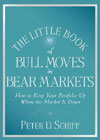
you need to read Peter Schiff's 2008 bestseller "The Little
Book of Bull Moves in Bear Markets" [buy
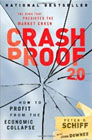
here] And his recent release "Crash Proof 2.0: How
to Profit from the Economic Collapse" [buy
here]
For a look back at how Peter
Schiff predicted the current crisis, read his 2007 bestseller
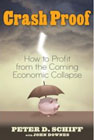
"Crash Proof: How to Profit from the Coming Economic Collapse"
[buy
here]
More importantly, don't wait
for reality to set in. Protect your wealth and preserve your purchasing
power before it's too late. Discover the best way to buy gold at www.goldyoucanfold.com, download our free
research report available at www.researchreportone.com, and subscribe to our
free, on-line investment
newsletter.
John Browne
Senior
Market Strategist
Euro Pacific Capital, Inc.
1 800-727-7922
email: jbrowne@europac.net
website:
www.europac.net
 John
Browne is the Senior Market Strategist for Euro Pacific Capital,
Inc. Mr. Browne is a distinguished former member of Britain's
Parliament who served on the Treasury Select Committee, as Chairman
of the Conservative Small Business Committee, and as a close associate
of then-Prime Minister Margaret Thatcher. Among his many notable
assignments, John served as a principal advisor to Mrs. Thatcher's
government on issues related to the Soviet Union, and was the
first to convince Thatcher of the growing stature of then Agriculture
Minister Mikhail Gorbachev. As a partial result of Browne's advocacy,
Thatcher famously pronounced that Gorbachev was a man the West
"could do business with." A graduate of the Royal Military
Academy Sandhurst, Britain's version of West Point and retired
British army major, John served as a pilot, parachutist, and communications
specialist in the elite Grenadiers of the Royal Guard. John
Browne is the Senior Market Strategist for Euro Pacific Capital,
Inc. Mr. Browne is a distinguished former member of Britain's
Parliament who served on the Treasury Select Committee, as Chairman
of the Conservative Small Business Committee, and as a close associate
of then-Prime Minister Margaret Thatcher. Among his many notable
assignments, John served as a principal advisor to Mrs. Thatcher's
government on issues related to the Soviet Union, and was the
first to convince Thatcher of the growing stature of then Agriculture
Minister Mikhail Gorbachev. As a partial result of Browne's advocacy,
Thatcher famously pronounced that Gorbachev was a man the West
"could do business with." A graduate of the Royal Military
Academy Sandhurst, Britain's version of West Point and retired
British army major, John served as a pilot, parachutist, and communications
specialist in the elite Grenadiers of the Royal Guard.
In addition to careers in British politics and the military, John
has a significant background, spanning some 37 years, in finance
and business. After graduating from the Harvard Business School,
John joined the New York firm of Morgan Stanley & Co as an
investment banker. He has also worked with such firms as Barclays
Bank and Citigroup. During his career he has served on the boards
of numerous banks and international corporations, with a special
interest in venture capital. He is a frequent guest on CNBC's
Kudlow & Co. and the former editor of NewsMax Media's Financial
Intelligence Report and Moneynews.com. He holds FINRA series 7
& 63 licenses.
321gold Ltd

|