Don't Buy the Head Fake
John Browne
Jul 17, 2008
This week, we were treated
to strong statements by both Treasury Secretary Hank Paulson
and Fed Chairman Ben Bernanke about the desirability of a "strong
dollar", and the intention of policy makers to pursue strategies
that will enhance its value. To the relief of many, the dollar
responded to the moral support and managed a mild rally. The
move is inconsequential. The harsh realities have not changed
in the slightest, and the dollar is set to continue its overall
decline.
Although some investors respond to such jawboning, the more sophisticated
international players, who in large part determine the foreign
exchange market, do not. Why the bearish sentiment despite the
bullish talk from Washington?
First, the political situation is that both Paulson and Bernanke
were handed a poisoned chalice by their predecessors. By consuming
more than we have produced for decades, Americans are now confronting
the reality of diminished living standards. These inevitable
declines have been masked by a series of massive liquidity injections
by former Fed Chairman Greenspan. This was done to avoid the
political cost of the natural corrective medicine of recession.
It fueled both the dot.com and the real estate booms. The current
liquidity injections are now fueling inflation in food and energy.
The problem for policy makers is that large portions of the electorate
are starting to realize that a weak dollar is not simply a problem
for those who vacation in Paris. People innately understand that
a falling dollar is adding to the cost of living. So there are
very strong political reasons for the Fed and the Treasury to
talk tough on the dollar. In his Congressional testimony, Bernanke
noted that the strength of the dollar is "a top priority".
Notably, he did not say that it was "the" top priority.
The political reality of the continued erosion of American wealth,
and the reluctance of officials to allow the public to fully
comprehend the extent of the problem, has tied their hands and
feet. However, their mouths still have the ability to move freely.
While inflation inflicts greater economic damage over the long
term, recession causes more "political" damage over
the short term. In an election year, it may come as no surprise
that the short term problems will attract the lion's share of
attention. However, the rest of the world is not nearly as concerned
with these political points, and instead favors combating inflation
over recession.
Doubtless, Bernanke and Paulson see the acute danger of raising
rates to combat inflation and to defend the U.S. dollar. The
present recession is based on a housing collapse of gigantic
proportions and could all too easily be pushed into a depression
by an interest rate hike. With this terrifying prospect in view,
it is little wonder that Bernanke and Paulson are keener to avoid
depression.
Therefore, like a tackler in American Football or in Rugby, it
pays not to look at what an opponent 'says' with his eyes or
arms or mouth, but at what he 'does' with his feet!
By ignoring the head fakes, and concentrating solely on the fundamentals,
it's easy to see that the Fed is pursuing a policy of inflation
and dollar debasement. So, expect continued soft to neutral action
on interest rates, accompanied by further overall weakness in
the U.S. dollar.
With such a stance likely to be in place well into 2009, international
faith in the U.S. dollar may fall to such depths that the special
"reserve" status it enjoys may be challenged by the
Euro. This possibility would move a step closer to a probability
once the European Union becomes a sovereign state after January
1, 2009.
***
For a more in depth analysis
of our financial problems and the inherent dangers they pose
for the U.S. economy and U.S. dollar denominated investments,
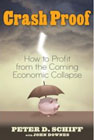
read Peter Schiff's book "Crash Proof: How to Profit
from the Coming Economic Collapse." Click here
to buy a copy today.
 More importantly, don't wait for reality
to set in. Protect your wealth and preserve your purchasing power
before it's too late. Discover the best way to buy gold at www.goldyoucanfold.com, download our free
research report on the powerful case for investing in foreign
equities available at www.researchreportone.com, and subscribe to
our free, on-line investment
newsletter. More importantly, don't wait for reality
to set in. Protect your wealth and preserve your purchasing power
before it's too late. Discover the best way to buy gold at www.goldyoucanfold.com, download our free
research report on the powerful case for investing in foreign
equities available at www.researchreportone.com, and subscribe to
our free, on-line investment
newsletter.
John Browne
Senior
Market Strategist
Euro Pacific Capital, Inc.
1 800-727-7922
email: jbrowne@europac.net
website:
www.europac.net
 John
Browne is the Senior Market Strategist for Euro Pacific Capital,
Inc. Mr. Browne is a distinguished former member of Britain's
Parliament who served on the Treasury Select Committee, as Chairman
of the Conservative Small Business Committee, and as a close associate
of then-Prime Minister Margaret Thatcher. Among his many notable
assignments, John served as a principal advisor to Mrs. Thatcher's
government on issues related to the Soviet Union, and was the
first to convince Thatcher of the growing stature of then Agriculture
Minister Mikhail Gorbachev. As a partial result of Browne's advocacy,
Thatcher famously pronounced that Gorbachev was a man the West
"could do business with." A graduate of the Royal Military
Academy Sandhurst, Britain's version of West Point and retired
British army major, John served as a pilot, parachutist, and communications
specialist in the elite Grenadiers of the Royal Guard. John
Browne is the Senior Market Strategist for Euro Pacific Capital,
Inc. Mr. Browne is a distinguished former member of Britain's
Parliament who served on the Treasury Select Committee, as Chairman
of the Conservative Small Business Committee, and as a close associate
of then-Prime Minister Margaret Thatcher. Among his many notable
assignments, John served as a principal advisor to Mrs. Thatcher's
government on issues related to the Soviet Union, and was the
first to convince Thatcher of the growing stature of then Agriculture
Minister Mikhail Gorbachev. As a partial result of Browne's advocacy,
Thatcher famously pronounced that Gorbachev was a man the West
"could do business with." A graduate of the Royal Military
Academy Sandhurst, Britain's version of West Point and retired
British army major, John served as a pilot, parachutist, and communications
specialist in the elite Grenadiers of the Royal Guard.
In addition to careers in British politics and the military, John
has a significant background, spanning some 37 years, in finance
and business. After graduating from the Harvard Business School,
John joined the New York firm of Morgan Stanley & Co as an
investment banker. He has also worked with such firms as Barclays
Bank and Citigroup. During his career he has served on the boards
of numerous banks and international corporations, with a special
interest in venture capital. He is a frequent guest on CNBC's
Kudlow & Co. and the former editor of NewsMax Media's Financial
Intelligence Report and Moneynews.com. He holds FINRA series 7
& 63 licenses.
321gold Ltd

|