The Statistical Battleground
John Browne
May 30, 2008
With consumer confidence now
testing generational lows, our politicians are never the less
continuously assuring us that the economy is strong, and that
there is no cause for worry.
Although it is standard procedure for governments to soothe their
citizenry with placebo politics in order to avoid panic and uprising,
there is a line after which such a campaign is counterproductive.
In fact, misleading statements about financial security are potentially
dangerous to the country's long term economic well being, and
potentially toxic to investors.
Economic and financial statistics are the battleground over which
the war of perception is fought. But as the saying goes:
"Figures lie, and liars figure." Politicians
are masters of the selected use of statistics to lend credibility
to their statements. In reality, the numbers often mask
the truth.
A year ago, financial markets hovered near nominal highs, retail
sales appeared to be growing and real estate prices were near
historic highs. Wall Street and Washington made the most
of these 'over-the-top' numbers to foster a sense of economic
invincibility. With the national gaze lifted towards sunny
skies, few noticed the danger of the mortgage crisis, which lay
below like a tiger trap.
But like a poorly dubbed martial arts film, the average American
is beginning to notice that the dialogue does not match the on-screen
action. As a result, many people are a developing a deep
suspicion of statistics, which over time will greatly diminish
the government's credibility. In the coming economic crisis,
this loss of credibility may have severe consequences.
One vital statistic in the perception battle is GDP, which is
the total of all spending on goods and services within our economy,
and is used as the key measure of national wealth generation.
It may be surprising to some, but GDP includes money spent on
clearing up natural disasters that include hurricane relief and
pollution control. How such expenditures, which really
only replace what has been lost, increase national wealth, is
beyond me.
Unemployment figures are another worry. Government adjustments
for seasonal and population changes are acceptable. But
excluding from the unemployment rolls those who are neither actively
seeking jobs nor the 'long-term' unemployed is not.
Perhaps, the greatest area of concern about statistical manipulation
is the measurement of inflation, or Consumer Price Index (CPI).
By manipulating this single statistic the government can miraculously
transform rising prices into economic growth.
Today, the Department of Labor sets so-called "core"
inflation, excluding food and energy, at 2.2 percent. Even
"headline" inflation, including food and energy, is
published officially at only some 4 percent. The problem
is that these figures bear very little relation to the reality
of price increases experienced on Main Street, which some estimate
to be in excess of 10 percent.
Statisticians assign different weights to the elements comprising
the CPI that are often not reflective of the spending habits
of ordinary citizens. For example, housing maintenance
(including heating oil), a major expenditure, is given only a
small part in the Index's makeup. In addition, the re-pricing
of items such as automobiles to allow for added 'hedonistic"
features such as enhanced "value for money" is wide
open to varying judgments. How these statistical decisions
are made is really anyone's guess. But it is absurd to assume
that the government's overwhelming interest in reporting low
inflation does not influence the final numbers.
The financial consequences for investors can be severe.
For example, the Dow Jones Industrial Index, against which many
investment returns are measured, closed at a nominal high of
14,093 on October 12, 2007. The media reported it as a
sign of good things to come. On May 23, 2008, the Dow closed
at 12,480 -- off a bit, but apparently not too bad. However,
the Dow close of 12,480, if adjusted for the official CPI, is
worth not 12,480, but only 9,856 when compared with its previous
market cycle high, of 11,723, in the year 2000.
Worse still, if adjusted for the more reasonable, but conservative,
inflation rate of 8 percent, the recent close of 12,480 becomes
the equivalent of only 6,742 in the year 2000. What looks
like a nominal gain of some 757 points or 6.4 percent is, in
fact, a real loss of 4,981 points or some 42 percent over those
eight years!
One set of statistics that is impossible to distort are currency
exchange rates, which have provided a somber report card on America's
economic fortunes. Not able to manipulate these numbers,
the authorities instead distort their meaning, and have attempted
to convince Americans that a weak dollar is in the national interest.
Those wise enough to ignore the spin, and see the falling dollar
for what it is, namely a loss of wealth, have invested in good
companies listed on the stock exchanges of producer nations,
such as Australia, Canada and Switzerland, with appreciating
currencies. Such moves have greatly enhanced wealth and
protected those investors against further dollar erosion.
***
For a more in depth analysis
of our financial problems and the inherent dangers they pose
for the U.S. economy and U.S. dollar denominated investments,
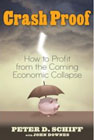
read Peter Schiff's book "Crash Proof: How to Profit
from the Coming Economic Collapse." Click here
to buy a copy today.
 More importantly, don't wait for reality
to set in. Protect your wealth and preserve your purchasing power
before it's too late. Discover the best way to buy gold at www.goldyoucanfold.com, download our free
research report on the powerful case for investing in foreign
equities available at www.researchreportone.com, and subscribe to
our free, on-line investment
newsletter. More importantly, don't wait for reality
to set in. Protect your wealth and preserve your purchasing power
before it's too late. Discover the best way to buy gold at www.goldyoucanfold.com, download our free
research report on the powerful case for investing in foreign
equities available at www.researchreportone.com, and subscribe to
our free, on-line investment
newsletter.
John Browne
Senior
Market Strategist
Euro Pacific Capital, Inc.
1 800-727-7922
email: jbrowne@europac.net
website:
www.europac.net
 John
Browne is the Senior Market Strategist for Euro Pacific Capital,
Inc. Mr. Browne is a distinguished former member of Britain's
Parliament who served on the Treasury Select Committee, as Chairman
of the Conservative Small Business Committee, and as a close associate
of then-Prime Minister Margaret Thatcher. Among his many notable
assignments, John served as a principal advisor to Mrs. Thatcher's
government on issues related to the Soviet Union, and was the
first to convince Thatcher of the growing stature of then Agriculture
Minister Mikhail Gorbachev. As a partial result of Browne's advocacy,
Thatcher famously pronounced that Gorbachev was a man the West
"could do business with." A graduate of the Royal Military
Academy Sandhurst, Britain's version of West Point and retired
British army major, John served as a pilot, parachutist, and communications
specialist in the elite Grenadiers of the Royal Guard. John
Browne is the Senior Market Strategist for Euro Pacific Capital,
Inc. Mr. Browne is a distinguished former member of Britain's
Parliament who served on the Treasury Select Committee, as Chairman
of the Conservative Small Business Committee, and as a close associate
of then-Prime Minister Margaret Thatcher. Among his many notable
assignments, John served as a principal advisor to Mrs. Thatcher's
government on issues related to the Soviet Union, and was the
first to convince Thatcher of the growing stature of then Agriculture
Minister Mikhail Gorbachev. As a partial result of Browne's advocacy,
Thatcher famously pronounced that Gorbachev was a man the West
"could do business with." A graduate of the Royal Military
Academy Sandhurst, Britain's version of West Point and retired
British army major, John served as a pilot, parachutist, and communications
specialist in the elite Grenadiers of the Royal Guard.
In addition to careers in British politics and the military, John
has a significant background, spanning some 37 years, in finance
and business. After graduating from the Harvard Business School,
John joined the New York firm of Morgan Stanley & Co as an
investment banker. He has also worked with such firms as Barclays
Bank and Citigroup. During his career he has served on the boards
of numerous banks and international corporations, with a special
interest in venture capital. He is a frequent guest on CNBC's
Kudlow & Co. and the former editor of NewsMax Media's Financial
Intelligence Report and Moneynews.com. He holds FINRA series 7
& 63 licenses.
321gold Ltd

|