The Problems Spread
John Browne
Apr 15, 2008
Last week, General Electric
one of the finest companies in the world and an American icon,
announced a major fall in earnings. Amazingly, the bad news surprised
Wall Street, and GE shares fell 13 percent in a single day. Some
surprise!
GE is one of the best-diversified and well-managed companies
on earth, and is seen as a barometer of both the US and the world
economies. Its latest earnings report was impacted by the expected
fall in financial services and a continued strength in overseas
earnings. However, it also showed a largely unexpected fall in
the sales of US medical devices as public and not-for-profit
hospitals, suffering massive increases in their borrowing costs,
cut back on spending.
In other words, the fall in GE's earnings suggests that recession
in America is taking hold across a wider spectrum and is not
restricted to sub-prime real estate. As this idea reality finally
began to dawn on Wall Street, the Dow Jones Industrials and other
broad market indices lost some 2 percent on the day.
As investors lick their wounds, they should also realize that
nominal losses in U.S. stocks are really just half the story.
So far this year, the American dollar has lost some 7 percent
against the Euro and some 10 percent against the Japanese Yen.
As more GE-like earnings reports loom on the horizon, and as
the dollar continues to slip, holding even blue chip American
stocks will remain a risky proposition.
Not long ago, before the sub-prime debacle (of which Peter Schiff
and I had warned of repeatedly) really began to take its toll,
the majority of economists foresaw little widespread difficulties
in the American economy. However, when Bear Stearns became completely
unraveled almost overnight, most of these formerly optimistic
observers now belatedly recognized real problems. However, their
fears have been largely assuaged by the magnitude of the Government's
response.
Using methods that the legendary former Fed Chairman, Paul Volcker,
said, "stretched the very limits of its legal powers,"
the Fed dramatically rescued Bear Stearns on March 17th. Such
was the sanguine sense of relief that investors felt our national
economic problem had been largely cured, at a single stroke,
by the Fed.
In the four weeks since March 17th, stock markets appeared to
rally, on the back of what can best be described as the 'euphoria
of blindness' to the realty of the systemic economic problem
we face in the 'real' world.
Renowned Yale Professor Robert Shiller has shown that from 1995
to 2006 the value of U.S. real estate rose some 30 percent above
its century-long value line. Today, the U.S. residential housing
stock is valued at some $20.145 trillion, of which more than
half is debt! Admittedly, not all this debt is sub-prime. But
the sub-prime problem is, as we have long forecast, spreading
both upwards and across the real estate field and the credit
markets.
As the average consumers' single most important asset is their
homes, the fall in house values is now adversely affecting American
consumer confidence. This bodes ill for both the American and
the world economy, in general.
The Fed Chairmen, Ben Bernanke, now has an historic opportunity
staring him in the face. Should he continue to back the government
in disguising the natural economic recession, by debasing the
U.S. dollar and so continue to rob every single American citizen
of his or her hard-earned wealth? Or, on the other hand, should
he, at long last, stand up for American citizens and their money
by using his 'independence' to force our government to adopt
sound economic and financial policies?
Recent pronouncements indicate that he has decided to ignore
his legal 'independence', and instead submit to political pressures
and allow the government to silently tax current and future citizens
in order to bail out financial and real property. Characteristically,
Wall Street appears to applaud the decision, accepting both more
inflation and further debasement of our dollar to save themselves,
for a time, at least.
The Fed balance sheet amounts to some $800 billion. This sounds
like a lot of money and it is. But it is dwarfed by the county's
debt exposure, which includes not just the $10 trillion of residential
property debt, but also trillions more in commercial property,
auto loans, and credit cards and increasingly vulnerable business
loans!
The key question is; has the government got enough money to finance
a bailout of several trillion dollars? The answer, of course,
is no. But, although national savings are at an all time low,
both the American taxpayer and many ordinary citizens still have
some net worth that can be both taxed and eroded by inflation
and currency debasement!
Recent pronouncements to extend the regulatory powers (read funding
ability) of the Fed to the really big gamblers, namely investment
banks, derivative traders, insurance companies and even to hedge
funds (the speculative vehicles of the super rich) and the increasing
political talk of 'help', indicate that both the government and
Congress are now set on a path of higher taxation, inflation
and dollar erosion.
For alert Americans, investment attitudes must undergo a sea
change. Instead of thinking in terms of return 'on' capital,
investors will be well advised to think about return 'of' capital!
Greed should give way to extreme prudence.
It is becoming increasingly clear that any investors, who wish
to protect their wealth, should invest in non-dollar denominated
financial assets and, where possible, hold them (legally, including
paying tax) offshore, in order to avoid any risk of the future
imposition of American exchange controls.
As the old song goes, 'the times, they are a changing'. Soon
unfortunately, that refrain will bring smiles only to those who
have taken wise protective action with their investments.
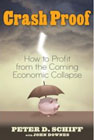
For a more in depth analysis of our financial problems and the
inherent dangers they pose for the U.S. economy and U.S. dollar
denominated investments, read Peter Schiff's book "Crash
Proof: How to Profit from the Coming Economic Collapse."
Click here
to buy a copy today.
 More importantly, don't wait for reality
to set in. Protect your wealth and preserve your purchasing power
before it's too late. Discover the best way to buy gold at www.goldyoucanfold.com, download our free
research report on the powerful case for investing in foreign
equities available at www.researchreportone.com, and subscribe to
our free, on-line investment
newsletter. More importantly, don't wait for reality
to set in. Protect your wealth and preserve your purchasing power
before it's too late. Discover the best way to buy gold at www.goldyoucanfold.com, download our free
research report on the powerful case for investing in foreign
equities available at www.researchreportone.com, and subscribe to
our free, on-line investment
newsletter.
John Browne
Senior
Market Strategist
Euro Pacific Capital, Inc.
1 800-727-7922
email: jbrowne@europac.net
website:
www.europac.net
 John
Browne is the Senior Market Strategist for Euro Pacific Capital,
Inc. Mr. Browne is a distinguished former member of Britain's
Parliament who served on the Treasury Select Committee, as Chairman
of the Conservative Small Business Committee, and as a close associate
of then-Prime Minister Margaret Thatcher. Among his many notable
assignments, John served as a principal advisor to Mrs. Thatcher's
government on issues related to the Soviet Union, and was the
first to convince Thatcher of the growing stature of then Agriculture
Minister Mikhail Gorbachev. As a partial result of Browne's advocacy,
Thatcher famously pronounced that Gorbachev was a man the West
"could do business with." A graduate of the Royal Military
Academy Sandhurst, Britain's version of West Point and retired
British army major, John served as a pilot, parachutist, and communications
specialist in the elite Grenadiers of the Royal Guard. John
Browne is the Senior Market Strategist for Euro Pacific Capital,
Inc. Mr. Browne is a distinguished former member of Britain's
Parliament who served on the Treasury Select Committee, as Chairman
of the Conservative Small Business Committee, and as a close associate
of then-Prime Minister Margaret Thatcher. Among his many notable
assignments, John served as a principal advisor to Mrs. Thatcher's
government on issues related to the Soviet Union, and was the
first to convince Thatcher of the growing stature of then Agriculture
Minister Mikhail Gorbachev. As a partial result of Browne's advocacy,
Thatcher famously pronounced that Gorbachev was a man the West
"could do business with." A graduate of the Royal Military
Academy Sandhurst, Britain's version of West Point and retired
British army major, John served as a pilot, parachutist, and communications
specialist in the elite Grenadiers of the Royal Guard.
In addition to careers in British politics and the military, John
has a significant background, spanning some 37 years, in finance
and business. After graduating from the Harvard Business School,
John joined the New York firm of Morgan Stanley & Co as an
investment banker. He has also worked with such firms as Barclays
Bank and Citigroup. During his career he has served on the boards
of numerous banks and international corporations, with a special
interest in venture capital. He is a frequent guest on CNBC's
Kudlow & Co. and the former editor of NewsMax Media's Financial
Intelligence Report and Moneynews.com. He holds FINRA series 7
& 63 licenses.
321gold Ltd

|