|
|||
|
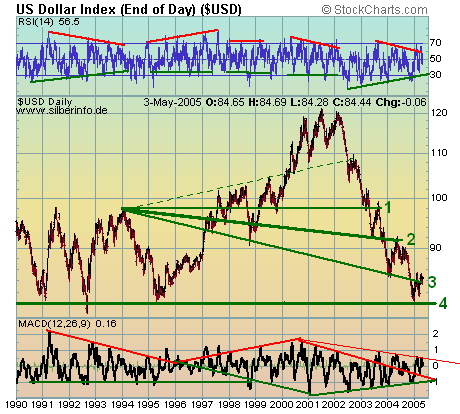
Let's get ready to rumble page 2 As it's quite useless and risky to speculate about all the possibilities how the Dollar might behave now during the current "Breakout" and if a sharp rise above the violet resistance might be either a sustainable "Thrust" to the upside or merely a Breakout with a potentially upcoming Pullback to the upper leg or apex, let's take a look at an even longer picture of the Dollar:
The Dollar is moving in dominance of a massive Head & Shoulder (HS) Formation. As it's not definite if the price action of the first or second half of the 1990s is the left shoulder, it's difficult to say which "the correct" neckline is. The possible necklines are the green ones and have all been breeched as per the rule of a HS-Formation:
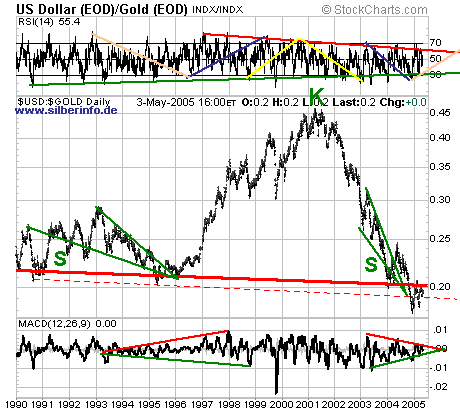
The first two necklines have been breeched just like that. However, the Dollar is still doing its "pullback" to the third neckline at the very moment. A sustainable crash below the 4th neckline is due. However, what might happen now is a volatile price action comparable with the first half of the 1990s as to build a massive right shoulder going up to 100 points. As Gold is not valued as a commodity these days but as a currency, let's not only look at the Dollar-Index (which compares the strength of the Dollar against other paper currencies) but as well let's have a closer look at the value of the Dollar in terms of Gold. As can be seen in the chart below, the trend since the middle of 2001 is clear: Down; which means that you need fewer and fewer of one ounce of Gold to buy a 1 Dollar paper bill. Since 2001 the amount of a Gold ounce required to purchase a 1 Dollar bill has more than halved:
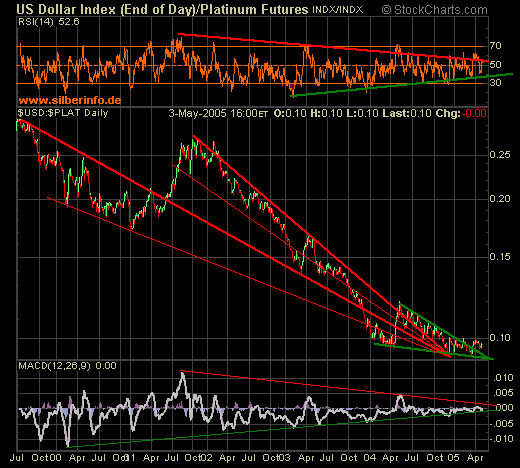
More importantly - in respect of the above analysis of what the Dollar-Index might be up to in the next months - is that the above Dollar-Index relative to Gold price is moving in a Head & Shoulder-Formation since the 1990s as well. The difference is that it's easy to draw the neckline here. The price has already formed a right shoulder and even fell below the (red) neckline at the end of 2004. The "classical pullback to the neckline" is finished as well. The impulse movement of the HS-Formation is due anytime now: A sustainable crash. This not only implies that the ongoing trend (you require fewer and fewer amounts of a Gold ounce to buy a Dollar) since 2001 will continue but accelerate. As there are many possibilities on how this can be achieved (i.e. Dollar is declining & Gold rising, or Dollar rising & Gold rising stronger, etc) it's useless to speculate about all the possibilities as long as the ongoing trend is continuing and the HS-Formation is finalizing correctly. The MACD is being pressurized by the triangular legs more and more and as well suggesting that an "explosion" is approaching. Now let's take a view of the Dollar valued in Platinum, on which chart we can see a similar trend:
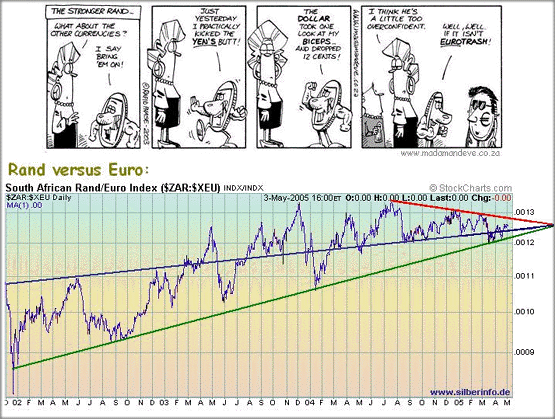
The difference is that the Dollar relative to the price of Platinum has been moving within the boundaries of a triangle. The price recently made a "Breakout" above the green upper leg, so a decision is soon to be made. A Pullback to the apex is likely to happen anytime soon at which point the "Thrust" (either up or down) will occur. The MACD is suggesting that "something big" is about to happen in the coming weeks and months. The RSI recently shot up again, but facing the (red) resistance now. The previous rise by the RSI above the red resistance line was not able to hold on that new support, so it will be interesting if it will now succeed or if the recent shot up is only a "pullback" to say "farewell" to that resistance from below. As shown above, the Rand has outperformed the Dollar by more than 200% since 2002. As the Euro was (virtually) perfectly negatively correlated with Dollar, the question now is: Who was stronger, the Rand or the Euro?
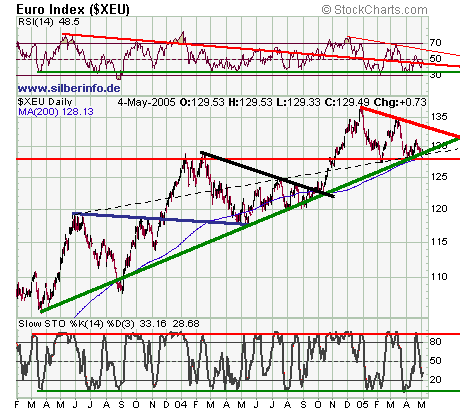
As can be seen above, the Rand was even beating the Euro: The Rand/Euro was appreciating up to 70% since 2002. However, since 2004 the trend has been moving sideways in a triangular fashion. As the price is close to the apex, the decision if this triangle is either a trend continuation or correction pattern will be made shortly. As the Dollar has been breeched its upper resistance in the last weeks, the Euro is still moving upon the strong (green) upward trendline; whereas short breaks of this support lines have occurred in the past, whereupon strong upswings occurred. It is important that the red horizontal line will not be breeched for long and holds as support. The RSI recently jumped above the red resistance line and it would be a positive sign if it can be transformed into support to be able to shoot up even more.
|