|
|||
Paper Money and GoldAcamar Journal In 1705, John Law submitted a proposal to the Scottish Parliament that a new bank be set up that issued interest bearing notes to replace gold and silver coins as currency. He believed that public confidence alone was the basis of public credit and would allow bank notes to replace gold. As he told a friend "I have discovered the secret of the philosopher' stone; it is to make gold out of paper." The Scots rejected the proposal as did the Duke of Savoy, who said about Law's scheme "I am not rich enough to ruin myself." Unfortunately France adopted Law's scheme. In 1718 his Banque Royal effectively became the French Central bank and he became Controller General of Finances. Paper replaced gold by decree and the massive growth in money supply that followed led to the doubling of consumer prices by 1720. There was a massive bubble in the stock of his Mississippi Company and by June 1720 the grand experiment was over with paper money supply now four times larger than the gold and silver coins previously used. Paper money works as long as there is faith in the creditworthiness of the country issuing the currency and debt. The massive growth of money supply and debt in many countries prior to and following the financial crisis led to Dubai's default and the recent downgrades of Greek and Spanish sovereign debt. Morgan Stanley has just issued a report which highlights the danger of a sovereign debt crisis in the UK. Many countries in the developed world are running massive deficits to try to sustain economy recovery, but run the risk of sovereign default, currency devaluation, and serious inflation. These risks have spurred investor demand for gold as a hedge. There is even talk of the potential for hyperinflation (one definition of which is consumer prices increases of more than 50% per annum). Peter Bernholz (Professor of Economics at the University of Basel) studied the world's 12 most important periods of hyperinflation and discovered that the tipping point occurs when deficits amounted to 40% of the expenditures. For the United States last year's deficit of $1.4 trillion amounted to 40% of the $3.6 trillion in expenses. And deficit for first two months of the current fiscal year (Oct/Nov) is running higher than the same period last year... New players of the Park Avenue ilk have entered the market, who would never have looked twice at gold if not for US dollar weakness and the potential for serious inflation ahead. Hedge fund manager John Paulson made $ 20 billion betting against the housing market. He has now invested over $ 4.3 billion in gold mining companies and is raising a new gold fund in January. Other high profile investors in gold now include David Einhorn of Greenlight Capital, Paul Tudor of hedge fund giant Tudor Investment Corp. and Kyle Bass's Hyman Capital. Some of these investors have actually overcome an aversion to gold. As Paul Tudor put it: "I have never been a gold bug. It is just an asset that, like everything else in life, has its time and place. And now is that time." Paulson recently told investors that the rally in gold is just beginning. He will invest $ 250 million of his own capital in his new gold fund, which will mostly buy shares of mining companies. "I can't remember in 20 years so many respected investors focused on a single strategy," said Bradley Alford of Alpha Capital Management, which invests in hedge funds. "Some of these people are icons of the industry with at least 15-year track records." In fact, HSBC in New York has told its retail customers to remove all their gold from its vaults as it is now catering to institutional investors (who are buying gold in size) because it can charge institutions higher rates. And the Central Banks are now net buyers of gold. After China and Russia disclosed that they have been steadily buying gold, India bought 200 tonnes from the IMF and Sri Lanka and Mauritius also bought gold. For good measure, Russia also says it is buying Canadian dollars to diversify away from the US dollar. In fact, China, Russia, the Middle East and the Asia countries hold just 2.2% of their foreign exchange reserves in gold, compared to 38% for the Western countries, according to Stephen Jen of Blue Gold Capital (he was an expert on sovereign wealth funds at Morgan Stanley). To get to even half of Western levels, they would have to buy $ 700 billion worth of gold. And yet more evidence of exploding investment demand for gold comes from the US Mint: it has periodically suspended the sale of 1 ounce Gold Eagles and the 1 ounce Silver Eagle as production cannot keep up with demand. The impact of mainstream money on gold will be profound, because the size of the gold and silver industry is so small. The total value of all the gold ever mined is estimated at just $ 5 trillion. Total 2008 gold production was valued at $ 73 billion. The market capitalisation of all the world's gold producers is just equal to Wal-Mart and is less than Microsoft. The oil and gas industry is 12 times larger. The silver industry is much smaller, with total 2008 production currently valued at about $ 10 billion. Or as Doug Casey put it in September: "There's no doubt in my mind that we'll have a mania in gold. And because the gold and especially silver markets are so tiny, the rush into them will be like trying to push the contents of Hoover Dam through a garden hose. Our positions will go absolutely ballistic." And just a demand is ratcheting up, global gold supply has been falling, despite a four-fold increase in gold prices since 2001: 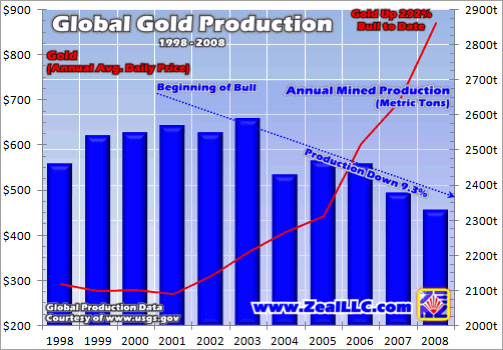 Source; Zeal LLC As is happening currently, the US was running large trade deficits in the late 1960s, which meant its trading partners were being given significant amounts of US dollars. When they tried to get the US to convert the dollars to gold (under Bretton Woods, currencies were convertible into gold upon demand), the US de-linked the US dollar from gold in 1971. Between 1971 and 1980, gold increased over 24 times in price (from $35 to $ 850). So, the potential for a significant increase in the price of gold does have historical precedent. With gold having hit $ 1,200, the calls for gold to rise to $ 2,000 are becoming more acceptable to investors. Whether it goes higher than that will depend on how things are when (not if) it reaches that milestone. ### Acamar Journal Disclaimer Although the statements of facts in this report have been obtained from and are based upon sources Zabina believes to be reliable, we do not guarantee their accuracy, and any such information may be incomplete or condensed. All opinions and estimates included in this report constitute Zabina's judgment as of the date of this report and are subject to change without notice. Zabina makes no warranties, express or implied, as to results to be obtained from use of information in this report, and makes no express or implied warranties of merchantability or fitness for a particular purpose or use. This report is for informational purposes only and is not intended to be advice, or an offer or a solicitation with respect to the purchase or sale of any security. This report does not take into account the investment objectives, financial situation or particular needs of any particular person. Investors are advised that investing in securities entails certain risks, and they should obtain individual financial advice and undertake extensive due diligence based on their own particular circumstances before making any investment decisions. Zabina may from time to time perform corporate communications or other services for companies mentioned in this report. Zabina and/or its principals may be compensated for such services, in the form of fees and/or options. In addition, Zabina or any individuals preparing this report may at any time have a position in any securities or options of issuers mentioned in this report. Directors, shareholders or employees of Zabina may be a director or officer of officer of a company mentioned in this report. Copyright © 2004-2011. All rights reserved. 321gold Ltd |