Volume 8 Issue 1
From Greece to America
Acamar Journal
Aug 1, 2011
The crisis in Greece is not so much about
Greece, which is irrelevant in the greater scheme of things (at
2% of the EU economy). It is about the German, French and British
banks and the consequences if Greece defaults, followed by Ireland,
Italy, Portugal and Spain (the infamous PIIGS).
These countries will default on their
sovereign debt; it's just a question of when. The ratings agencies
were late to the game again but are now relentlessly downgrading
PIIGS debt, making the solution more difficult.
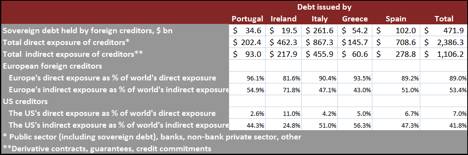
Creditors worldwide had a combined direct
exposure to the PIIGS of almost $2.4 trillion, according to the
Bank for International Settlements, as at Dec 31, 2010.
To put this in context, the total profits
of all the EU banks for the six months ended June 2010 were just
€46.8 billion while total equity was €1.8 trillion,
according to European Central Bank data.
In a surprising turn of events, US banks
also have significant exposure to the PIIGS debt, as they have
sold a substantial amount of Credit Default Swaps (CDS) to European
banks. Yes, those CDS made infamous by the housing bust, which
brought down AIG and other financial institutions during the
financial crisis, after which taxpayers were forced to bail out
Wall Street.
CDS are essentially insurance policies
against debt defaults by the PIIGS and the US banks are betting
that there will not be a default in the near-to-medium term or
at all (in which case, they would pocket the premiums on the
CDSs with no liabilities). This is, I believe, a spectacularly
poor bet and the Europeans have happily laid off some of their
exposure to these US banks.
Thus, while Bank of America only has
$500 million of direct exposure to Greece, it has collected over
$9.1 billion in CDS premiums covering the PIIGS by the end of
2010 (which means it has several multiples of potential liability
against such premiums).
 Source:
BIS report, June
2011
Source:
BIS report, June
2011
and Betting
on the PIGS
US creditors (primarily US banks), which
own only 7% of debt directly, are on the hook for up to 42% of
all indirect exposure, in case of default and contagion.
In addition, the European Central Bank
is itself highly exposed to the PIIGS debt, which it took from
European banks, just as the Federal Reserve took toxic assets
off US banks. Both have become highly leveraged, with assets
in the range of 15-20 times their capital.
You have to feel for the Germans. Having
tried militarily to conquer Europe twice in the last century,
this time they tried to dominate it economically. Their intention
may even have been honourable: economic integration and the free
movement of people and trade to help prevent the endless wars
Europe has seen throughout history.
Their attempts to bring Europe together
into a common market allowed countries like Greece to tap into
capital markets at virtually the same rates of interest as the
Germans, with just a 20 basis point spread on 10 year bonds.
Greece took on far more debt in an era
of easy money than it could afford to pay back, with the government
now so bloated that it accounts for 46% of GDP. The long-term
solution is cutting back on government spending through
austerity measures, despite the riots. But this not only causes
pain through high unemployment and reduced government services,
it worsens the problem in the medium term.
It is the high debt/GDP ratio that forced
the crisis. Austerity measures require government to reduce spending,
which shrinks GDP. This makes the debt/GDP ratio worse, precipitating
more calls for cutting spending. It is a vicious downward cycle,
as shown by Greece's first quarter GDP which fell 5.5%.
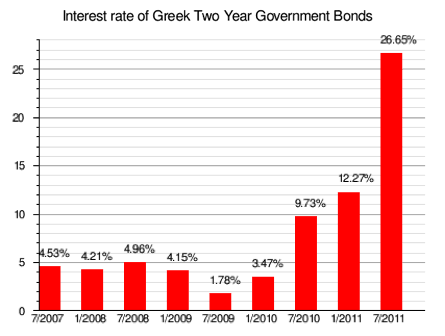
Now the spread between Greek and German
10 year bonds is 1,400% and its unemployment rate is 16.2%! And
their public assets are to be privatised at fire sale prices.
Goldman Sachs helped make this excess
possible, by helping to hide the level of debt that Greece took
on when capital ran amok. But the average Greek, young and old,
will pay a severe price for this chicanery. Unemployment is projected
at between 17% and 23%, by the end of 2011. And, as GDP falls,
many small businesses with less than five employees (which accounts
for 97% of all registered business) are failing. 60,000 of them
(out of 960,000) went out of business in 2010.
The food banks already cannot feed all
the people in their line-ups and hungry people of all age groups
are turned away. Unemployment benefits, at less than €500
per month, run out after one year and there is no safety net
after that. A large segment of the population is being driven
into grinding poverty.
The EU experiment itself is being severely
tested. The Danish Parliament has now passed legislation introducing
permanent customs controls, in violation of the Schengen Agreement.
They first justified this as necessary to prevent eastern European
gangs wreaking havoc in Denmark, then changed the reason to the
need for tariffs. I suspect the real motive may be to intercept
economic refugees fleeing high unemployment rates from the PIIGS
countries.
Ironically the German people anticipated
a north-south divide in the EU. I reported in the Acamar Journal
in
June 2008 that, before the worst of the crisis, 59% of Germans
polled said they did not trust the Euro and were swapping Euros
printed in Greece and other countries for those printed in Germany.
When the consumer and corporate debt
crisis came in 2007-2008, it was massive government intervention
that saved the global financial system. But governments took
on unprecedented levels of debt and the next major crisis will
arise from a sovereign debt default(s).
The problem is not limited to the EU,
as the chart below from The Economist shows.
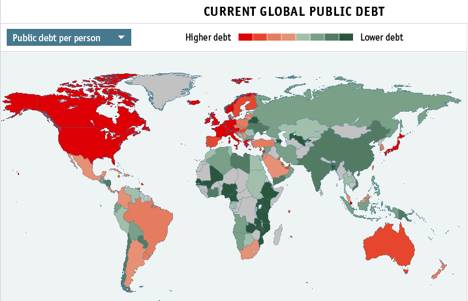
The debt problem lies fundamentally with
the EU, North America and Japan. Conventional wisdom holds that
a debt level over 100% of GDP is a tipping point. While Greek
debt was 130% of GDP at the end of 2010 according to the IMF,
Japan was 225%. Germany came in at 74%, France at 84%, Britain
at 77%, Canada at 81%.
The US debt/GDP ratio stands at 93%.
But the problem the Western developed countries face is a demographic
one. Their populations are aging at a dramatic rate and living
longer.
While US debt is currently $14 trillion,
Professor Kotlikoff at Boston University estimates that the fiscal
gap is 15 times worse, at $202 trillion. In a Bloomberg opinion
piece titled "US
Is Bankrupt And We Don't Even Know It" he says that
the unfunded liabilities are simply unsustainable. It would take,
for instance, a doubling of taxes to close the fiscal gap, or
massive cuts to Medicare and Social Security.
So while the US government faces enormous
political pressure to deal with its deficits (the next showdown
in the US will be the August 2 deadline to raise the debt ceiling),
Americans have generally not saved up for retirement.
In a March AP poll, 24% of US baby boomers,
who began to retire last year, have no savings and say they will
have to work till they die. Of the remaining 76%, only half have
saved more than $100,000.
64% of boomers see Social Security as
a keystone of their retirement earnings. But Social Security
is already paying out more than it receives in contributions
and its trustees expect it to run dry in 2036.
In Homer's epic poem Odyssey, Odysseus
and his crew have to navigate between Scylla and Charybdis,
two dangerous sea creatures that lay on either side of a narrow
strait. The end result is that he barely survives but loses his
men and ship in those dangerous waters. The developed countries
are caught between the dangers of potential sovereign debt default
if deficits are not reduced and populations heavily dependent
on ever-expanding unfunded liabilities, which are rioting in
protest as governments make painful budget cuts.
I took a year-long break from writing
the Acamar Journal, waiting to see if the lessons from the financial
crisis that I had predicted had been learnt. They have not.
Wall Street has passed on its losses
to the taxpayers and is back to taking substantial risks and
paying outrageous bonuses. The US Government is being lobbied
to continue to transfer wealth from the middle class to the rich
and is dramatically eroding civil rights. The European countries
are trying to shield bondholders from the consequences of their
improvident lending in yet another round of "privatised
gains, socialised losses."
The pain imposed on the Greeks will become
untenable and Greece will default at some point. The Greek riots
may be a prelude of things to come in other developed countries.
There is a real danger that there will be another, deeper financial
crisis. The danger with a deep economic crisis, apart from the
direct economic pain, is that it may spawn authoritarian regimes
as people demand solutions at all costs. It will be truly ironic
if the country that was the cradle of democracy helps initiates
such a reversal.

###
Acamar Journal
Disclaimer
The
Acamar Journal is intended to provide factual and timely research
on general economic trends, opinions about trends in specific
industry sectors, information on specific companies, references
to other publications and reports that may be of interest to investors,
and information on general trading strategies. Zabina Ventures
Inc. ("Zabina") is not a registered investment dealer
or adviser.
Although the
statements of facts in this report have been obtained from and
are based upon sources Zabina believes to be reliable, we do not
guarantee their accuracy, and any such information may be incomplete
or condensed. All opinions and estimates included in this report
constitute Zabina's judgment as of the date of this report and
are subject to change without notice. Zabina makes no warranties,
express or implied, as to results to be obtained from use of information
in this report, and makes no express or implied warranties of
merchantability or fitness for a particular purpose or use.
This report
is for informational purposes only and is not intended to be advice,
or an offer or a solicitation with respect to the purchase or
sale of any security. This report does not take into account the
investment objectives, financial situation or particular needs
of any particular person. Investors are advised that investing
in securities entails certain risks, and they should obtain individual
financial advice and undertake extensive due diligence based on
their own particular circumstances before making any investment
decisions.
Zabina may from
time to time perform corporate communications or other services
for companies mentioned in this report. Zabina and/or its principals
may be compensated for such services, in the form of fees and/or
options. In addition, Zabina or any individuals preparing this
report may at any time have a position in any securities or options
of issuers mentioned in this report. Directors, shareholders or
employees of Zabina may be a director or officer of officer of
a company mentioned in this report.
Copyright ©
2004-2011. All rights reserved.
Visit:
www.acamaronline.com
for a unique perspective on global economic events!
321gold Ltd

|